Finn Brooks: Hey, hey — real quick before anything else, are you okay? Because you sent me something last night that I still haven't fully processed.
Hope Sterling: I'm NOT okay, thank you for asking, because Jane Schoenbrun released Teenage Sex and Death at Camp Miasma yesterday — August 7th — and the Slate review dropped at the same time calling it a 'bloody manifesto about problematic faves' and I've been a little unwell since.
Finn Brooks: Okay wait, 'bloody manifesto' — that's the actual phrase they used?
Hope Sterling: Verbatim. And like, it earns it? Because the setup is — okay, Hannah Einbinder's character Kris is a queer filmmaker who gets hired to reboot this dormant zombie IP called Camp Miasma, and her specific mandate is to strip out the transphobic and sexist elements so it can make money again.
Finn Brooks: The zombie IP thing is — no but that is literally the studio pitch meeting. Someone actually greenlit that as a narrative.
Hope Sterling: Schoenbrun built Camp Miasma as this full fictional 1980s slasher that already went through the whole lifecycle — original hit, sequels, box office drop, merchandise, cult following, problematic classic re-evaluation — like, the whole thing. It's not a real franchise but it has a real franchise's entire biography.
Finn Brooks: That is actually wild. She invented the IP just to autopsy it.
Hope Sterling: And Gillian Anderson plays a reclusive actress from the original, which — I mean, the casting alone? Come on.
Finn Brooks: Okay, I need to know everything about Gillian Anderson in this film because that detail is not small.
Hope Sterling: Okay but — Gillian Anderson is actually, like, the sidebar. Because I can't stop thinking about what Kris is actually being asked to DO, right? Like her literal job description is remove the transphobic and sexist elements. That's it. That's the gig.
Finn Brooks: And here's where I want to just — cut to the actual new idea, because the coverage keeps saying 'deconstruction of reboot culture' and that's fine but it undersells the specific, weirder thing. The new thing is: you can't remove those elements. Not because it's hard. Because they ARE the franchise.
Hope Sterling: Like — load-bearing walls.
Finn Brooks: Exactly that! You pull out the transphobia, the sexism, the exploitation — Camp Miasma doesn't get cleaner, it just... collapses. Because THAT is what the fans were fixated on. That's what made it a cult object. So Kris isn't renovating the house, she's being asked to remove the walls holding it up.
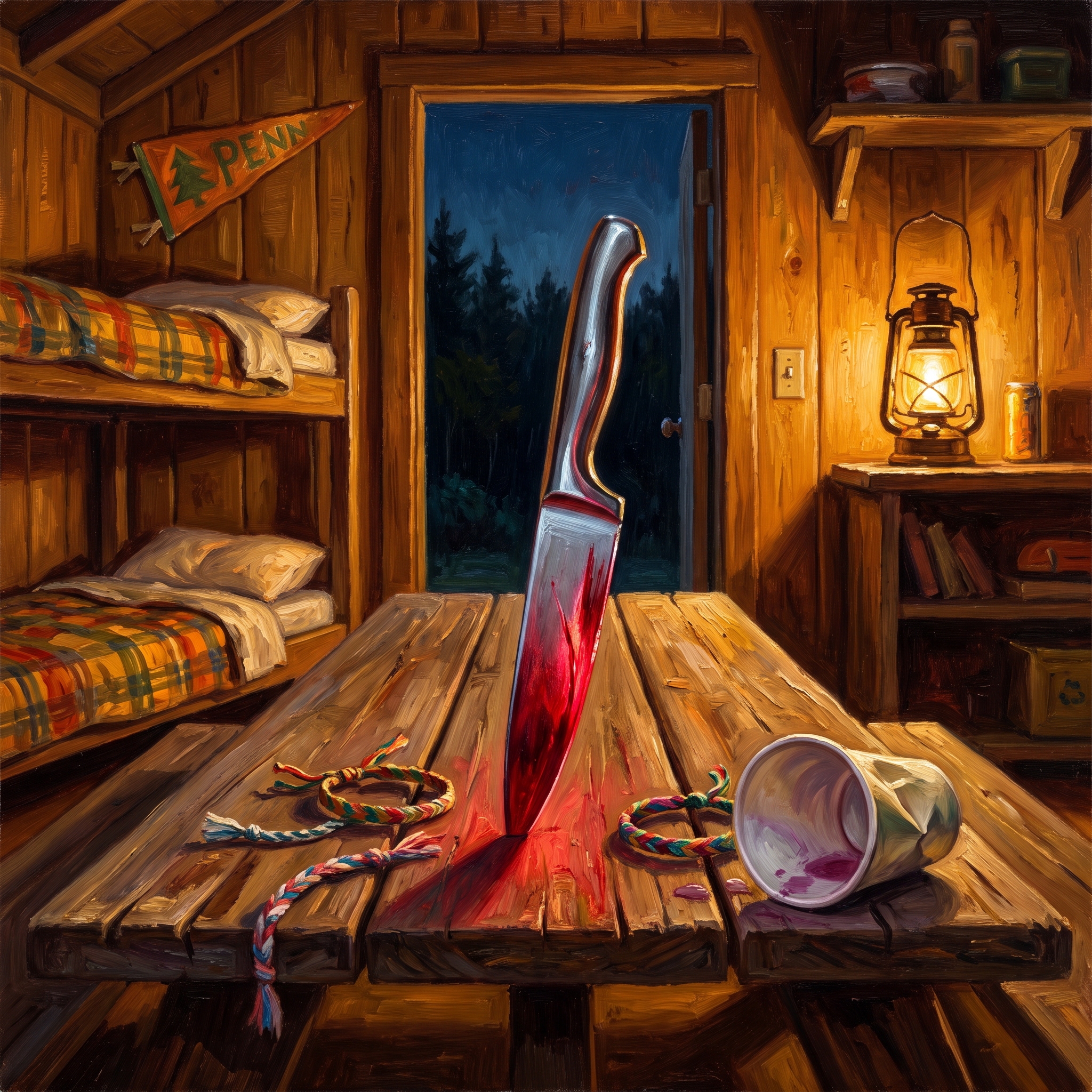
Hope Sterling: And the film doesn't let her off the hook either, because — okay, this is the detail that broke my brain — Kris is personally, erotically fixated on the franchise's most exploitative kill. Two lovers impaled by a fishing spear during sex. Which is drawn from Friday the 13th Part 2. That kill is her whole thing.
Finn Brooks: Wait — she's hired to clean it up and she's obsessed with the worst part of it?
Hope Sterling: That IS the point! Like, that's Schoenbrun's whole move — the harm and the love are the same feeling. You can't sanitize it without losing the thing you actually loved. Kris knows this because she's living it.
Finn Brooks: So the horror logic — the film framing this sanitization as violent and unresolvable — that's not a metaphor, it's actually the mechanics. The zombie IP gets resurrected, Kris is handed a scalpel, and the movie is like: no. There is no version of this that doesn't bleed.
Hope Sterling: And THAT is the thing that's actually new. Not 'reboot culture bad.' It's that the badness is the appeal. For everyone. Including the queer filmmaker they hired to fix it.
Finn Brooks: But wait — okay, that clean version of the argument? The one where everyone goes 'Schoenbrun is queer, it premiered at Cannes, Slate said brilliant, so obviously it's fine'? That's the take I keep seeing and I don't think it holds.
Hope Sterling: Oh I've been clocking that take EVERYWHERE. Like, the prestige framing does a lot of heavy lifting that maybe it shouldn't.
Finn Brooks: Because — hang on — the film is literally built on Sleepaway Camp. The 1983 one. Not as a reference, like, not a wink. That Angela reveal — killer turns out to have been assigned male at birth — that is the foundation. That's the text Schoenbrun is constructing Camp Miasma on top of.
Hope Sterling: And Sleepaway Camp's ending is still — people STILL argue whether that's representation or exploitation. Like, genuinely unresolved.
Finn Brooks: Right, so — actually no, here's what bothers me — queer authorship doesn't retroactively settle that argument for Sleepaway Camp. It just means Schoenbrun gets to pick up those bones. She's critiquing transphobia in this fictional franchise while the whole film is structurally resting on a real transphobic text. Does 'I know this is a problem' function as a shield? Or does it just... make you the person who knows and does it anyway?
Hope Sterling: Mmm. And the Cannes premiere — May 13th — that prestige stamp makes it even easier to skip past that question.
Finn Brooks: Cannes to August slasher season is — that's kind of the film's own dual identity problem, right? Like it wants both the essay credibility AND the kill-sequence.
Hope Sterling: Which, okay, I think is actually what makes it interesting? But also — and this is the part we haven't even gotten to yet — what Schoenbrun is actually asking underneath all of this, whether loving something harmful is reclamation or relapse, she refuses to answer that. And I think that's where it gets really uncomfortable.
Finn Brooks: No, I don't buy that the refusal is a cop-out. I think that IS the answer. But — we should get into that.
Hope Sterling: And like — the refusal IS the discomfort, right? Because Schoenbrun is not gonna hand you a verdict. She's specifically leaving you in the VHS feeling.
Finn Brooks: The VHS feeling — okay, that's the thing I keep coming back to. Like, imagine you're a queer teenager in 1987, someone's older sibling brings Sleepaway Camp to a sleepover, and you watch Angela's reveal and something happens to you that you genuinely cannot name. Not 'this is good representation' or 'this is transphobic' — just, something. That's — that's the specific feeling Schoenbrun is making a whole film about.
Hope Sterling: And Kris's erotic fixation on the spear kill is THAT. That's not politics. That's the actual texture of loving a thing that's hurting you.
Finn Brooks: Which means — wait, actually this reframes the whole film — Kris isn't just a surrogate for Schoenbrun professionally, she's a surrogate for everyone who had that sleepover moment. The 'deep genre archaeology' thing, building new horror from the same bones, that's not a technique. That's the only honest move available.
Hope Sterling: Mmm. And the bones are still the bones.
Finn Brooks: Right — but here's the part that doesn't fully resolve for me. If the film refuses to say whether that love is reclamation or re-enactment of the original harm... does watching it change anything? Like, do you leave the theater with a different relationship to Camp Miasma — or Sleepaway Camp — or does the film just give you very sophisticated permission to stay exactly where you were?
Hope Sterling: Okay but — I think that IS the question every queer creator with a problematic fave is actually living right now. Not in theory.
Finn Brooks: No, totally — and that's why I can't call the refusal a cop-out. The refusal IS the argument. Schoenbrun saying 'I won't resolve this' is the most honest thing she could do, because there IS no clean answer. You loved it to death. The death was real. So was the love.
Hope Sterling: Yeah — and that's the thing that's gonna hit people hardest walking out of this movie. Not the kills. The fact that she refused to let you off the hook.
Finn Brooks: The one detail I cannot shake — Kris is erotically fixated on the fishing spear kill from Friday the 13th Part 2, and she is the person they hired to remove it. That's the whole movie in one sentence.
Hope Sterling: Mine is Gillian Anderson, reclusive, from the original Camp Miasma, showing up to — like, what does she KNOW? What did she survive? I need a whole other film. But okay, I mean — the real thing I'm leaving with is this: Schoenbrun made a queer-authored, Cannes-premiered, Slate-certified brilliant manifesto that still reproduces every transphobic bone it picked up from Sleepaway Camp, and she called that the point, and I genuinely don't know if the next creator gets to use that as a permission slip or a warning. Both? Neither? I keep flipping.
Finn Brooks: Both and neither — that's the VHS feeling. You don't get to know.
Hope Sterling: Honestly? To Schoenbrun for making the film nobody was brave enough to call a manifesto until she did — and to Kris, who did not survive the reboot. Cheers.