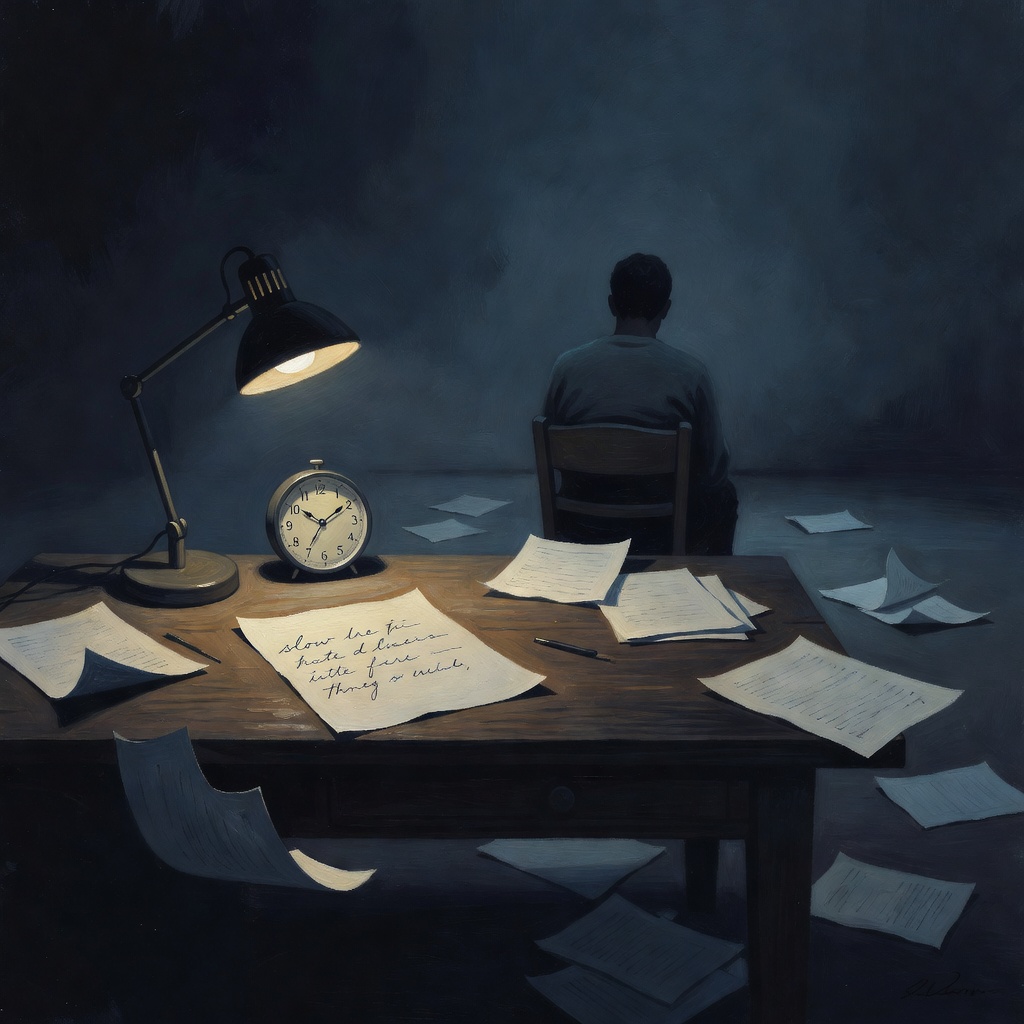
Spuds Oxley: Spuds Oxley: It's late and I've been chewing on something. A picture, really. Not a photograph — just a scene that won't leave my head.
Spuds Oxley: Summer of 1966. Near Princeton. There's a man lying flat on his back on a picnic table under an ash tree, and he has been there for nearly two weeks.
Spuds Oxley: Not sick. Not sleeping. Not waiting for anything, exactly.
Spuds Oxley: His name is John McPhee, and he's — at this point — a staff writer for The New Yorker, eight months into a piece he cannot figure out how to write. The research is done. The material is there. But the structure, the angle, the way in — none of it has arrived. And so he lies there, on his back, under the ash tree, staring up.
Spuds Oxley: From the outside, this looks like nothing.
Spuds Oxley: And here's what I want you to actually sit with — even at The New Yorker, even inside an institution that had carved out space for exactly this kind of slow, unhurried, deep long-form work, this was considered radical. People noticed. The lying there was a provocation, even if McPhee didn't intend it as one.
Spuds Oxley: He wasn't being lazy. He was working at the only pace the work would allow.
Spuds Oxley: I came to this story looking for something else, honestly. I was thinking about busyness — about why we treat the appearance of effort as though it were effort itself. And then I found McPhee under his ash tree and I thought … oh. There it is.
Spuds Oxley: The whole argument, right there. A man lying still in 1966.
Spuds Oxley: That's where this starts.
Spuds Oxley: There's a book. Published March 5th, 2024. Cal Newport — computer science professor at Georgetown University — calls it Slow Productivity: The Lost Art of Accomplishment Without Burnout. New York Times bestseller. Washington Post, USA Today, IndieBound. The whole row.
Spuds Oxley: And I want to be careful here, because the moment you say 'bestselling book about slowing down' a certain kind of skepticism kicks in. Self-help. Airport bookshelf. You know the feeling. But Newport isn't selling a morning routine. He's making a diagnosis.
Spuds Oxley: The diagnosis has a name. Pseudo-productivity.
Spuds Oxley: Which is — and this is worth actually sitting with — the tendency to use visible busyness and constant activity as a stand-in for actual valuable output. Not work itself. The appearance of work. The performance of effort as a substitute for the thing effort is supposed to produce.
Spuds Oxley: We built entire careers on looking occupied.
Spuds Oxley: And it didn't happen because people are dishonest. It happened because, somewhere along the way, exhaustion became legible as a signal. You wear the overload. You mention the back-to-back calls, the inbox, the weekend you worked. And people around you read that as: serious person. High-stakes work. Worth taking seriously.
Spuds Oxley: Busyness became a status symbol. Burnout became proof.
Spuds Oxley: Think about what that does to the actual work — the slow, invisible, lying-on-your-back-under-a-tree kind. It makes it unspeakable. You can't describe it without sounding like you're not pulling your weight. The legitimacy of the effort depends entirely on whether someone can see it happening.
Spuds Oxley: Newport's counter to all of this — Slow Productivity — rests on three principles. Do fewer things. Work at a natural pace. Obsess over quality. Not speed. Not volume. Not the appearance of momentum. The thing itself, done well, over a timeline that the work actually requires.
Spuds Oxley: That's the claim. And I believe it — not because the book convinced me, but because McPhee under that ash tree already had. Newport just named what I'd been watching.
Spuds Oxley: The three principles aren't just a framework, though. They're a description of a cognitive reality. And the mechanism underneath them has a name.
Spuds Oxley: Attention residue. The finding — and this is the research, not the metaphor — is that when you switch between tasks, the prior task doesn't leave cleanly. It leaves traces. Mental residue that sits on the next thing you're trying to do and degrades how well you do it. You're never quite fully where you think you are.
Spuds Oxley: Which is why doing fewer things isn't about comfort. It's about not poisoning your own attention.
Spuds Oxley: The first principle — do fewer things — isn't a license to be idle. It's the recognition that every active commitment you carry is leaking into everything else. The administrative drag alone, the follow-up, the status update, the reply you owe someone — all of it is sitting on the work that actually matters. You limit the commitments, you reduce the residue. That's the logic.
Spuds Oxley: And then there's the question of flow states — that state of complete absorption where you're not managing yourself anymore, you're just doing the thing. Fragmented schedules make those impossible. Not difficult. IMPOSSIBLE. The structure of the day prevents them from ever arriving.
Spuds Oxley: Newport calls this Deep Work — the earlier concept, the one that preceded Slow Productivity. Cognitively demanding, distraction-free, at maximum concentration. Slow productivity is, in a sense, the conditions you build so that deep work can actually happen. It's not a replacement. It's the architecture.
Spuds Oxley: Now think about Barbara McClintock.
Spuds Oxley: Nobel Prize-winning geneticist. What she did — and this is worth actually picturing — was spend years in patient, intimate study of individual corn plants. Not populations. Not statistical summaries. Individual plants. She knew them. She could look at one and tell you something was different before she could tell you what. That quality of attention, sustained over that kind of timeline, is what produced her Nobel Prize-winning discoveries about genetic transposition.
Spuds Oxley: That's obsessing over quality. Not as a personality trait — as a method.
Spuds Oxley: And the natural pace principle lives right there too. McClintock wasn't slow because she lacked ambition. She was slow because the work required it. You can't rush a corn plant into telling you something it isn't ready to tell you.
Spuds Oxley: Then there's Alex Soojung-Kim Pang — researcher, author of Rest: Why You Get More Done When You Work Less. He took a three-month sabbatical at Microsoft Research Cambridge. And what he reported afterward was striking enough that it changed how he thought about everything. He said he accomplished an enormous amount. And he described the experience as living an 'amazingly leisurely life.'
Spuds Oxley: Those two things are not supposed to coexist. That's the whole point.
Spuds Oxley: Pang's case — and it became the core of Rest — is that leisure and reduced hours don't diminish meaningful output. They can increase it. The rest isn't time stolen from the work. It IS the work, in a form we've trained ourselves not to recognize.
Spuds Oxley: When you line these up — McClintock, Pang, McPhee under his ash tree — what you're looking at isn't a collection of eccentric exceptions. It's a pattern. Slow conditions producing deeper work, consistently, across very different fields.
Spuds Oxley: The evidence isn't thin. It just doesn't look like effort from the outside.
Spuds Oxley: Spuds Oxley: And that's the problem Newport is circling — and honestly, the problem I wrestle with too. Because the case for slow productivity is solid. The mechanism is real, the examples hold. But then you have to actually work inside an institution, inside a system that is still measuring the wrong thing … and inside that system, it becomes much harder to hold onto that idea.
Spuds Oxley: Here's where I have to turn on myself a little. Because the thing that nags at me about my own argument is not small.
Spuds Oxley: McPhee under his ash tree. McClintock and her corn plants. Pang taking three months at Microsoft Research Cambridge and coming back having accomplished an enormous amount while living what he called an amazingly leisurely life. These are the people Newport reaches for. And they're extraordinary examples — genuinely. But look at who they are.
Spuds Oxley: McPhee was a staff writer at The New Yorker. McClintock had a Nobel Prize. Pang was on sabbatical — a formal, institutionally granted sabbatical. These are not people who had to justify lying on a picnic table to a line manager.
Spuds Oxley: They had autonomy. REAL autonomy. The kind most knowledge workers simply don't have.
Spuds Oxley: And Newport's framework — the three principles, do fewer things, work at a natural pace, obsess over quality — it's addressed to individual knowledge workers. That's explicit. The book is a personal philosophy. A reorientation you make yourself. But most people aren't making their own conditions. They're working inside institutions that are still measuring the wrong thing, still rewarding visible busyness, still reading the full inbox and the back-to-back calendar as the signal of a serious person.
Spuds Oxley: Pseudo-productivity isn't just a bad habit. It's a structural incentive.
Spuds Oxley: There are pharmacy faculty who've tried to apply slow principles inside their institutions — scholars in education who've attempted it too. And what they found, consistently, is friction. Not philosophical friction. Structural friction. The institution still wants the grant application, the committee report, the visible deliverable on the visible timeline. Slow productivity as a personal commitment runs directly into a system that was not built for it and has no interest in being rebuilt.
Spuds Oxley: So the question I keep sitting with is — is slow productivity a philosophy for the already-secure? Is it, at its core, a luxury?
Spuds Oxley: I don't think Newport would accept that framing. And I'm not sure I do either. But I also can't fully dismiss it.
Spuds Oxley: And then there's the harder one. The one I find myself returning to at the end of all this. Pang's argument — rest as a productivity enhancer — is compelling. The sabbatical data is real. The recovery literature is real. But notice what that framing does. It justifies rest by making it useful. It earns leisure by proving it pays off. Which means the ultimate measure of your time is still … its productive yield.
Spuds Oxley: Slow productivity might be — and I say this carefully — just another productivity ideology. In slower clothing. It hasn't escaped the logic. It's optimized within it.
Spuds Oxley: I don't know how to fully resolve that. The case Newport makes is solid. The mechanism is real, the examples hold where they hold. But the structural gap doesn't close, and the deepest tension — whether we can actually value rest without instrumentalizing it — stays live. I think it has to.
Spuds Oxley: The version of this I keep returning to isn't about whether the philosophy is right. I think it is. The version that stays with me is structural. Because if slow productivity ever moves from being something an individual commits to quietly, in defiance of their institution, and becomes something an institution actually adopts as policy — the question is which institutions. Which ones are willing. And whether the places willing to do it are the ones where most people already work, or only the ones where people are already positioned to live it.
Spuds Oxley: That's the gap I can't close. Not neatly. Cal Newport's framework lands beautifully inside certain kinds of organizations — the ones with long-horizon research cultures, strong tenure protections, real autonomy baked into the structure. Places, honestly, that already look a little like The New Yorker did in 1966. And those places can afford to say: we value deep work, we protect long timelines, we resist the visible busyness signal. They have the standing to say that. But most knowledge workers aren't there. They're somewhere with quarterly targets and a manager reading their calendar.
Spuds Oxley: And the institutions most likely to adopt slow productivity as genuine organizational policy … truth is, they may already be the ones least infected by pseudo-productivity. Which means the reform arrives where it was always already easier to breathe. And the people who most need the structure built around them — built FOR them — are still inside systems that have no language for what John McPhee was doing under that ash tree. They just see someone who isn't at their desk.