Brian Reed: Hey. Good to be here.
Eliza Ward: Yeah, good — though this one's a heavy one today.
Brian Reed: It is. An 80-year-old woman in Tampa died from dengue she caught near her own home. Her name was Gay Rabb Small. She died September 4th.
Eliza Ward: And she didn't travel anywhere. That's — wait, that's the part that matters. This wasn't imported. The Florida Department of Health confirmed it September 18th. Florida's first confirmed dengue death of 2026.
Brian Reed: Right — and locally acquired is doing a lot of work in that sentence. It means a Florida mosquito bit her. Not a mosquito in, I don't know, Puerto Rico or Brazil. Here.
Eliza Ward: Which means the virus was already circulating in Tampa mosquitoes. It didn't arrive with a traveler — it was produced in-state. That's the line being crossed.
Brian Reed: Yeah. The difference between dengue showing up at customs and dengue living in your neighborhood.
Eliza Ward: And once it's living in your neighborhood, the numbers get real fast. By October 31st, Florida had 524 locally acquired cases. The previous record was 189 — set in 2023. We more than doubled it.
Brian Reed: Wait — 524. That's not a cluster anymore.
Eliza Ward: No. And it's concentrated — Hillsborough County alone logged over 400 of those. I mean, that's not just the epicenter, that's almost the whole story. By September 12th officials already had 134 local cases sitting in Hillsborough out of 152 statewide. So this thing was Hillsborough almost from the start.
Brian Reed: Gabriela Henderson — she's with Hillsborough County Mosquito Management — she cited urban infrastructure as the driver. What does that actually mean on a street level? Dense housing, containers holding water, Aedes aegypti breeding in a bottle cap.
Eliza Ward: Right, and Josh Bellotti — Director of Engineering and Operations for Hillsborough County — he said the goal isn't to reduce case counts. It's to stop local transmission entirely. Which, actually — wait — if you're setting that as your benchmark, you're already telling us partial suppression failed.
Brian Reed: They're calling this the largest dengue outbreak in the continental U.S. in nearly a century, and the response goal is total transmission stoppage — and there's a piece of this we haven't gotten to yet about whether the spray they're using can actually do that.
Eliza Ward: Right, and that's — that's the part that isn't landing in the coverage. November 5th, helicopters over Hillsborough and Pinellas. Looks decisive. Looks like action. But the June 2026 Collier Mosquito Control District research confirmed that local Aedes aegypti populations have already developed resistance to common adulticide classes. So we're spraying mosquitoes we know don't reliably die from the spray.
Brian Reed: Hold on — are you saying it's useless?
Eliza Ward: Not useless — I want to be careful here. But there's daylight. The February 2026 academic study documented knockdown resistance specifically, kdr mutations, statewide. That means the mosquitoes have a genetic mechanism that literally reduces how well the adulticide penetrates. So partial kill, maybe. Full suppression of an active outbreak? That's — wait, that's a different claim.
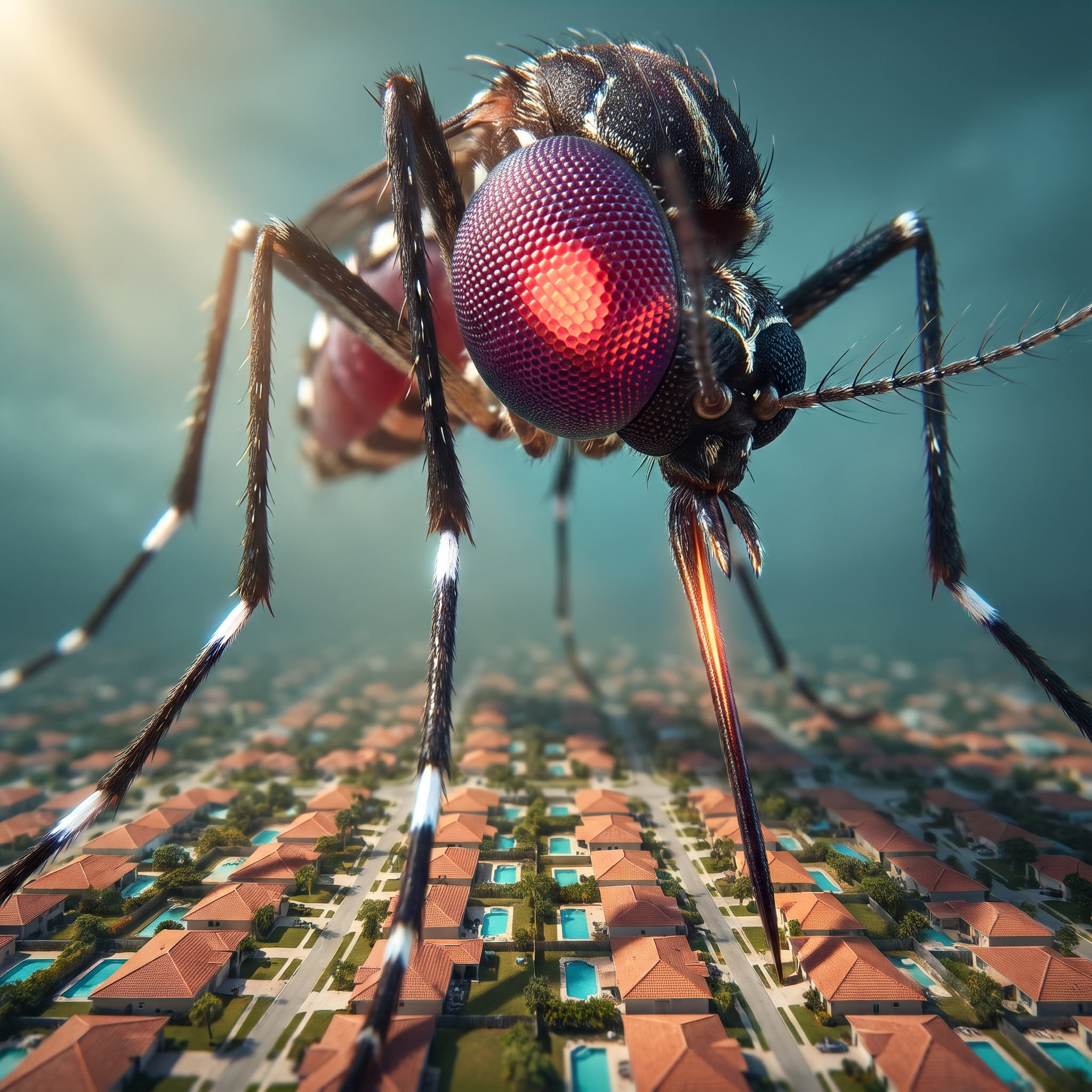
Brian Reed: And Aedes aegypti makes this worse because of how it actually lives. It's not sitting in a swamp waiting for a helicopter. It's daytime-biting, container-breeding — a saucer under a potted plant, a bottle cap, a clogged gutter. The spray passes over and the breeding site is two feet off the ground on someone's back porch.
Eliza Ward: That's the scenario that sticks with me. Hillsborough resident sees the helicopter November 5th, closes the window, feels like — okay, handled. And the Aedes aegypti breeding in the plant saucer outside may survive the pass entirely. The visible response and the actual outcome have decoupled.
Brian Reed: So the take that's wrong is — 'aerial spraying equals containment.' That's the thing circulating that doesn't hold.
Eliza Ward: Yeah. And Josh Bellotti said the goal is stopping local transmission entirely — not reducing counts. If the mosquitoes have kdr mutations and they're breeding in containers the spray can't reach, I mean — actually, that goal and this tool may not connect the way the optics suggest.
Brian Reed: And mid-November — I mean, the rate is slowing. Officials are saying that. Cold front coming, mosquito activity dropping. That part is real. But I genuinely don't know if transmission is breaking or if we're just... it's November in Florida and mosquitoes die in cold.
Eliza Ward: That's the unresolved part. And it's the one that carries into 2027. Because the Aedes aegypti population that drove 524 cases doesn't go away when the temperature drops. It waits.
Brian Reed: Right — and the question officials are actually asking, explicitly, is whether dengue becomes endemic. Self-sustaining, year-round. That threshold hasn't been crossed yet. But I don't know what would tell us it has until it already has.
Eliza Ward: Yeah. That's where I land. Cautious, not resolved.