Finn Brooks: You sent me a voice memo at 11pm that was just you going 'Garfield' and then hanging up.
Hope Sterling: Because what else do you even SAY. Okay so — no wait, let me just — the AP. The Associated Press. April 20th, 2021. Published a report documenting that some online participants sincerely believe Wyoming does not exist. As in, not joking. Sincere.
Finn Brooks: Sincerely. Okay, and this connects to the cat how.
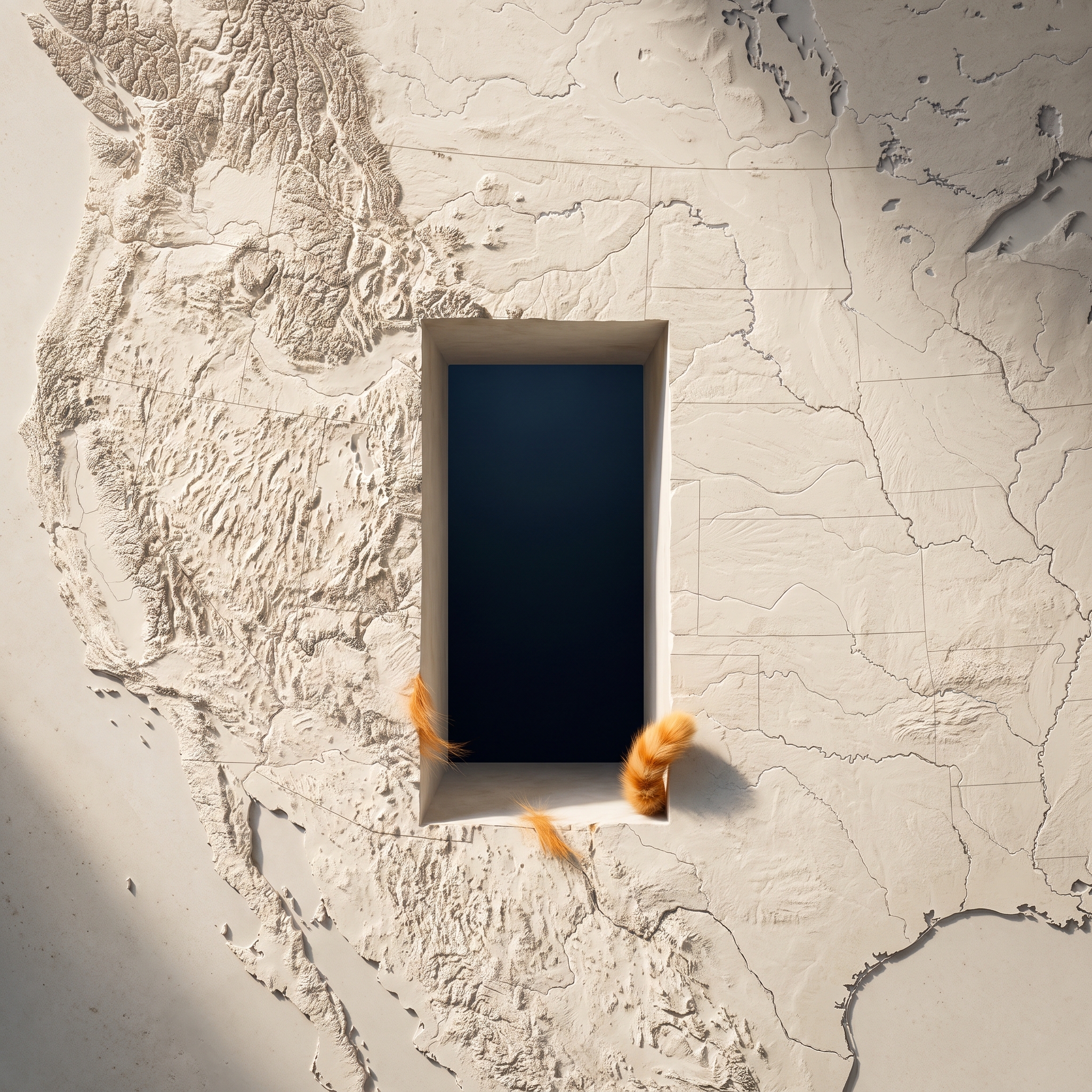
Hope Sterling: November 1989. Garfield and Friends, CBS, Season 2, episode called 'It Must Be True' — Garfield announces, on air, that Wyoming is a mapmaking fabrication invented to fill a blank rectangular space. And he attributes it to a made-up Italian explorer named Arbuckle Vespucci, like a cousin of Amerigo apparently, and the bit is that it must be true because he read it somewhere. That's the whole joke. That's it. And now we have r/WyomingDoesntExist.
Finn Brooks: The subreddit is real — I've been down that rabbit hole and it is deeply committed.
Hope Sterling: It has elaborate internal logic! Like, Wyoming denial is a whole thing with its own — I mean, the AP called it 'Wyoming denial.' That's a phrase that exists because of a Garfield bit from 1989.
Finn Brooks: And here's the part that's genuinely wild to me — the episode aired and then just... nothing. Like two full decades of silence before the internet picked it back up.
Hope Sterling: Twenty years dormant! How does that happen?
Finn Brooks: Okay but — wait, that dormant thing actually breaks the 'Garfield started it' story a little, right? Because the AP wouldn't even commit to that. They said the movement 'either began or gained national exposure' from the episode. That's a hedge. That's a meaningful hedge.
Hope Sterling: Wait, 'either began or gained' — those are two really different things though.
Finn Brooks: Completely different! And here's the plain version of what I think is actually going on — the cartoon might have been the spark, but Wyoming was already dry tinder. Like, it didn't need Garfield. It needed something, but not necessarily that specific lazy cat. Because look at the structure of the joke — 'have you ever met anyone from there, have you ever been, if not it doesn't exist' — that exact template got applied to Bielefeld, Germany. Independently. No Garfield involved.
Hope Sterling: Bielefeld — like, a whole German city went through the same thing?
Finn Brooks: Same rhetorical structure, totally separate origin. Which means the template travels on its own. So Wyoming's actual numbers — 580,000 people, rectangular shape, basically zero cultural footprint — that's the tinder. Jim Davis and Film Roman accidentally threw a match at it in 1989, but if they hadn't, something else probably would have.
Hope Sterling: Okay, I mean — I don't fully want to give up the Garfield origin story, like it's so good — but the AP hedging is real and I can't pretend it's not. The thing that still gets me though is that even if Wyoming was always vulnerable, someone had to say it on CBS on a Saturday morning to a million kids first.
Finn Brooks: No, that's fair — and Garfield and Friends ran 121 episodes over seven seasons, so that's a massive Saturday-morning footprint. It's not nothing. It's just — the spark theory gets oversimplified into 'Garfield made this happen' when really the state was always a little invisible.
Hope Sterling: Right — but also Urban Dictionary eventually defined Wyoming experiences as 'false memories implanted by government scientists,' which, like, that detail came from somewhere and it wasn't Jim Davis.
Finn Brooks: Right — and that Urban Dictionary entry is actually the thing that proves the dormancy gap is the real story, not the 1989 episode. Like, 'government-implanted false memories' — Jim Davis did not write that. A cartoon cat made a pun about maps. Everything after that is the internet building its own mythology from scratch.
Hope Sterling: Government scientists. SCIENTISTS.
Finn Brooks: Completely detached from the source! And here's what I keep picturing — like, imagine someone, maybe a grad student, 2003, it's 1am, they're on some message board, and they type 'wait, has anyone actually BEEN to Wyoming?' as a throwaway. And they have no idea there's a twenty-year-old cartoon joke sitting underneath that question just waiting.
Hope Sterling: They're lighting a fuse they can't even see.
Finn Brooks: Exactly that. And then the 2010s hit, r/WyomingDoesntExist exists, COVID happens and everyone's locked inside with nothing but time and Google Maps, and suddenly the AP is publishing an actual report in April 2021 like — we need to address this. That gap, 1989 to the 2010s, that's not a lag. That's the internet being invented in between.
Hope Sterling: Okay but wait — that actually gives Garfield a partial win though, right? Like, the dormancy doesn't mean the spark didn't matter, it just means it needed the right — I don't know, oxygen? The kindling was always Wyoming's 580,000 people and the rectangle and the nothing-ness of it, but someone still had to say it on CBS first.
Finn Brooks: Yeah okay — partial win, I'll take it. The cartoon is the fuse. The internet is the match. Both things.
Hope Sterling: And honestly the part that I can't stop thinking about — and we're gonna get into this more — is WHY Wyoming and not the raisins. Like, Garfield called raisins shrunken bowling balls in that same segment. Where's r/RaisinsAreNotReal? What did Wyoming have that a raisin didn't?
Finn Brooks: Oh, I have thoughts on that and they involve — actually, no, hold on, it's messier than I thought because the joke structure was identical. It's the THING it was aimed at that changed everything.
Hope Sterling: Okay but THAT is the verdict, right? Like — raisins being shrunken bowling balls, fire hydrants being compressed water sitting there, Wyoming doesn't exist — structurally the same joke, same segment, same cat. And only one of them has an AP report in 2021. Why?
Finn Brooks: Because raisins have no plausibility scaffolding. You have held a raisin. You know it is not a bowling ball.
Hope Sterling: Wyoming though — I mean, have you BEEN? Most people haven't. It's rectangular, it's 580,000 people, it doesn't ping culturally the way Texas does, it's just — it's a placeholder in people's heads. The joke had something to grab onto.
Finn Brooks: And that's the actual mechanism for how irony tips into belief — wait, actually this is the thing — you need the real world to look like it's backing the joke up. Wyoming's numbers accidentally corroborate the bit. Raisins don't.
Hope Sterling: Which is what the AP caught in 2021, right? Some of those people were not in on the joke anymore.
Finn Brooks: Sincerely. And nobody can tell who, because online you cannot distinguish committed-to-the-bit from actual belief — they post the same meme.
Hope Sterling: That's what genuinely keeps me up. Like, the content detaches from the Garfield source, nobody spreading it in 2020 is thinking about Arbuckle Vespucci, and then it just — it acquires its own evidence? 'Evidence'?
Finn Brooks: Government scientists implanting false memories, yeah.
Hope Sterling: So the calibrated thing is — Wyoming won because it was structurally vulnerable in a way raisins and fire hydrants never could be. The joke was the ignition, but the state's own geography and anonymity were the fuel. And once the source context drops out, some percentage of people slide from irony into actual belief and you cannot get them back.
Finn Brooks: Okay, fine — maybe Garfield didn't start it, maybe he just accelerated something inevitable, I'll half-concede that. But Arbuckle Vespucci? A fictional Italian explorer who doesn't exist, credited with creating a blank space on a map? That guy absolutely did not help.
Hope Sterling: Arbuckle Vespucci is my favorite detail in this entire story and I will die on that hill.
Finn Brooks: And the thing is — Garfield and Friends premiered September 17th, 1988, on CBS, Saturday morning, children's cartoon — and it has a thirty-five year half-life. Like, that is not a normal outcome for a joke a cat made about a map.
Hope Sterling: Thirty-five years. And somewhere right now, some writer's room is doing the exact same thing — throwing away a line, moving on — and it's already in the pipeline. It's probably also about a raisin.
Finn Brooks: It's DEFINITELY about a raisin.
Hope Sterling: r/RaisinsAreNotReal, 2055 — you heard it here.