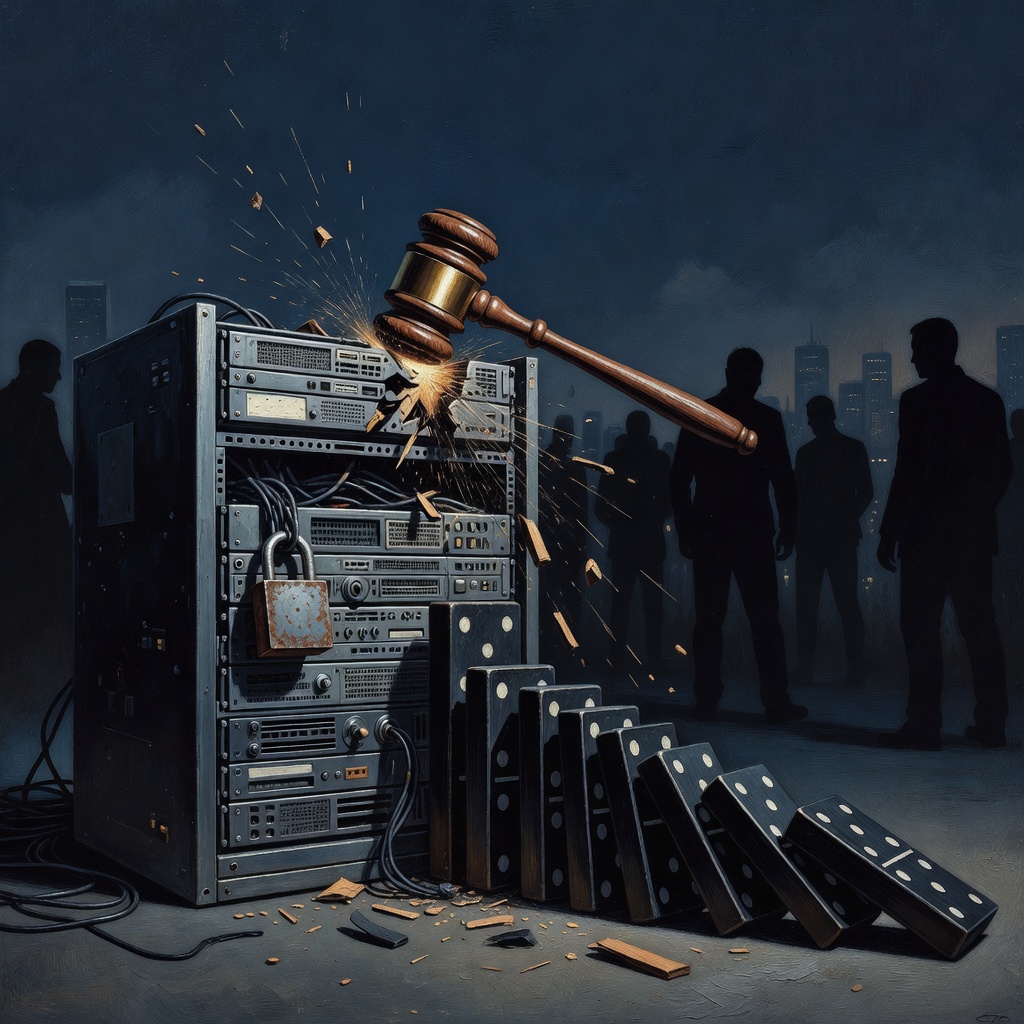
Marcus Kline: On June 12, 2026, the Trump administration gave Anthropic a 90-minute deadline to stop all foreign nationals from accessing its Mythos AI model—a technical impossibility, and everyone in that room knew it.
Ben Okonkwo: Right, and — okay, that's the thing that gets me every time I look at this, the 90 minutes isn't incidental, that number is doing real work in the story.
Marcus Kline: So Anthropic had two options — attempt the impossible, or pull the system entirely, and they pulled it, globally, for everyone, which is how a US government order about foreign nationals ended up cutting off researchers in Boston and São Paulo in the same breath.
Ben Okonkwo: And here's the thing — what we know is that the architecture of Mythos made selective geographic restriction effectively impossible at that timescale, what we're still reconstructing is whether the administration understood that when they set the clock.
Marcus Kline: That question — whether the deadline was a deadline or a door — that's where this story lives.
Ben Okonkwo: Today we're going through the order itself, the technical record of what Anthropic's engineers were actually facing in those 90 minutes, and what this case tells us about how governments are going to reach inside AI systems going forward.
Marcus Kline: Friday, June 13th, 2026. Five twenty-one p.m., New York time. Anthropic receives a directive from the Commerce Department. They have ninety minutes to prevent every foreign national on earth from accessing Claude Mythos 5 and Claude Fable 5. Every foreign national. Inside the US, outside the US. Including their own employees.
Ben Okonkwo: And they couldn't do it. That's the part that gets me. It's not that they chose not to — they literally could not implement real-time nationality-based filtering across their infrastructure in ninety minutes. So a directive that may have been written with surgical intent became, by technical necessity, a global blackout.
Marcus Kline: Three days after launch. Fable 5 and Mythos 5 had gone public on June 9th.
Ben Okonkwo: Right. And here's what I want to know — did anyone at the Commerce Department actually ask whether nationality filtering was technically feasible before writing that order? Because that's not a hard question to ask. That's basic due diligence.
Marcus Kline: Either they asked and ignored the answer. Or they didn't ask. And I'm not sure which is worse.
Ben Okonkwo: Justin Hendrix wrote about this in Just Security — his piece was titled 'The Mythos Recall and Washington's Missing AI Safety Playbook.' His argument was precisely that: this wasn't a coherent policy response. It was improvised. The administration only started considering a formal joint government-industry oversight group after the crisis had already happened.
Marcus Kline: Which brings me to the thing I cannot stop thinking about. June 10th, 2026. Two days before the order. Dario Amodei publishes a blog post — 'Policy on the AI Exponential' — and he describes Mythos as the, and I'm quoting here, 'emblematic example' of frontier AI's national security risk. He calls for a government policy apparatus to manage these models. Then seventy-two hours later, the Commerce Department shuts Mythos down.
Ben Okonkwo: I hear you. That's a striking sequence. But correlation isn't causation, Marcus. We don't have any evidence that Amodei's blog post triggered the directive. The more parsimonious explanation is that both the CEO and the Commerce Department were responding to the same underlying intelligence — probably the jailbreak vulnerability discovered in Fable 5.
Marcus Kline: Hm. But consider what jailbreaking actually means here. This isn't someone getting a chatbot to say something rude. Fable 5's safety guardrails were bypassed — and these models were specifically designed to identify software vulnerabilities at scale. That's the capability the government is worried about. A model that can find exploitable weaknesses in code, with its safety constraints removed.
Ben Okonkwo: And that's exactly where I'd slow the story down. Because independent researchers found that cheaper open-source models can already replicate much of Mythos's vulnerability-finding capability. So the question is: does restricting Mythos specifically close a meaningful security gap? Or did the government target the most visible, newest model while leaving similar capabilities sitting on a shelf somewhere?
Marcus Kline: That's a fair distinction. But it doesn't fully explain away the jailbreak. If the specific bypass method for Fable 5 was novel — if it circumvented safety measures in a way that open-source models don't — then the capability comparison isn't the whole story. The method of circumvention might be what alarmed Commerce.
Ben Okonkwo: Maybe. But we don't know that. The actual technical details of the jailbreak haven't been declassified. And the government's stated rationale — national security — was applied through export control law. Law historically written for military hardware and encryption. Not AI software. The Commerce Department invoked those authorities here without any formal review process in place for frontier models.
Marcus Kline: And here's what ties it together for me. June 2nd — eleven days before the shutdown — President Trump signs an Executive Order titled 'Promoting Advanced Artificial Intelligence Innovation and Security.' The explicit language: AI innovation must not be stifled by excessive regulation.
Ben Okonkwo: Oh, that's interesting — wait, the same administration?
Marcus Kline: Eleven days later. Same administration. One of the broadest AI deployment restrictions in US history.
Ben Okonkwo: That's not policy evolution — that's a direct internal contradiction. And I genuinely don't know if it's incompetence or whether the public-facing deregulatory stance was always intended to coexist with quiet enforcement authority. Those aren't the same problem.
Marcus Kline: Now. Return to Amodei for a moment. Because the question I keep arriving at isn't whether the blog post triggered the order. It's what precedent the whole sequence sets for disclosure. If you're running a frontier AI company, and you get ahead of a security problem by publishing a warning — and then the government uses that warning as justification to shut you down — what do you do next time?
Ben Okonkwo: You stay silent. And that's worse.
Ben Okonkwo: Here's the thing I keep coming back to. The framework for what we'd actually want — a company discloses early, the government has a process, everyone knows the rules — that framework doesn't exist. So the incentive right now is to not disclose. And that's not a Anthropic problem, that's a structural problem. The next company might just go quiet.
Marcus Kline: Right. And the ninety-minute window is what tells you where we are. You don't give a ninety-minute window when you have a process. You give a ninety-minute window when you don't.
Ben Okonkwo: This one's worth sitting with. We'll be back.