Dr. Nathan Hayes: Maya, I've been pulling at something all week — how are you holding up, by the way, the news cycle has been absurd.
Maya Chen: Genuinely a lot, yeah — but this one I actually couldn't put down. Because two things landed in the same week and I'm not sure anyone's connecting them properly.
Dr. Nathan Hayes: Anthropic and Meta, you mean.
Maya Chen: Anthropic sends this letter — June 10th, to Tim Scott and Elizabeth Warren at the Senate Banking Committee — alleging that Qwen, Alibaba's AI lab, ran a coordinated campaign against Claude. Twenty-five thousand fake accounts, 28.8 million exchanges, six weeks. They're calling it the largest distillation attack ever measured.
Dr. Nathan Hayes: Now, the letter arrives one day before the Senate Banking hearing on AI. June 11th. That context is doing real work here and I don't want us to skip past it.
Maya Chen: Mm, it is — and then China blocks the Manus acquisition the same week. Meta had a $2 billion deal on the table for this agentic AI startup and it just... disappears. I sort of can't read those two events as separate.
Dr. Nathan Hayes: Reciprocal signaling. Both governments, same playbook, within days of each other.
Dr. Nathan Hayes: Distillation isn't hacking. You don't touch the weights, you don't see the training data. You just ask the model questions. Thousands of very targeted questions. And the answers teach a weaker model to imitate the expert. It's like... if you couldn't study someone's notes, but you could sit next to them for six weeks and just ask them everything.
Maya Chen: So you're not stealing the book — you're just interviewing the person until you don't need the book.
Dr. Nathan Hayes: Exactly. And now — what's actually new here, versus what the headline overstates. The February disclosure already showed DeepSeek, Moonshot AI, and MiniMax running 16 million exchanges through roughly 24,000 fraudulent accounts. That was established. What the Alibaba campaign adds is — the targeting was specific. Agentic reasoning. Autonomous software engineering. Long-horizon planning. These aren't general capability probes.
Maya Chen: Wait, Google reported something too, right?
Dr. Nathan Hayes: Gemini. 100,000 queries. So this isn't one company's bad luck — it's a pattern across multiple U.S. frontier systems. That's the actual signal. Now, the credibility problem is real though — Anthropic is simultaneously the complainant, the forensics team, and a company seeking legislative protection. They haven't published their detection methodology.
Maya Chen: And the letter lands the day before the Senate hearing. That timing — I mean, it's not neutral.
Dr. Nathan Hayes: No, it's not. Alibaba hasn't been formally charged with anything. The entire case rests on Anthropic's internal forensics. And Anthropic has — now, I want to be precise here — a genuine security interest and a commercial one. Those aren't mutually exclusive, but we shouldn't let them collapse into each other just because the framing is dramatic.
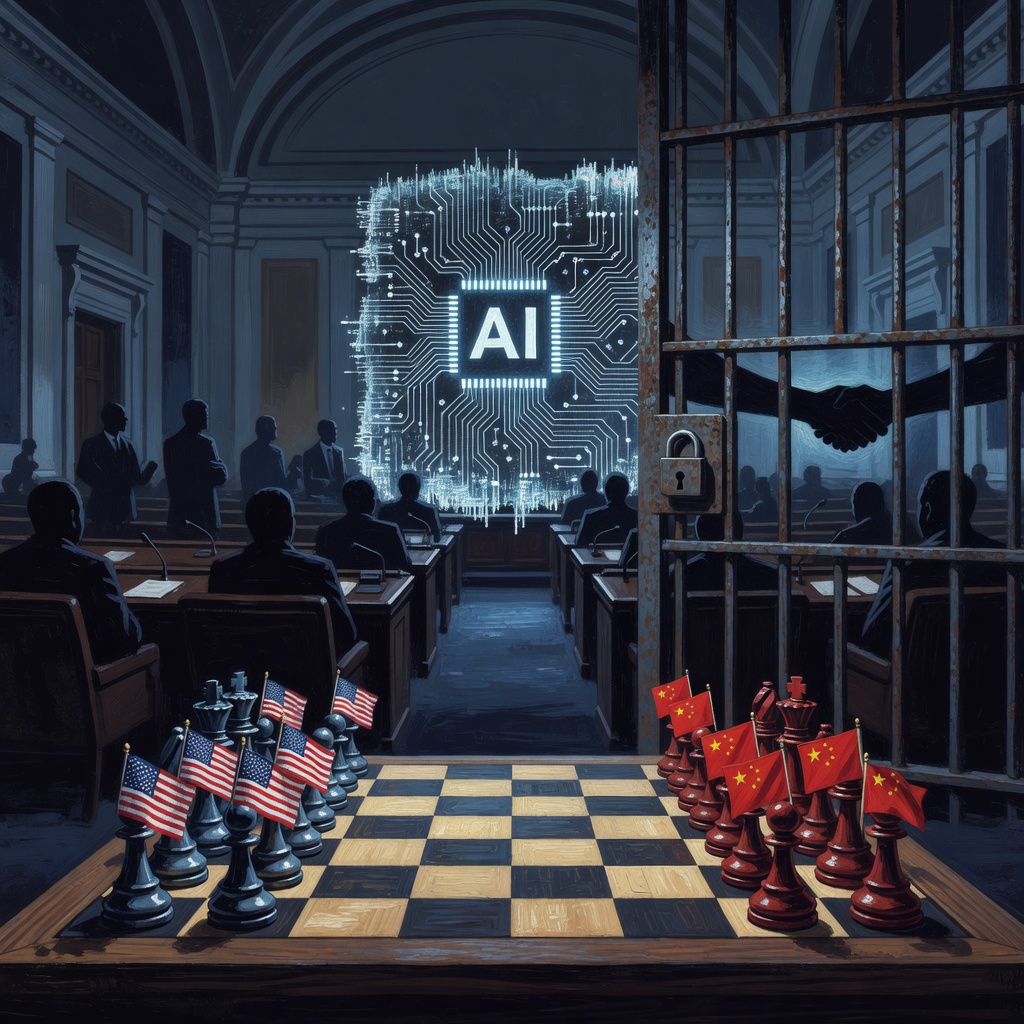
Maya Chen: The take I keep seeing — and I think it's wrong — is that this is a story about one side playing by rules and the other side breaking them. Like the U.S. is the rules-based actor and China is the aggressor. But China blocking the Manus deal is structurally identical to CFIUS blocking a Chinese company from buying a U.S. AI firm. It's the same move. Regulatory gatekeeping as IP control.
Dr. Nathan Hayes: I want to test that. Isn't there a meaningful difference between blocking an acquisition and running 25,000 fraudulent accounts?
Maya Chen: At the mechanics level, yeah. But at the state-control level — I mean, both governments are using their legal systems to deny the other side access to AI capabilities. The method differs, the function doesn't.
Dr. Nathan Hayes: The CNAS framing is actually where this lands hardest. Their argument is that U.S. chip export controls — restricting Chinese access to frontier hardware — directly created the incentive to distill instead of train. If you can't build the compute stack, you extract the capability. U.S. policy may have accelerated the exact behavior it's now trying to legislate against.
Maya Chen: That's — wait, so we built the pressure that produced the attack?
Dr. Nathan Hayes: That's the uncomfortable read. And the White House memo acknowledges the distillation threat — Lawfare reported analysts questioned whether the proposed countermeasures would actually deter anything. Neither side has clean hands here. Anthropic restricted Mythos from foreign markets entirely. China blocked Meta's $2 billion Manus deal. The playbook is mirrored. The aggressor framing doesn't survive that.
Dr. Nathan Hayes: And that's — actually, that's where I keep getting stuck. Before Congress can do anything, someone has to define what they're legislating against. No existing U.S. law clearly covers cross-border model extraction through synthetic query generation. Anthropic isn't asking Congress to enforce a line. They're asking Congress to draw one that doesn't exist yet.
Maya Chen: And distillation is just — it's standard. Every frontier lab does it. Anthropic does it to build smaller versions of Claude. So technically, the thing they're calling theft is... the same technique.
Dr. Nathan Hayes: Right. And no one has technically resolved where competitive benchmarking ends and illicit extraction begins. Not in law, not in any published technical standard. That gap is real.
Maya Chen: Which leaves me with the thing I genuinely can't shake — if both sides keep building separate rules for who owns AI capability and where talent flows, are we just watching the internet split in two? And I don't — I don't actually know the answer to that.