Hope Sterling: Juniper, long week and then THIS drops on June 30th — I genuinely could not sleep.
Juniper Vale: Which part kept you up?
Hope Sterling: The antibiotic demo! Oliver Vince, Basecamp Research, types a prompt — a patient microbiology report — and gets peptide antibiotic candidates back in minutes. That's the part. That's the clip.
Juniper Vale: Mm-hm, it's a striking demo.
Hope Sterling: And the room! Vas Narasimhan from Novartis, Chris Boerner from Bristol Myers Squibb — like these are not people who show up to beta software launches, you know? But there they are in San Francisco for Claude Science like it's... I don't know, like it's something different.
Juniper Vale: That's actually the part that matters to me — Dario Amodei has been pushing life sciences as the application area for a while, and this launch feels like the moment Anthropic cashed that check. Eric Kauderer-Abrams called it a major expansion, and with that room, it's hard to argue.
Hope Sterling: A major expansion and a vibe shift. Those are different things and somehow it was both at once.
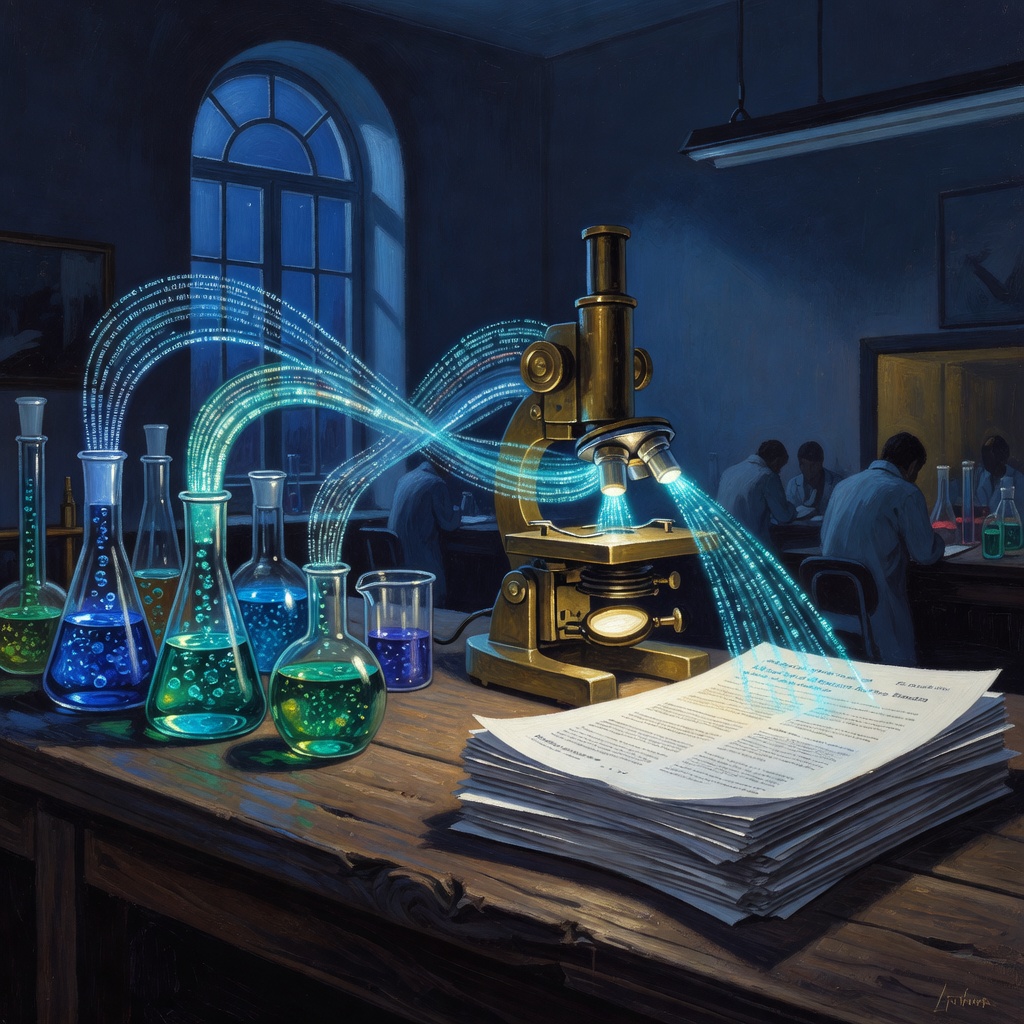
Juniper Vale: I keep wanting to say out loud though — Claude Science runs on Claude Opus 4.8. The same model anyone with a Claude subscription already has. No special gating, no secret capability unlock. Think of it like this: they didn't give researchers a smarter brain. They gave them a better desk. Same mind, everything within reach, no tab-switching.
Hope Sterling: Wait — so the model isn't new?
Juniper Vale: Not at all. What's new is the desk — local code execution, sixty-plus pre-configured scientific databases, remote compute, a reviewer agent, all in one environment. That's the product. That's what Anthropic shipped.
Hope Sterling: Okay but like — is that actually less impressive? Because honestly a better desk sounds... kind of huge if your current desk is seventeen browser tabs and a prayer?
Juniper Vale: It is genuinely useful, I'm not deflating it — the provenance tracking alone is meaningful. Every figure, every table, automatically linked back to the exact source code and compute environment that generated it. That's real for reproducibility. I mean, that's a workflow problem that has plagued labs forever.
Hope Sterling: So it's — wait, it's less 'AI discovered antibiotics' and more 'AI finally organized the lab notebook'?
Juniper Vale: That's almost exactly it. And Anthropic also dropped Claude Sonnet 5 the same day — June 30th — which is now the default on free and Pro tiers. So there's a whole separate model story happening simultaneously that kind of got swallowed by the Claude Science launch noise.
Hope Sterling: But wait — that's where I actually have to concede your workflow point, because the Nature study numbers just broke my brain a little. AI users publishing three times more papers. Three times. But research topics narrow by 4.63% and academic collaboration drops 22%. Like... that's not a side effect, that's the whole story?
Juniper Vale: That's the kernel that actually worries me. More output, less diversity, less human contact. And Claude Science just went live to every Pro, Max, Team, and Enterprise subscriber on June 30th. That pattern doesn't stay in one lab — it scales everywhere, simultaneously.
Hope Sterling: Okay because — I keep thinking about like, a postdoc on a Tuesday morning who now generates a full manuscript draft before lunch. Which sounds amazing, right? But the verification work — someone still has to check it. And if generation is basically free now, that checking becomes the... actually, wait, is that the inversion? The scarce thing flips?
Juniper Vale: That's exactly it. That's the verification budget problem. Generation approaches zero cost. Human time and methodological discipline to distinguish truth from error — that becomes the expensive thing. And JMIR literally published on June 25th a rise in fraudulent papers, false authorship, predatory journal identity theft — all linked to AI-generated content. The fraud isn't hypothetical.
Hope Sterling: And then — oh no — Geraint Rees, he's vice-provost at UCL, warned at a League of European Research Universities webinar on June 26th that AI agents flooding grant competitions is an existential threat to how grants even get awarded. So grant reviewers become the bottleneck. Human review capacity is suddenly the scarcest resource in science.
Juniper Vale: And that's the cognitive sovereignty problem underneath all of it — if AI is handling end-to-end manuscript generation, does the researcher still actually understand what they produced? Or are they just... signing off?
Hope Sterling: Okay but wait — provenance tracking, full audit trail, every figure traced back to its source code — that all sounds airtight. And then I think about a journal editor trying to spot a fraudulent submission and it's like... the audit trail is inside the app. The journal doesn't have the app.
Juniper Vale: That's exactly the gap. Provenance tracking is a beautiful internal audit trail — it tells you precisely how the paper was made. It doesn't give the journal any way to tell that paper apart from a fraud that was also made quickly, also looks clean, also has confident citations. The infrastructure that decides what's real isn't inside Claude Science. And Anthropic just hit a valuation of $965 billion on $42 billion in annualized sales — the ambition is enormous. But the journals and the grant committees haven't grown at all. Which is basically the whole Oliver Vince demo, looping back around: a prompt, minutes later, peptide candidates. That felt like a watershed. And maybe it was. Just not for the reason the room in San Francisco thought.
Hope Sterling: Sure, maybe it's a better desk. It's just — the desk is printing papers now. On its own. Automatically. And the people who have to read them are still reading at human speed.