Eliza Ward: Hey — you catch everything on this FAA thing yet?
Brian Reed: Most of it. Still wrapping my head around the scale, honestly.
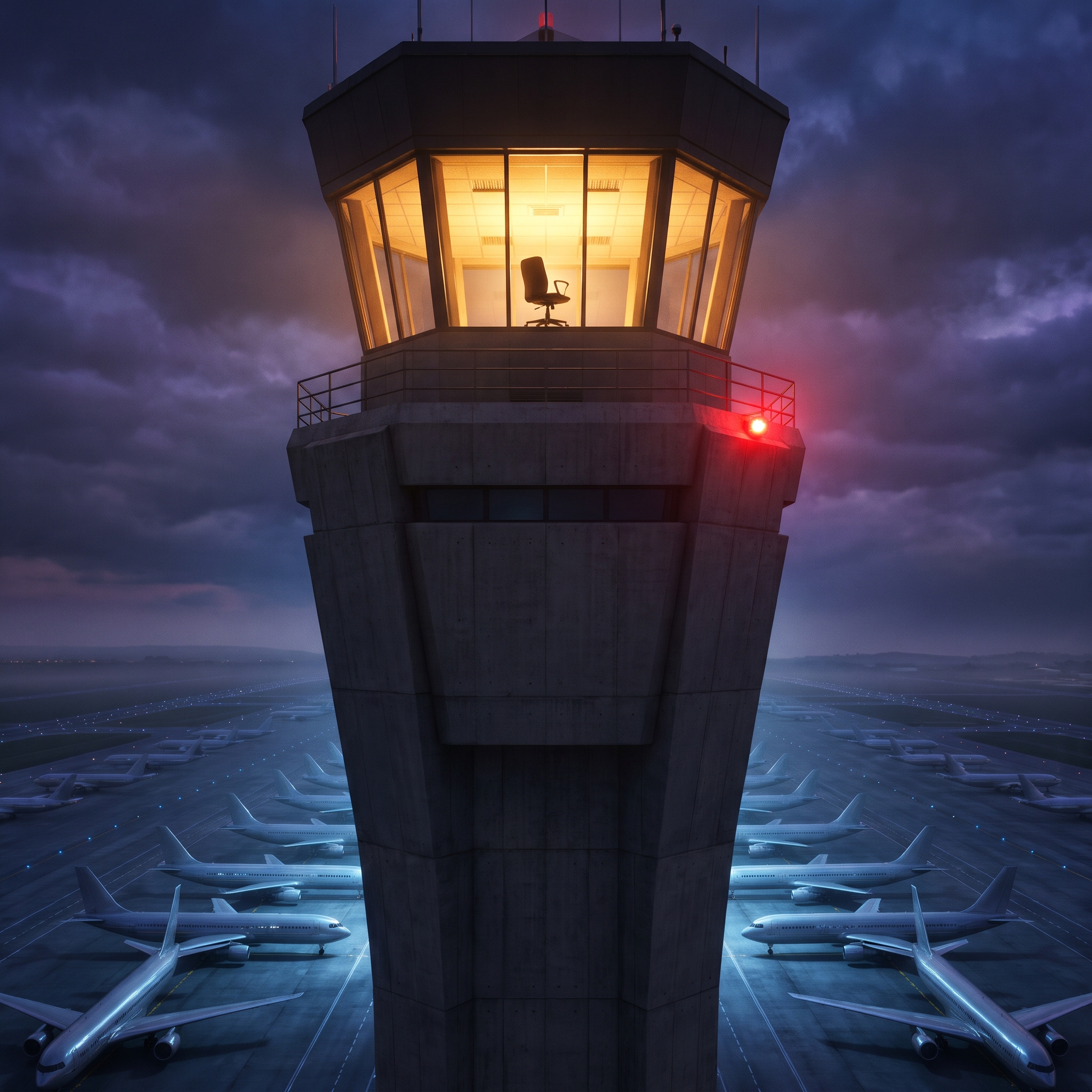
Eliza Ward: The scale is — okay, so: nationwide ground stop, Friday, almost five hours, roughly ten thousand flights affected. FAA Administrator Bryan Bedford calls it faulty equipment.
Brian Reed: And the thing that doesn't quite fit — Trump's Truth Social feed during those five hours. At five fifty-two, he posted about the Motion Picture, Television and Entertainment Revitalization Act.
Eliza Ward: Entertainment legislation.
Brian Reed: And a Gavin Newsom attack. No mention of the ground stop. That's not reading between lines — that's just what was on the feed.
Eliza Ward: So the confirmed fact is: ten thousand flights halted, and Truth Social had California governors and movie studios. Nothing on the aviation halt.
Brian Reed: What does that actually tell passengers who were, let me think — sitting at gates refreshing their phones from three fifty-four to eight fifteen?
Eliza Ward: They got nothing — and that's actually the part that makes this different from a bad weather delay. A nationwide ground stop isn't one airport closing. It's the FAA simultaneously shutting every on-ramp to the sky. No plane moves anywhere. Not just Newark, not just O'Hare — everywhere.
Brian Reed: Every on-ramp. At once.
Eliza Ward: This has happened three times. Total. Ever. Nine-eleven. January 2023, FAA computer system failure. And now this.
Brian Reed: Three. In the entire history of — wait, that changes the framing completely. Because if this were a chronic maintenance problem you'd expect this more often, right? But three times in twenty-five years means... I mean, the system actually holds. Which makes whatever happened Friday look worse, not better.
Eliza Ward: And it was the longest stoppage since 9/11. Longer than the 2023 failure. That's not — yeah, that's the number that lands for me.
Brian Reed: So what actually happened inside it — was this one failure that spread, or multiple things breaking at once?
Eliza Ward: Michael McCormick — former FAA airspace manager — called it a 'rolling outage.' Which is, the system wasn't just slow or down in one place, it was unpredictably failing across multiple air traffic control centers. So you can't even reroute around it because you don't know where it's going next.
Brian Reed: And FlightAware tracked sixty-four hundred cancellations Saturday alone. Eight hundred more Sunday. So the rolling part — that's what made it cascade for two days after the stop was lifted.
Eliza Ward: And that cascade is actually where the defense falls apart — because Senator Mullin went to a news conference and said Trump 'puts leaders in place and allows them to lead.' Which is... I mean, that's describing what happened. That's not a philosophy that was chosen before Friday.
Brian Reed: It's a cleanup frame. You say that after, not before.
Eliza Ward: And the administration's actual evidence of presidential engagement is — one phone call. Sean Duffy confirmed he spoke to Trump. That's it. One call. That's the whole record.
Brian Reed: The part I don't get — say you're a passenger. FlightAware's showing your Sunday flight cancelled, you're checking your phone Saturday night, and what you find is the president posting about entertainment legislation. Duffy's on camera. Bryan Bedford's on camera. The White House is not.
Eliza Ward: Right — and you can't call Duffy. You're at a gate.
Brian Reed: So what does Trump eventually say? Because 'delegation' implies at some point there's acknowledgment, right? Like — wait, actually, what did he say?
Eliza Ward: Hours after the ground stop was resolved, he called it 'old broken stuff.' That's not crisis communication — that's a cleanup line, and it wasn't even a formal statement. More than twenty-four hours after the halt ended, he still hadn't publicly addressed it directly.
Brian Reed: No, I don't buy the delegation defense then. Delegation covers the operational response. It doesn't cover being visible. Those are — those aren't the same thing.
Eliza Ward: And that visibility question gets a lot harder when you look at why the system actually broke — because the 'old broken stuff' framing skips the decision that caused this. We'll get to that: who approved the upgrade timeline that put copper and fiber integration into a live system, and what Duffy's fifty billion dollar ask actually admits.
Brian Reed: And that's the part that stops me — because Duffy is now asking Congress for fifty billion dollars to fix this. That number doesn't describe a surprise failure. That describes decades of deferred investment that everyone could see.
Eliza Ward: Fifty billion is — wait, hold on. That's not a repair estimate. That's a modernization budget. Which means Duffy is admitting the infrastructure problem predates this administration by a long stretch.
Brian Reed: So both things can be true? Chronic underinvestment for years, and then someone made a specific bad call last week?
Eliza Ward: That's actually — yeah, that's exactly the split. Democrats demanded answers over the chaos, the administration pointed to aging legacy equipment. Neither of those is wrong. But only one of them explains Friday specifically. The twenty-two regional air traffic control centers didn't lose communication because the copper was old. They lost it because someone switched part of that system to fiber while it was live.
Brian Reed: No contingency. No — was there a rollback plan at all?
Eliza Ward: That's the question nobody's answered yet. Who approved that changeover timeline? That's not settled. Duffy attributed it to overloaded legacy equipment during tech integration, which is true as a description — but it doesn't tell you whose sign-off put a live fiber migration into an active system with no apparent kill switch.
Brian Reed: Let me see if I have this right — the fifty billion request is actually the thing to watch, because if Congress responds to it, there's going to be a paper trail. Somebody's going to ask for the upgrade approval documentation as part of that process.
Eliza Ward: That's the concrete thread. The fifty billion ask opens a congressional hearing, and a congressional hearing means someone has to produce who signed off on the copper-to-fiber timeline and whether there was a contingency plan in writing.
Brian Reed: And until that documentation surfaces — the 'aging infrastructure' frame and the 'operational decision' frame are both just sitting there unresolved. We don't actually know yet which one carries more of the weight.
Eliza Ward: And that's genuinely where I land — Duffy can run crisis communications. Bedford can explain a failure to a camera. What we can't say yet is whether a president being visible during something this rare, a nationwide halt that happens three times in a quarter century, actually changes anything for the person whose Sunday flight is cancelled. We don't have that answer.
Brian Reed: The part that gets me — if the FAA's infrastructure fails again before that fifty billion gets appropriated, before modernization is even halfway funded, who owns it? Like, actually owns it. Because the White House position right now is that Trump puts leaders in place and lets them lead. But there's no precedent anyone's offered for a prior president staying publicly silent during a disruption at this scale. That's not a partisan point, that's just — I mean, is there an example? Because nobody produced one.
Eliza Ward: Not that I've seen. And that absence of precedent is — wait, that's actually the unresolved thread, isn't it. It's not whether Duffy performed well. He did. It's whether the symbolic gap, president silent, cabinet visible, it only becomes a real accountability problem if it happens again and the outcome is worse.
Brian Reed: Does presidential acknowledgment change outcomes, or just optics. I genuinely don't know.
Eliza Ward: Neither do I. And that's where I'd want to leave it — not because it's comfortable, but because the evidence doesn't close it.