Eliza Ward: Hey. Good morning. I want to jump straight to something because I haven't been able to stop thinking about it.
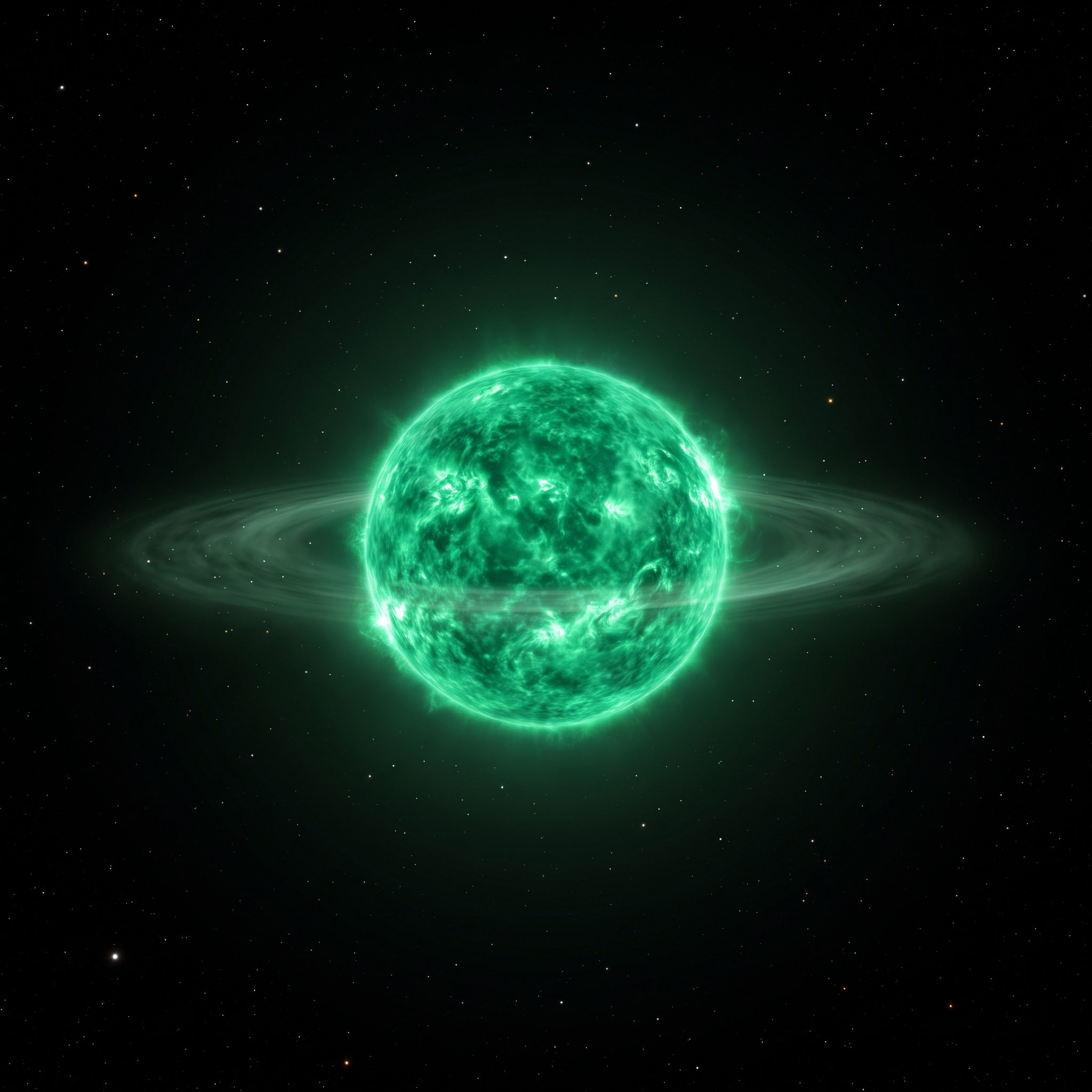
Brian Reed: The green star.
Eliza Ward: The green star. Space.com ran it around October 17th — University of Warwick researchers identifying WD J1330+6435 as, and I'm quoting here, the first credibly reported green star.
Brian Reed: And the thing that got me is — this shouldn't exist. Like, the prior scientific consensus was that no star could appear green to the naked eye. Full stop.
Eliza Ward: Because if a star peaks in green, it still radiates enough red and blue that your eye blends it to white. That's the blackbody rule.
Brian Reed: So how does WD J1330+6435 actually look green?
Eliza Ward: It's a dead star — a white dwarf — and it's been accreting planetary debris. Sodium, calcium, lithium. The Warwick team's argument is that the dense, chemically altered atmosphere selectively absorbs certain wavelengths and shifts the perceived color.
Brian Reed: Right — so the 'cosmic zombie' label. It's still actively processing material from whatever planetary system used to orbit it. That's not nothing.
Eliza Ward: But that framing — 'cosmic zombie' — kind of buries the actual new thing. The new thing isn't that it's accreting debris. White dwarfs do that. The new thing is that the Warwick team asked a completely different question from every prior study.
Brian Reed: Which was what, exactly?
Eliza Ward: Not where the spectrum peaks — what color would a human actually see. Those are different questions. Prior stellar color descriptions tracked spectral peak, which is temperature. The Warwick team ran the spectra through a human cone sensitivity model. That's the methodological break.
Brian Reed: So — wait, let me see if I have this — we've been answering a physics question when the real question was a perception question.
Eliza Ward: Exactly. And here's the — okay, the analogy that actually clicked for me. Stained glass. The light behind the window might be pure white. But the chemicals in the glass absorb certain wavelengths and you see deep red or blue. That's what sodium, calcium, and lithium in WD J1330+6435's atmosphere are doing. The star underneath isn't green. The atmosphere is filtering it green.
Brian Reed: That's — yeah, that's the click. The pollution is the glass.
Eliza Ward: Right. So chemistry overrides the temperature rule. Blackbody physics still holds — the star is still radiating across wavelengths the way temperature predicts — but the atmosphere selectively absorbs enough that what reaches your eye is chartreuse-green, not white. The rule wasn't wrong, it just — it assumed a clean atmosphere. This one isn't clean.
Brian Reed: The part I don't get — if their model also predicts pink, purple, cyan — are those already in the catalogs somewhere and we just filed them wrong because nobody was running perception models?
Eliza Ward: That's actually the open question I can't answer confidently yet. The Warwick team's model says those colors should exist. Whether they're already in existing data, mislabeled — that's unconfirmed. No outside peer commentary on record as of the October 17th reporting. So we're still at 'researchers propose,' not 'field confirms.'
Brian Reed: But that 'researchers propose' versus 'field confirms' gap — that's actually where Gizmodo stumbled, and I want to name it directly. Their headline said the star 'swallowed its planets.' That's not what the evidence shows.
Eliza Ward: Is that scientifically important or just — pedantic headline-policing?
Brian Reed: No, it actually matters. Gradual debris accretion over time is a different physical process than one planet-swallowing event. Because if it's accretion — slow, ongoing — you can read the chemistry. Sodium, calcium, lithium building up in layers. That's forensic. You can infer what the planetary system looked like. A single whole-planet consumption gives you — I mean, it's a different signal entirely. You lose that granularity.
Eliza Ward: Wait — so the accretion timescale is what makes it readable.
Brian Reed: Right. And Gizmodo's framing — 'swallowed its planets' — collapses that into a one-time drama. Which is vivid, but it's actually the wrong picture of the mechanism.
Eliza Ward: 'Cosmic zombie' has the same problem, actually. It's — okay, it's evocative, I get why people reach for it. But WD J1330+6435 is a dead star processing debris. There's no reanimation. It's not coming back. The label implies something technically wrong about what's happening.
Brian Reed: And the new-class claim is still — hang on, we should be clear here. No outside peer commentary on record. No formal ratification. The University of Warwick team is proposing this. That's not the field agreeing.
Eliza Ward: Which is exactly where I'd pump the brakes on the headlines. And — actually, the thing that makes all of this stranger is the color-modeling finding isn't just about this one star. The implications for pink, purple, cyan white dwarfs — and what they could tell us about dead planetary systems — it's genuinely weird, and we'll get there.
Brian Reed: And that's the part that actually keeps pulling at me — because if the model predicts pink, purple, cyan, yellow, and those wavelength signatures already exist in catalogs we've been building for decades, someone might have spent five years imaging white dwarfs and filed them as — I don't know, slightly anomalous, temperature mismatch, move on. Old data just became newly interpretable. That's not a small thing.
Eliza Ward: Right — but that's the thing I can't confirm yet. Whether yellow or purple white dwarfs are actually sitting in existing catalogs, mislabeled. That's what the Warwick model predicts. Whether anyone's gone back and found one — no confirmation as of October 17th.
Brian Reed: No, I know — I'm not saying it's confirmed. I'm saying imagine you're an amateur astronomer, October 16th, 2026, you see the Space.com headline, and you open a catalog of nearby white dwarfs you've been imaging for five years. And you start wondering if one of those — the one that always looked slightly off, slightly pinkish — if you just didn't have the framework to flag it.
Eliza Ward: That's — yeah, that's real. The framework shapes what you notice.
Brian Reed: And if polluted atmosphere equals readable chemistry — sodium here, calcium there — then a purple white dwarf isn't just a different color. It's a different planetary fingerprint. Different elements absorbed, different former solar system.
Eliza Ward: Which is — wait, that's actually the forensic case for why classification matters. It's not taxonomy for its own sake. A new color means new elemental signature means — actually, no, let me back up — it means a tool for reading what planetary systems looked like before they died. That's the second-order effect.
Brian Reed: And the Sun fits into this. In roughly five billion years, white dwarf. If Earth or Venus debris ends up accreting into its atmosphere — the color the Sun takes on is not predetermined. It depends on what chemistry it absorbs.
Eliza Ward: Space.com framed it as a preview of our solar system's fate, and — I mean, that framing actually holds. WD J1330+6435 is showing us one possible outcome. Chemical fingerprint of a dead world written into a star's perceived color.
Brian Reed: So the concrete thing to watch: does the broader astrophysics community formally ratify this as a new observational class for polluted white dwarfs? Because right now we have the University of Warwick team proposing it. That's one group. Peer ratification is what makes the color model a tool the field actually uses — not just a striking result from one paper.
Eliza Ward: And that's — actually, that's where I land too. One paper, one team, no public response from outside astrophysicists in the week of October 11th through 18th. The social engagement was thin. That's not a knock on the finding — it's just the honest current state. The field hasn't weighed in.
Brian Reed: Which means the deeper question isn't even settled yet — it's, wait, actually let me put it plainly. If color in astronomy is a perception shaped by atmospheric chemistry, not an objective read of temperature, then WD J1330+6435 might not be the anomaly. It might be the first example we noticed because we finally asked the right question. And I don't know what that means for classifications we've already built on the wrong one.
Eliza Ward: No confirmed answer to that yet.
Brian Reed: No. So — textbook category or vivid footnote, I genuinely don't know. Neither does anyone outside Warwick right now.