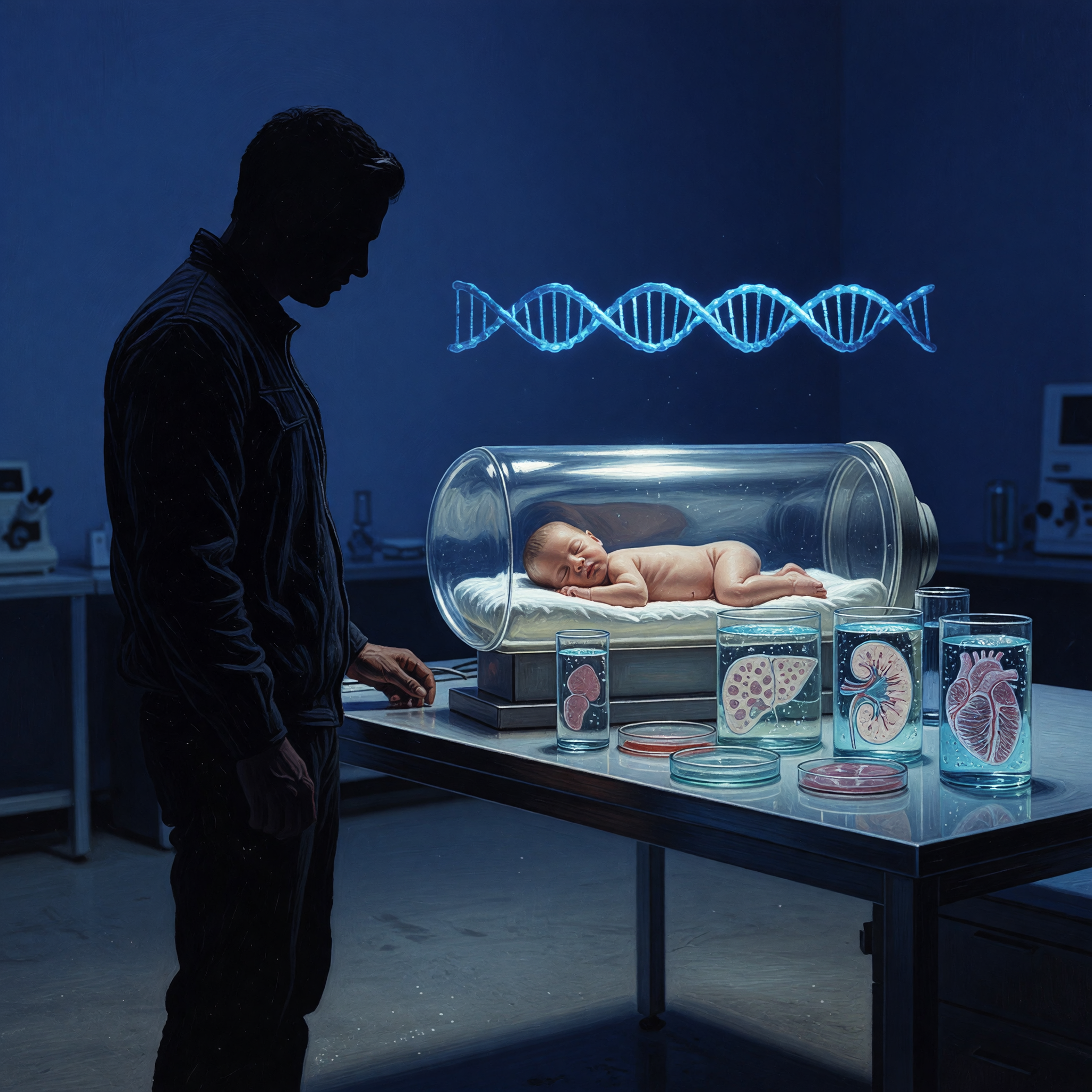
Jonathan Ingles: Ben, rough week — my feed has just been absolutely on fire.
Ben Okonkwo: Mm, same energy here — I kept seeing this one post come up and I kept thinking someone had altered it, because the words in it don't quite — they can't mean what they look like they mean.
Jonathan Ingles: Bryan Johnson, July 21st, on X: 'I just cloned myself as a newborn.' That's the post. That's the actual post.
Ben Okonkwo: Right — and the name he gave it is baby-Bryan.
Jonathan Ingles: Baby-Bryan. And then he lists what he's going to do with it. His own 'blood boy,' testing therapies, growing organs, injecting young cells into himself. That's not a metaphor, that's what he wrote.
Ben Okonkwo: Now, the framing that landed in the press — Complex was documenting people calling him outright evil — that tracks, because if you read 'clone' and 'harvest organs' in the same breath, your brain fills in the gap fast.
Jonathan Ingles: And Blueprint is the backdrop here — this is a $2 million-a-year anti-aging protocol he's already running. This isn't a one-off. So today what we're actually trying to figure out is: what did he really announce, and what's the gap between that and what he said he announced.
Ben Okonkwo: Because within 24 hours he walked it back — not a clone, he said. A collection of induced pluripotent stem cells. Which is — I mean, that's a genuinely different thing, and that distinction is doing enormous work.
Jonathan Ingles: That distinction is doing work — but the 'clone' word had already done its work first. That's the sequence that matters.
Ben Okonkwo: Right — and to actually understand why the clarification landed so flat, you need the plain version of what he actually made. Imagine you take a skin cell from your arm, and you hit a biological reset button. The cell forgets it was ever a skin cell. Now it can become heart muscle, a neuron, retinal tissue — almost anything. That's an iPSC. No embryo involved. No copied organism. You're just reversing the clock on one cell.
Jonathan Ingles: And that method — the reset button — who worked that out?
Ben Okonkwo: Shinya Yamanaka. He identified the transcription factors — the Yamanaka factors — that trigger the reprogramming. Nobel Prize, 2012. So we're talking about foundational science that is now, what, fourteen years old at the prize stage, twenty years if you track back to when the method was actually developed.
Jonathan Ingles: So why does Johnson say 'clone'?
Ben Okonkwo: Because 'I reprogrammed blood cells using a method from 2006' doesn't — I mean, that doesn't move the needle on X. 'Clone' does. Reproductive cloning, the thing that actually horrified people, means creating a viable genetically identical organism. What Johnson made is a cell culture in a petri dish. Scientifically, ethically — not the same category. But the word landed first, and the accurate description arrived after the backlash was already baked in.
Jonathan Ingles: The clarification was damage control dressed as science communication.
Ben Okonkwo: And the damage — the 'evil' framing Complex was documenting — that stuck because 'harvesting organs from my clone' is a coherent narrative even if it's wrong. The accurate version, iPSC derivation from autologous blood cells, is coherent too, but it doesn't carry that charge. The sensational frame set the terms. The correction never really caught up.
Jonathan Ingles: Frankly, that's the whole strategy — call it baby-Bryan, let the internet run with 'clone,' then walk it back just enough to keep the credibility intact. Blueprint stays in the conversation either way.
Ben Okonkwo: But that's where the circulating take goes wrong in the other direction too — because the dismissal, 'Johnson is a fraud, this is nonsense' — that doesn't hold either. The Springer Nature review from February 2026 is documenting iPSC-based organoid development and disease modeling as genuinely advancing science. The cell-culture level of what he's describing is real. You can differentiate iPSCs into neurons, cardiomyocytes, retinal cells. That's not disputed.
Jonathan Ingles: No, I don't buy 'he's a fraud' as the clean answer either. That's too easy.
Ben Okonkwo: Right — and using baby-Bryan as a drug-testing platform, running therapies against a cell line that's genetically his? Actually near-term viable. That's what labs are doing now. The Frontiers review from September 2025 confirms the disease-modeling pipeline is moving.
Jonathan Ingles: Okay but — wait, that's the architecture problem. Because he bundled that with injecting young cells into his body, which is experimental and has documented tumorigenicity risks, and then whole-organ transplantation, which scientists quoted after the announcement said is years away from routine clinical use. Those are three different timelines presented as one project.
Ben Okonkwo: Completely different timelines. Drug testing on iPSCs — now. Cell injection — experimental, and the Frontiers review flags immunogenicity alongside tumorigenicity as unresolved. Whole organs — the scientists quoted after July 22nd used the phrase 'years away.' Not 'challenging.' Years.
Jonathan Ingles: And he described them as a single announcement. That's not imprecision — frankly, that's architecture. The near-term thing makes the distant thing sound inevitable.
Ben Okonkwo: And then — I mean, this is the part that genuinely stops me — none of it has been independently verified. No protocol. No quality data on the derivation. The entire evidentiary basis for baby-Bryan is Johnson's own posts on X.
Jonathan Ingles: That's the gut-punch. The science behind iPSCs is real. The specific cells in that petri dish? We have no idea.
Ben Okonkwo: And the part we haven't touched yet — the regulatory gap that let this happen, and whether the autoimmune gastritis diagnosis is load-bearing motivation or something else entirely — it's hard to untangle.
Jonathan Ingles: The gastritis disclosure is where I'd start pulling that thread. Johnson announces baby-Bryan, gets absolutely torched online, and then — IBTimes UK reports it — he introduces the autoimmune gastritis diagnosis as the backstory. The sequencing there is not accidental. You lead with the dramatic reveal, absorb the backlash, then reframe the whole thing as 'I may need new organs.' Suddenly it's not a billionaire biohacking vanity project. It's a patient trying to survive.
Ben Okonkwo: Now — I want to flag what we actually know there, because the diagnosis doing narrative work and the diagnosis being real are not mutually exclusive. Those are separate questions. What I can't tell you is which one is load-bearing, because Johnson controls every piece of that story. No independent verification of the protocol, no IRB, no regulatory filing.
Jonathan Ingles: Which means the medical framing gets to do enormous work at zero cost to him.
Ben Okonkwo: Right — and this is the regulatory terrain that actually matters. iPSC derivation for personal cell-line research, that sits in a completely different regulatory space than injecting those cells into your own body, which is different again from growing a transplantable organ. Johnson announced all three as one project. The FDA framework that covers one does not cover the others.
Jonathan Ingles: And nobody required him to separate them publicly before he posted.
Ben Okonkwo: That's — I mean, this is the part that actually concerns me on a second-order level. Think about a 51-year-old woman with early-stage Parkinson's. She reads Johnson's announcement at Blueprint's scale — we're talking millions of followers on X — and the takeaway is: I can fund my own iPSC dopamine-neuron work, no approval required, contact a lab abroad. Three months later she's in a clinic in Mexico injecting cells with no quality data, no immunogenicity screening, none of the safety checks the Frontiers 2025 review flags as unresolved. That is not a hypothetical. That is the direct second-order consequence of a public announcement with no regulatory framing attached.
Jonathan Ingles: And Blueprint's audience reach is what makes that scenario real rather than theoretical. Two million dollars a year, commercial enterprise — he's not a private eccentric. He's a public credibility signal.
Ben Okonkwo: Which flags the assumption the whole 'personal autonomy' defense rests on — that the announcement stays personal. It didn't. It normalized a trajectory for everyone watching before any regulator addressed it.
Jonathan Ingles: The fact is Johnson carries the upside if baby-Bryan eventually produces something. Regulators, the broader research field, the woman in that Mexico clinic — they carry the downside. That's not autonomy. That's externality-shifting dressed as self-experimentation.
Ben Okonkwo: And the thing I keep sitting with — The Independent ran it, IBTimes UK ran it. This is not biohacking Twitter anymore. The narrative that baby-Bryan is a clone is now in mainstream coverage, and the accurate version, iPSC derivation, autologous cells, none of that traveled the same distance. So even if Johnson never injects anything, never grows a single organ — the public conversation on iPSC technology already moved.
Jonathan Ingles: Which is the real question, isn't it. Whether Blueprint-scale private announcements should be setting the terms for how stem cell medicine enters public life — or whether that's supposed to be slower, accountable institutions. And I don't actually know how you put that genie back.
Ben Okonkwo: No mechanism exists right now to require Johnson to distinguish between a rigorous research program and brand content. That's just — that's the terrain.
Jonathan Ingles: Yeah. I mean — I don't have a clean answer to that either. That's where I'm left.
Ben Okonkwo: Good conversation. Genuinely harder than I expected it to be.