Eliza Ward: Hey — glad we're doing this one today.
Brian Reed: Same. The McGrew news dropped and I had a lot of questions.
Eliza Ward: Let me just put the confirmed facts down first. Bob McGrew — OpenAI's former Chief Research Officer — publicly launched a company called Arda on October 20th. Series A, a hundred and sixty million dollars, valuation of one-point-five billion. Altimeter Capital led it, Accel and Khosla Ventures in as well.
Brian Reed: And he announced it himself on X. Which — that's not nothing. That's a deliberate public move.
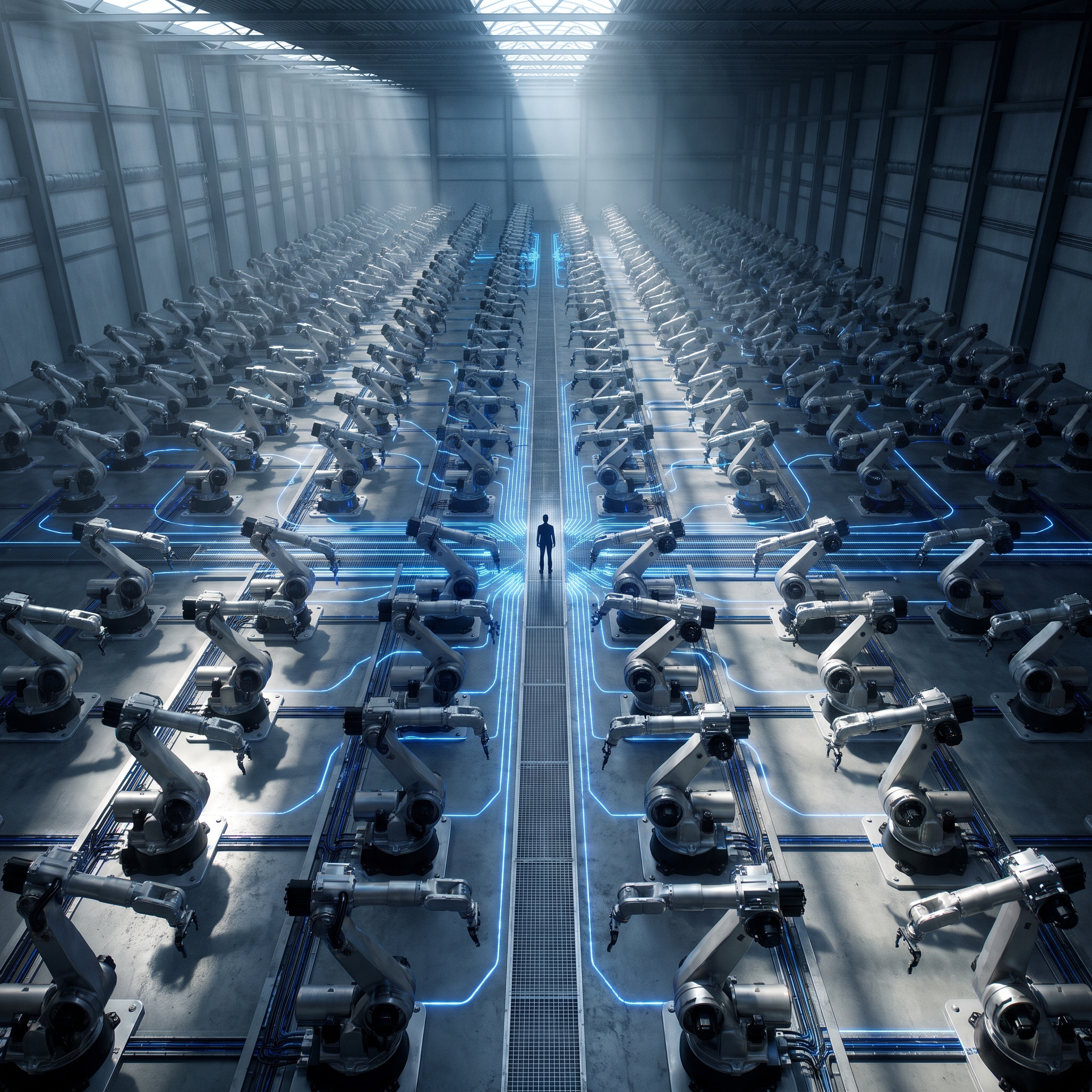
Eliza Ward: Right. So what does Arda actually build? Plain version: it reads a CAD design file — a factory blueprint, basically — and in fifteen minutes produces the full assembly instructions for the workers on the floor. Same job used to take ten hours manually.
Brian Reed: That's — I mean, that's the part that actually landed for me. Blueprint to construction manual, automated. The ten-hours-to-fifteen-minutes gap is real?
Eliza Ward: That's the claim. We don't have independent verification on that number yet.
Brian Reed: McGrew left OpenAI in September 2024 — same wave that took Mira Murati and Ilya Sutskever out — then founded Arda in 2025 and stayed dark for roughly a year. That's a lot of runway before going public.
Eliza Ward: And that year of stealth — that's actually where the signal is, not the funding number. Because Arda wasn't just building in stealth. They were deployed. Anduril was the design partner, first real customer, live during the quiet period. So this wasn't a demo company that emerged with a pitch. It shipped to defense first.
Brian Reed: Hang on — so the company that's supposed to revive American manufacturing ran its actual proof-of-concept through a military contractor?
Eliza Ward: That's the tension, yeah. And I don't think it's accidental. Look at who built this thing. McGrew — a decade-plus at Palantir before OpenAI. Co-founders Alex Mark and Jakob Frick, also ex-Palantir. Augustus Odena, who co-founded Adept AI before this. That's not a consumer-software roster. That's a team that has operated at the defense-data and frontier-research edge the whole time.
Brian Reed: The Odena piece is interesting — Adept was trying to build AI agents that could operate software. That's a different problem than factory assembly instructions. So what does he bring specifically?
Eliza Ward: Honestly, I don't know yet — that detail hasn't been reconciled publicly. But what I can say is the pattern matters more than any one hire. McGrew left OpenAI in September 2024, right after reasoning models shipped. He didn't spin up another LLM lab. He went to the factory floor. That's — wait, that's actually the signal. The frontier-model chapter, in his read, was done enough.
Brian Reed: Or he looked at what OpenAI still is — the Sam Altman reinstatement chaos, the IPO timeline that keeps slipping — and decided he wanted to control his own outcome.
Eliza Ward: Could be both. But one more thing that hasn't been resolved — some sources put total Arda funding at two-thirty, two-thirty-two million. The announced Series A is a hundred and sixty. That gap implies earlier stealth rounds nobody's confirmed.
Brian Reed: So seventy million, roughly, that we can't account for. And the question underneath all of this — if the best AI research talent is moving toward factory floors instead of next-generation models, what does that say about where the hard problem actually is now?
Eliza Ward: That question about where the hard problem is — that's exactly where the press is getting it wrong, actually.
Brian Reed: The speed framing, you mean.
Eliza Ward: Yeah. The coverage keeps landing on the ten-hours-to-fifteen-minutes number like that's the unlock. But the 2026 State of Manufacturing Survey found 72% of manufacturers had already adopted AI in some form — up from 53% just two years prior. Only 10% scaled it broadly. So if speed on assembly instructions were the binding constraint, why does that 10% number look like that?
Brian Reed: No, that's what strikes me. Imagine — let me try to make this concrete — a manufacturing engineer at a mid-sized auto-parts plant in Ohio. Arda gives her the 15-minute output. Great. Now she has to walk into a room with her plant manager, her line supervisor, and the union rep and say: run this on Tuesday morning's shift. The tool is fast. The organization is — I mean, it hasn't moved at all.
Eliza Ward: Right. And that's not a software problem.
Brian Reed: Capital equipment that's already paid for. Data that lives in seventeen different formats across three legacy systems. Risk aversion to anything untested on a live line. Those aren't things a faster CAD-to-instructions tool dissolves.
Eliza Ward: I'd say — wait, actually I want to be careful here — I'm not dismissing the speed gain as real or useful. But "useful" and "unlocks 90% of manufacturers" are different claims. And the Anduril deployment is sort of the tell. Anduril doesn't have the same org-friction problem as a civilian plant. Defense procurement moves differently.
Brian Reed: Dealroom categorizes Arda as a defense startup. McGrew and the CNBC coverage call it a manufacturing revival play. Those aren't the same company.
Eliza Ward: And that identity question — whether Arda is defense infrastructure or productivity software — that's actually what makes or breaks the $1.5B number. We'll get into that, because the 2026 defense-tech surge that funded Anduril and Shield AI and Saronic is the water this whole thing launched into, and it changes the valuation logic completely.
Brian Reed: That defense-tech funding surge is — I mean, that's the actual frame, isn't it. Anduril, Shield AI, Saronic all raised big in 2026. Altimeter is writing checks into that environment. So when they fund Arda at one-point-five billion, are they buying a manufacturing software company or are they buying a position in the defense-industrial build-out?
Eliza Ward: That's the bet. And I think the honest read is — it's not a product bet primarily. It's a macro bet. The valuation only makes sense if reshoring policy and defense procurement force that 10% adoption ceiling to move. CHIPS Act money, onshoring incentives, Pentagon procurement pressure — if those levers pull, Arda's customer base materializes. If they don't, the civilian market isn't coming on its own.
Brian Reed: Which means Altimeter is really underwriting the policy, not the software.
Eliza Ward: Essentially. And there's a parallel signal — Sam Altman said in 2026 OpenAI wouldn't IPO that year, then made the timeline fuzzier by tying it to AI model reliability. That's jitteriness at the very top of the AI valuation stack. Arda is entering at one-point-five billion into that exact environment.
Brian Reed: So the question is whether Arda's civilian-versus-defense identity gets resolved before that window tightens.
Eliza Ward: Right — and here's what I'd actually watch: McGrew's stated roadmap is building automated production lines that are reconfigurable as fast as human workers. That's the civilian pitch. But if in, say, eighteen months their customer list is four more Anduril-type companies and zero auto-parts plants, the founding thesis has quietly shifted and the valuation metric has to shift with it.
Brian Reed: A defense contractor and a mid-size domestic manufacturer have completely different procurement cycles, compliance requirements — I mean, a reconfigurable line that works for Anduril isn't automatically a product a civilian plant can adopt without — actually, wait. Is the reconfigurability pitch even aimed at civilian plants yet?
Eliza Ward: That's genuinely unresolved across sources. The public framing says manufacturing revival. The actual deployment history says defense first. Those coexist right now — they won't forever.
Brian Reed: So the concrete thing to watch is the second customer. Not the valuation, not the roadmap deck — just: who's the next name after Anduril?
Eliza Ward: The second customer is exactly right. That's the only number that actually moves anything. Not the valuation, not McGrew's roadmap statements — who signs next.
Brian Reed: And the part I can't resolve — I mean, I keep turning this over — is whether the 10% scaling figure is a ceiling Arda can actually push, or whether it's just the natural equilibrium of an industry that has tried AI, found the organizational friction real, and settled. Because if it's equilibrium, a faster CAD tool doesn't disturb it.
Eliza Ward: Those are genuinely different futures. One is a software company that grows. The other is a defense contractor with a civilian-sounding mission statement.
Brian Reed: And we don't know which one yet.
Eliza Ward: We don't. McGrew left OpenAI in September 2024, built for a year in the dark, shipped to Anduril, raised at one-point-five billion — all of that is confirmed. Whether the thesis underneath it survives contact with civilian manufacturing is, honestly, still open.
Brian Reed: Watch the customer list. That's where I land.