Clara Bennett: Finn, quick question before we start — did you sleep this week, or did you go down a Caterpillar rabbit hole?
Finn Brooks: The second one, honestly, because there is a detail in this deal that I cannot shake and I need you to help me figure out if I'm reading it right.
Finn Brooks: Komatsu led Skycatch's 2017 funding round — that's nine years of being a named investor, having board visibility, understanding what the tech actually does. And then on July 7th, 2026, Caterpillar acquires Skycatch. Caterpillar. Komatsu's biggest competitor. So did Komatsu just... spend years building a capability for its own rival?
Clara Bennett: The short answer is yes. Komatsu's investment was part of approximately seventy-five million dollars Skycatch raised since founding in 2013 — and that capital, that relationship, that visibility into the platform, all of it now sits inside a four-hundred-and-forty-seven-billion-dollar company that competes directly with Komatsu for mining equipment contracts.
Finn Brooks: Seventy-five million total — and Caterpillar's market cap is four hundred and forty-seven billion. That gap is almost comically large.
Clara Bennett: Right, and that asymmetry is actually the whole story. Christian Sanz, the co-founder, called this 'the beginning of a much bigger chapter' — not a rescue, not a quiet exit. So the question we're working through today is: what is Caterpillar actually building here, and what does it mean that Komatsu's money helped build the foundation?
Finn Brooks: And whether there's any strategic path back for Komatsu or — yeah. This is a good one.
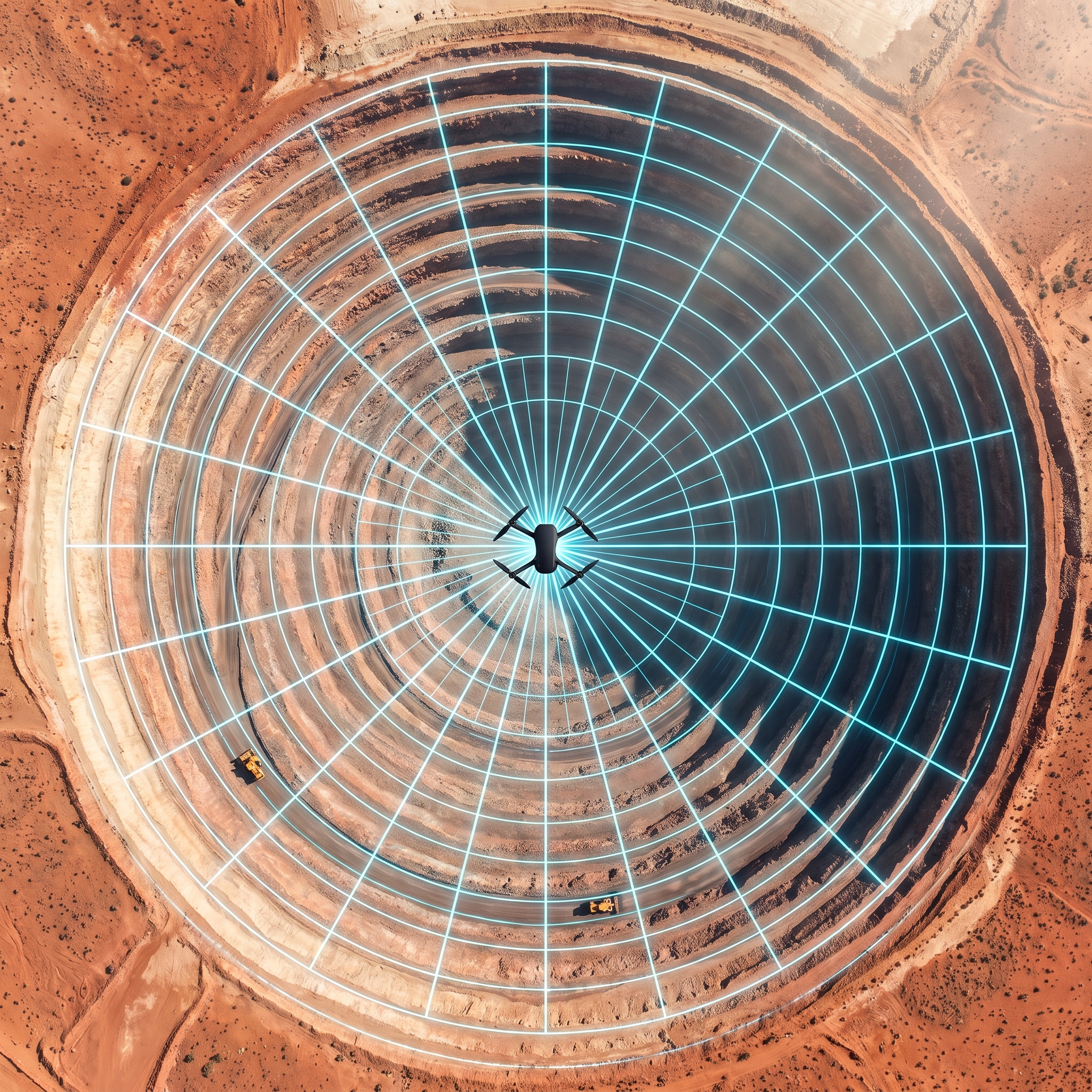
Clara Bennett: But before we get to Komatsu's path forward — let's actually nail what Caterpillar just bought, because I don't think the word 'drone' is doing the right work here. The core thing Skycatch does is spatial data capture: drones fly a mine site, collect high-precision positional and topographic data, and AI converts that into a digital twin — a continuously updated virtual replica of the entire site.
Finn Brooks: Okay wait — continuously updated, like... how continuously?
Clara Bennett: That's the operational punch. The whole survey — fly, process, deliver a live 3D map — deploys in approximately 30 minutes. Now picture a mine shift supervisor. A highwall just got blasted overnight. Before Skycatch, she's waiting on a survey crew, maybe days, before she can confidently route autonomous trucks into that zone. With the digital twin, she's got a walkable 3D replica on a tablet in half an hour. That's not abstract software — that's a Tuesday morning decision that actually changes.
Finn Brooks: Thirty minutes versus days — that is not an incremental improvement, that's a different category of tool.
Clara Bennett: Richard Mathews at RPMGlobal put it plainly — Skycatch lets miners process large volumes of spatial data much faster, and that speed improves day-to-day confidence in mine management. Not just planning. Execution. The decision to move a truck fleet, measure a stockpile, map a highwall — it's all downstream of having current data.
Finn Brooks: Okay, but — hang on, I want to actually push on this because it's the part that doesn't sit clean for me. Faster visibility into the site, fine. But does a digital twin actually change what she decides, or does it just surface the same constraints faster? Like, the highwall is still dangerous, the trucks are still where they are — what does she do differently?
Clara Bennett: That's — mm, that's the right tension to hold. Because there's a version of this where the bottleneck isn't data speed, it's decision authority or equipment availability. In theory the twin surfaces the constraint faster. Whether it actually resolves it depends on what MineStar and RPM can do with that feed once it arrives.
Finn Brooks: So the twin might just make the bottleneck more visible without removing it.
Clara Bennett: Exactly — and that's the real question Caterpillar has to answer when they integrate Skycatch into MineStar. Is the data actionable inside the existing workflow, or is it just a better-looking problem dashboard?
Finn Brooks: And that's actually where I want to press, because — okay, Caterpillar announced they're feeding Skycatch spatial data into both RPMGlobal's planning software AND MineStar. Two separate platforms. Simultaneously. That's not one integration project, that's two, running in parallel, five months after they spent seven hundred and thirty-six million dollars on RPMGlobal. Does that math work operationally?
Clara Bennett: That's the pressure point. In practice, RPMGlobal handles mine planning — scheduling, fleet optimization, long-horizon decisions. MineStar handles real-time execution on the ground. They're not duplicates, they're different layers. The Skycatch data, in theory, feeds the planning layer and the execution layer differently.
Clara Bennett: In theory, yes. Now, what makes me less worried about improvisation is what Denise Johnson actually said in November 2025 — this was before either acquisition closed — she called RPMGlobal, verbatim, 'the first of the technology investments we intend to do in this space' and flagged there is 'a lot in the sensor space' ahead. That's a sequenced roadmap, stated publicly, at an investor day. Skycatch is the sensor play she telegraphed.
Finn Brooks: Wait — she said that before they bought RPMGlobal?
Clara Bennett: Before either deal closed. So the sequence is: November investor day, roadmap declared. February, RPMGlobal at seven-thirty-six million. July, Skycatch. That's not two shiny things. That's a board-level commitment being executed against a stated plan.
Finn Brooks: Okay, I actually — no, that does change the read. But my pushback is still the gap between a slide deck and an integration that actually works. Like, declaring a roadmap and shipping coherent software to a mine fleet are very different problems, and Caterpillar is primarily — I mean, they're an equipment company. That's what they are.
Clara Bennett: That's the unresolved question, and it's fair. The logic on paper is clear. Whether execution matches the declared intent — that's still open. And honestly, the part that gets more complicated from here is the deal price, Skycatch's customers outside mining entirely, and whether Caterpillar is actually empowering operators or just making it harder to switch equipment vendors. That's where the story gets uncomfortable.
Finn Brooks: Yeah — the lock-in angle. That one's been sitting in the back of my head this whole time.
Clara Bennett: The lock-in angle is real, but the undisclosed deal price is where I'd actually start, because that silence is doing work. Skycatch raised roughly seventy-five million in total private funding since 2013. If Caterpillar paid a defensible number relative to that baseline, disclosure strengthens the story — it doesn't hurt it. So the fact that financial terms weren't released on July 7th suggests either they overpaid significantly, or the deal structure is messier than a clean acquisition. Earnouts, retention packages, maybe a carve-out of the non-mining assets.
Finn Brooks: Wait — non-mining assets? Skycatch has customers outside mining?
Clara Bennett: Founded in San Francisco in 2013 serving construction, mining, and energy. So there are construction and energy customers in that install base right now who have no obvious relationship with Caterpillar Resource Industries. And Caterpillar hasn't said what happens to them.
Finn Brooks: Oh — that's actually uncomfortable. Like, imagine you're a construction company using Skycatch's drone surveys on a bridge project. You wake up and your software vendor is now a mining equipment giant. That's — I mean, what is your path?
Clara Bennett: Your path is probably out. Caterpillar has no structural incentive to invest in a product roadmap for bridge contractors. Those customers get deprioritized, the platform drifts toward MineStar integration, and Skycatch's non-mining relationships quietly dissolve. That's not malicious — it's just resource allocation.
Finn Brooks: No, that tracks. But then — and this is the lock-in piece — even for the mining customers, what guarantees Caterpillar uses that integrated spatial data to genuinely improve their decisions versus to just optimize which Cat equipment to upsell them next?
Clara Bennett: Nothing guarantees it. And that's the version of this that actually backfires. If the digital twin data flows into MineStar and the primary output is 'you need two more Cat autonomous trucks in sector four' — miners notice that. They're not naive. And competitors will have time to build cleaner, vendor-neutral alternatives while Caterpillar is still integrating RPMGlobal and Skycatch simultaneously.
Finn Brooks: Okay but — credit where it's due. Johnson telegraphed the sequencing in November 2025, RPMGlobal landed in February, Skycatch in July. The declared roadmap held. That part actually checks out.
Clara Bennett: It does. The roadmap held. The unresolved part is whether Caterpillar — a company whose identity is still fundamentally hardware and equipment — can actually execute a vertical software integration without the price silence, the orphaned construction customers, and the lock-in risk all landing at once. The roadmap is real. The integration isn't proven yet.
Finn Brooks: Komatsu led that 2017 round. Had nine years of visibility into exactly what Skycatch was building. And walked away without buying it. And now it integrates with MineStar. That's the question though — was real-time spatial data ever actually a moat, or is it a capability that any drone vendor replicates in five years once the AI catches up?
Clara Bennett: And the only answer that actually matters is whether mine operators lock their workflows into Caterpillar's stack — or keep their options open. That's not a whiteboard question.
Finn Brooks: No. It isn't. And I don't think we know yet.