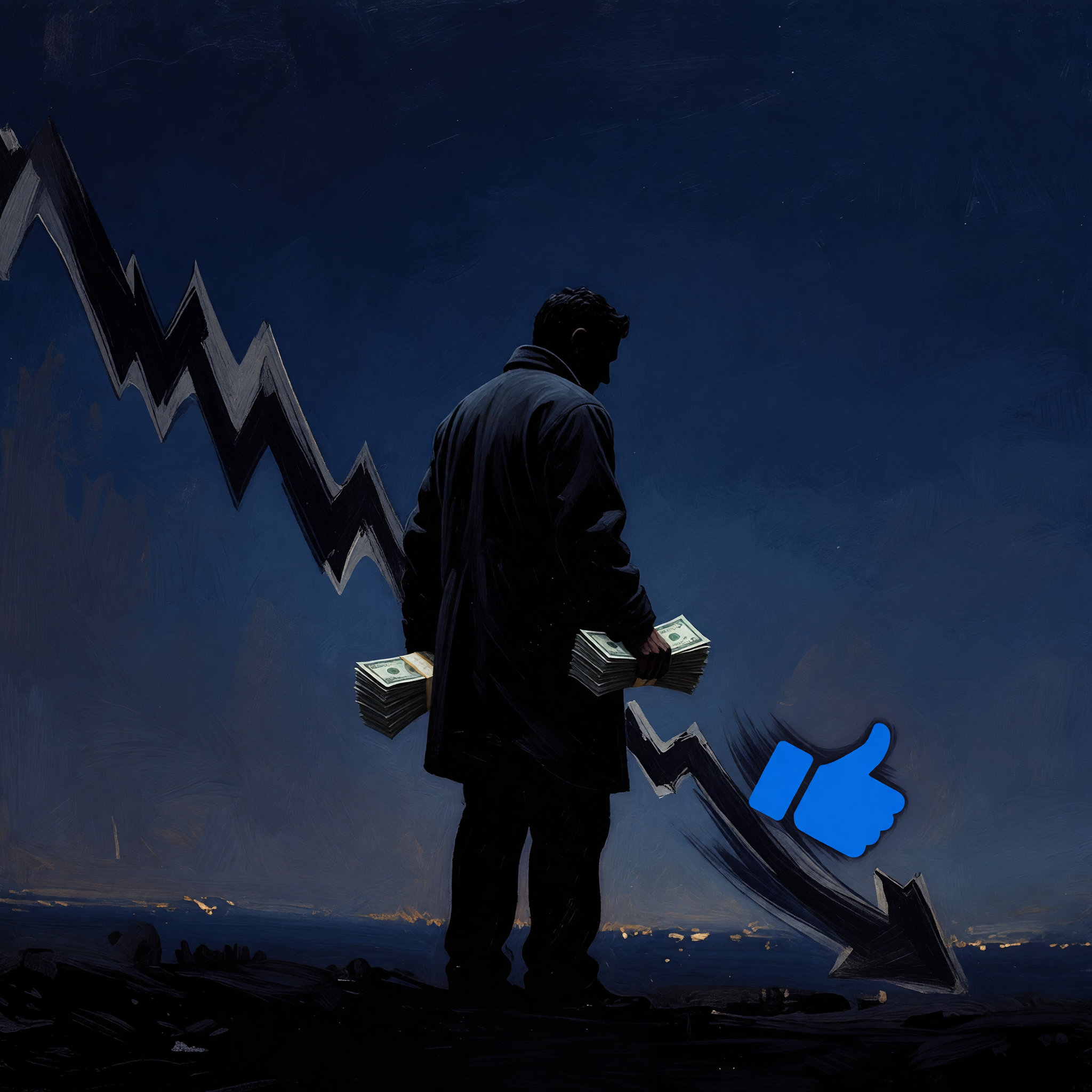
Spuds Oxley: There's a particular kind of trade that only makes sense if you believe something most people in the room flat-out don't.
Spuds Oxley: July 31st, 2026. Meta had just printed one of the ugliest single-session drops in recent memory — down 7.95%, closing at $539.03, after briefly touching 10% down earlier that same session.
Spuds Oxley: The reason was earnings. Q2 2026. Meta came in at $6.18 per share when the street was sitting at $7.22 — that's a $1.04 miss. Total costs had risen 55% year-over-year. And Q3 guidance? Roughly $62.5 billion. Consensus was $63.15 billion. Short.
Spuds Oxley: That's… a lot of bad in one report.
Spuds Oxley: Revenue — technically — beat. $60.8 billion against $60.17 billion expected. But when your costs are rising that fast and your earnings are missing by that much, a small revenue beat doesn't move anyone. Nobody cares.
Spuds Oxley: The underlying story is AI spending. Meta is pouring capital into infrastructure — data centers, compute, the whole apparatus — and the market looked at those cost numbers and decided the returns aren't coming fast enough. Maybe not for years. That gap, between what they're spending and what they're earning, is what people mean when they talk about AI monetization lag.
Spuds Oxley: And while most investors were selling that lag… Ark Invest was buying it.
Spuds Oxley: 26,509 shares of Meta. $14.3 million. Spread across ARKK, ARKF, and ARKW — all on July 31st, the morning after the worst of it.
Spuds Oxley: Think about what that means as a move.
Spuds Oxley: Everyone who sold Meta on July 30th had the same facts. Same EPS miss. Same cost explosion. Same soft guidance. Cathie Wood — CEO and Chief Investment Officer of Ark Investment Management — looked at identical facts and drew the opposite conclusion.
Spuds Oxley: That's either disciplined contrarianism or something closer to conviction. And the difference matters — it's just not always obvious from the outside which one you're actually looking at.
Spuds Oxley: What we can trace is the logic. And it starts here, with those numbers — $6.18 against $7.22, costs up 55%, and $14.3 million moving the other direction.
Spuds Oxley: Now, the Meta buy doesn't stand alone. That's what makes it worth your attention.
Spuds Oxley: Three days earlier — July 28th — Ark was already moving. They bought $15.5 million of Nvidia shares. Seventy-eight thousand, nine hundred and sixty-five shares, spread across five ETFs. Nvidia had fallen roughly 17% from its mid-May high by that point. Same logic: price down, conviction up.
Spuds Oxley: And on that same day — July 28th — they trimmed AMD.
Spuds Oxley: That detail matters more than it looks. This isn't just buying chips broadly. It's choosing WHICH chips — preferring Nvidia over AMD within the same sector, on the same morning. That's a judgment call about strategic positioning, not a broad bet on semiconductors.
Spuds Oxley: Then late July: roughly $20 million into Taiwan Semiconductor — TSMC — and around $12.2 million into SpaceX. Meanwhile they were trimming Amazon, Alphabet, and Shopify. Peeling back on the established mega-caps. Adding to the infrastructure layer underneath.
Spuds Oxley: And then July 31st — same day they bought Meta — Ark sold Caterpillar.
Spuds Oxley: Caterpillar makes heavy equipment. Earthmovers. Industrial machinery. Selling it to buy Meta on the same session is a statement. You're moving capital out of physical infrastructure and into — what Ark would call — the infrastructure of the next economy.
Spuds Oxley: That's thematic active management in its clearest form. Cathie Wood and Ark aren't reacting to individual earnings prints in isolation. They're rebalancing a thesis — concentrated, long-duration, built around disruptive technology themes. The rotation is the message.
Spuds Oxley: Look at what fits cleanly in that thesis: Nvidia, a chip architecture that runs AI at scale. TSMC, the foundry that physically manufactures the intelligence. SpaceX, which Wood has publicly called one of her top long-term opportunities — compute meets launch infrastructure.
Spuds Oxley: Then look at Meta.
Spuds Oxley: Meta is, at its core, an advertising and social platform company. The revenue engine is attention — people scrolling, clicking, seeing ads. The AI spending is real, enormous, but it runs underneath a business model that is fundamentally about selling eyeballs. That's a different animal than a chip foundry or a semiconductor designer.
Spuds Oxley: Here's the honest tension. When Ark buys Nvidia after a 17% drop, the AI-infrastructure thesis is legible — Nvidia IS the infrastructure. When they buy TSMC, same thing. But when they buy Meta the morning after a 55% cost explosion and a $1.04 EPS miss… the fit is murkier.
Spuds Oxley: I mean, there's another possibility sitting right alongside the thematic story. Ark's ETF structures carry weight limits and rebalancing mechanics. A sharp price drop in a position can trigger routine rebalancing — buying more simply to maintain a target weighting. Whether that's disciplined conviction or housekeeping dressed up as a thesis… from the outside, it can look identical.
Spuds Oxley: And that ambiguity is the thing I keep sitting with. Because the pattern is coherent enough to look like a strategy — and imprecise enough that you can't quite rule out the catching-a-falling-knife read. Both can be true at once. That's what makes this move worth watching.
Spuds Oxley: What actually resolves it — and this matters — it's not the stock price. That's the wrong instrument. Stock prices are noisy. They discount sentiment as much as reality, and right now sentiment around Meta is running hot in both directions.
Spuds Oxley: The number to watch is free cash flow. Specifically — whether Meta shows an improving free cash flow trend in Q4 2026 or Q1 2027 earnings. That's the hinge. Because free cash flow is where the AI monetization lag either starts to close… or announces itself as something much longer than the market priced in.
Spuds Oxley: Think about what that guidance told us. Meta's own management pointed to Q3 2026 revenue of roughly $62.5 billion. Consensus was $63.15 billion. Management itself came in short. That's not a Wall Street analyst being pessimistic — that's the company, with full visibility into its own pipeline, signaling that near-term headwinds are real.
Spuds Oxley: They're not promising a fast turnaround.
Spuds Oxley: And that matters for how you read Ark's buy. If Cathie Wood is holding a long-duration thesis — that the AI spending eventually flips from cost center to revenue driver — she can absorb a soft Q3. She's not positioned for next quarter. She's positioned for a different era of this company. But that patience has a cost, and Ark's own history is honest about what that cost can look like.
Spuds Oxley: Ark has made early calls that were genuinely prescient. They've also held conviction bets through drawdowns that tested — and in some periods, punished — the investors who stayed. Both things are true. You can't cite the wins without the losses sitting right beside them.
Spuds Oxley: Which is why the metric matters more than the narrative.
Spuds Oxley: If Meta's free cash flow improves through Q4 2026 — if the infrastructure spending begins compressing relative to revenue, if you start seeing the monetization machinery actually engage — then the July 31st buy looks like what Ark says it was. Disciplined. Early. Right.
Spuds Oxley: And if it doesn't — if costs stay elevated, if free cash flow flatlines or contracts into Q1 2027 — then you're watching a conviction bet absorb real damage. Thematic active management doesn't protect you from being early in a way that functionally looks the same as being wrong.
Spuds Oxley: That's where we are. Not at the verdict — at the watch. You have the facts, you have the logic, you have the ambiguity. Q4 2026 and Q1 2027 will do the talking. Free cash flow. Not price. That's the tell.
Spuds Oxley: Cathie Wood bought $14.3 million of Meta at $539.03 — into a 7.95% single-day selloff, into a $1.04 earnings miss, into a cost structure that had risen 55% year-over-year and guidance that the company's own management couldn't clear. That's the fact on the table. And it doesn't resolve into a clean read. It just… sits there, holding two shapes at once — conviction, or a trap door — and the trade itself cannot tell you which one it is.
Spuds Oxley: The pattern around it is coherent, I'll give it that. Nvidia down 17% from its May high, bought. TSMC, bought. SpaceX, bought. Caterpillar, sold — on the same morning they were buying Meta. That rotation has a shape to it. You can trace the logic. But coherence is not confirmation. A thesis can look airtight right up until the moment it isn't.
Spuds Oxley: The answer is not in the trade. It never was. It's in Meta's next free cash flow print — Q4 2026, or Q1 2027 at the latest. That's the number that says whether the AI spending is beginning to close the monetization gap, or whether it's still just weight on the balance sheet with no revenue yet to carry it. Everything else — the thesis, the rotation, the contrarian logic — all of it waits on that.
Spuds Oxley: Until then, Ark is just early — and early looks exactly like wrong.