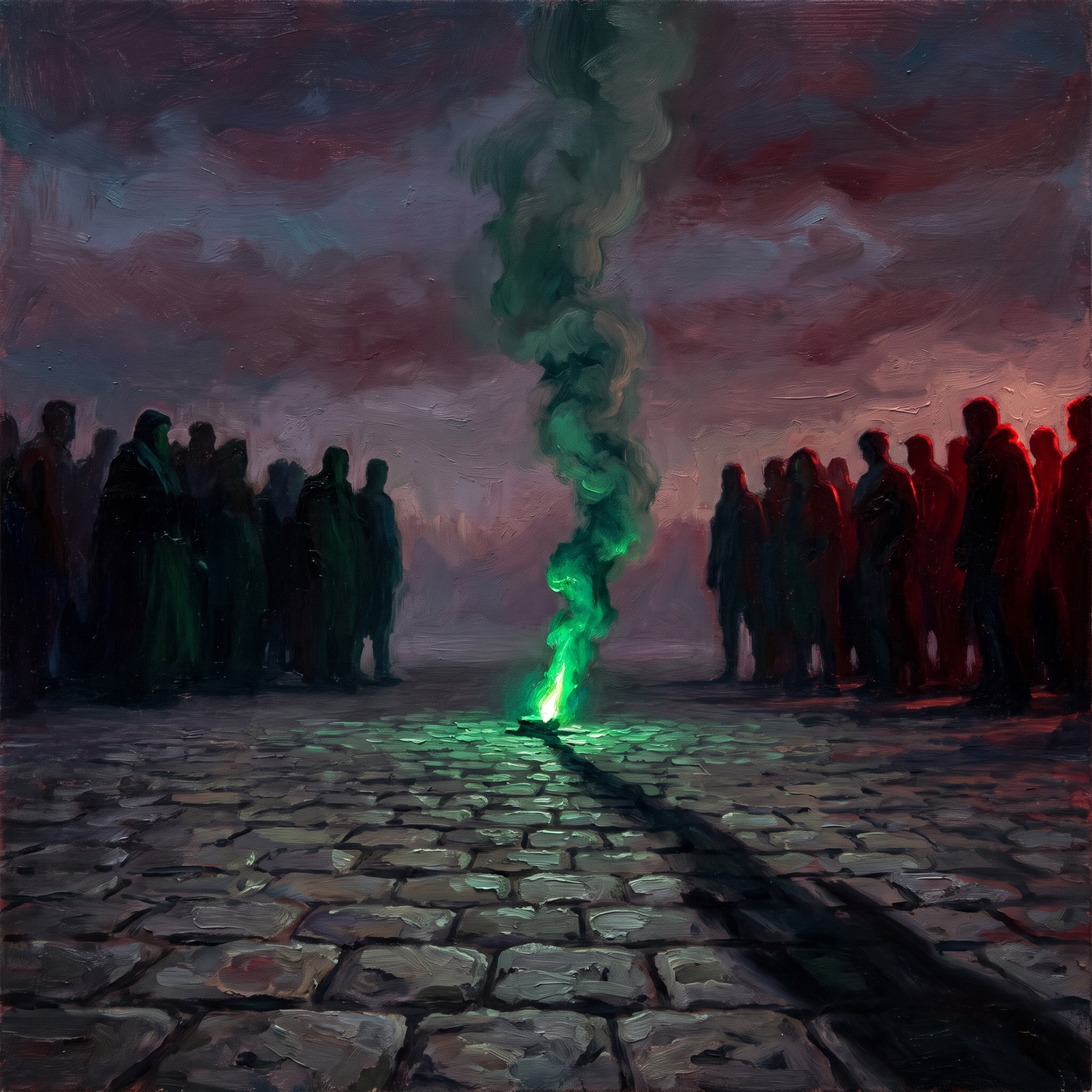
Adam: Eleven arrests. That's what West Midlands Police ended up with — on the night of November 6, 2025 — outside a stadium where the away fans had already been banned from entering.
Adam: Think about that for a second.
Adam: Birmingham City Council's Safety Advisory Group made their call on October 16. Maccabi Tel Aviv supporters: not permitted inside Villa Park. Public safety, that was the reason given. The Maccabi fans were the ones being protected — by being kept out.
Adam: Keir Starmer said it was the wrong decision. UEFA said reverse it.
Adam: The decision stood.
Adam: West Midlands Police still put over 700 officers on the ground — horses, dogs, drones, road units — and activated Section 60 stop-and-search from midday until three in the morning. For a match. With no away supporters in the ground.
Adam: Aston Villa won 2-0. UEFA Europa League. Which is — honestly, that fact almost disappears inside everything else that happened.
Adam: Outside Villa Park, the Palestine Solidarity Campaign had called for the match to be cancelled entirely, and for Israeli clubs banned from European competition altogether. Demonstrators showed up with banners — 'MACCABI NOT WELCOME.' Chants of 'Death to the IDF.' Independent MP Ayoub Khan addressed the crowd and offered his support.
Adam: And then the arrests. Eleven males, seventeen to sixty-seven. Most of them suspected of racially aggravated public order offences. A twenty-one-year-old caught with fireworks, trying to get them into the stadium. A seventeen-year-old ignoring a dispersal order. A twenty-one-year-old who refused to take off a face covering.
Adam: The away fans were absent. The trouble came anyway.
Adam: That's what the Safety Advisory Group's logic did not — could not — fully account for.
Adam: That's where this story starts.
Adam: Amsterdam came first. That matters.
Adam: Before Birmingham, before the October 16 decision, before the Safety Advisory Group sat down and weighed anything — there was the Johan Cruyff Arena. Ajax won 5-0, and Maccabi Tel Aviv fans and pro-Palestinian protesters clashed in the streets of Amsterdam, before and after that match.
Adam: Amsterdam authorities called it anti-Semitic. Full stop.
Adam: But the reporting was more complicated — there were also accounts of provocation from visiting Israeli fans. Both things were documented. The official framing and the messier reality didn't fully align.
Adam: The SAG cited Amsterdam. Explicitly. That was part of the public safety rationale for what they did on October 16.
Adam: And here's where the logic starts to close like a trap — because what the SAG did, operating in good faith on genuine safety grounds, was take the threat that materialized in Amsterdam and make it the governing principle of what happens in Birmingham. The threat decided who gets to attend. Not the law. Not rights. The threat.
Adam: Starmer called it the wrong decision. UEFA called it wrong and pushed British officials to find another way. The SAG did it anyway.
Adam: That disagreement is not a procedural footnote.
Adam: When the Prime Minister and European football's governing body both say reverse this — and the decision holds — that tells you something about how local safety calculus can override almost everything else once it gets going.
Adam: Look — I'm not saying the SAG was wrong to be afraid. Amsterdam had just happened. The intelligence picture was real.
Adam: But when you remove a minority from a public space to protect them from violence directed at them — you've made the violence the operating principle of civic life. The aggressor sets the terms. And you've ratified that.
Adam: Then the eleven arrests. Men aged 29, 32, 34, 63, 67 — most of them suspected of racially aggravated public order offences. And here's the honest problem: the public record doesn't clearly separate who those offences were directed at. Anti-Jewish violence? Anti-Palestinian? The reporting doesn't draw that line cleanly.
Adam: The crowd outside Villa Park wasn't simple. The Palestine Solidarity Campaign had called for Israeli clubs banned from European competition entirely — that's a position, not a safety concern. Ayoub Khan addressed them. And yet eleven people were still arrested on racially aggravated grounds.
Adam: The Maccabi Tel Aviv fans were absent. The trouble came anyway. And we still don't know exactly what kind of trouble it was — or who it was aimed at. That ambiguity is the thing you should sit with.
Adam: Maccabi Tel Aviv is still in the UEFA Europa League. More fixtures are coming. That's not speculation — that's the schedule.
Adam: And every away fixture they play from here carries the Birmingham template now. The SAG made a decision that held against the Prime Minister, held against UEFA. That precedent doesn't dissolve. It travels. Another council, another Safety Advisory Group, same calculus — Amsterdam happened, Birmingham happened, we're not permitting the fans.
Adam: Watch for whether it travels.
Adam: West Midlands Police classified this match as high-risk. Deployed over 700 officers. Section 60 powers running from noon to three in the morning. That cost — financial, operational, political — gets logged. And the next force that gets a Maccabi Tel Aviv fixture on the calendar looks at that log and makes its recommendation accordingly. The classification feeds the next classification.
Adam: Eleven arrests validate the threat assessment. The threat assessment validates the next ban. The next ban produces the next protest. The next protest produces the next arrests.
Adam: That's the loop. It doesn't have a natural exit.
Adam: The Palestine Solidarity Campaign has called for Israeli clubs banned from European competition entirely. UEFA has rejected that position. But watch whether that pressure accumulates — because Ayoub Khan standing outside Villa Park with a megaphone, an elected MP lending political legitimacy to that demand at a football fixture, that's now on the record. That's the new floor of what this looks like in the UK.
Adam: UEFA has a decision to make that it hasn't made yet.
Adam: Does it act on the PSC's demand — which would mean excluding an Israeli club from competition on the basis of political pressure? Or does it hold the line, let the fixtures proceed, and watch local safety bodies in Britain keep overriding it? Those are the only two paths. And neither one closes cleanly.
Adam: I don't know which way it goes. Nobody does yet. But the next Maccabi Tel Aviv away draw is the moment to watch — not the result, not the scoreline. Watch what the host council does. Watch whether the SAG precedent holds or gets challenged. Watch whether UEFA finally moves, in either direction. That's where the answer is — if there is one.
Adam: Eleven arrests. Seven hundred officers. Zero Maccabi Tel Aviv supporters inside the ground.
Adam: And Aston Villa won 2-0 like it was any other Thursday night in Europe.
Adam: The scoreline looks completely ordinary. The match result — the thing the whole apparatus was built around — it just sits there, clean, unremarkable. Two goals. A Europa League fixture concluded. And everything that actually happened, happened outside Villa Park, in the streets, with horses and drones and Section 60 powers running until three in the morning.
Adam: The violence the ban was designed to prevent never reached the pitch. It didn't need to.