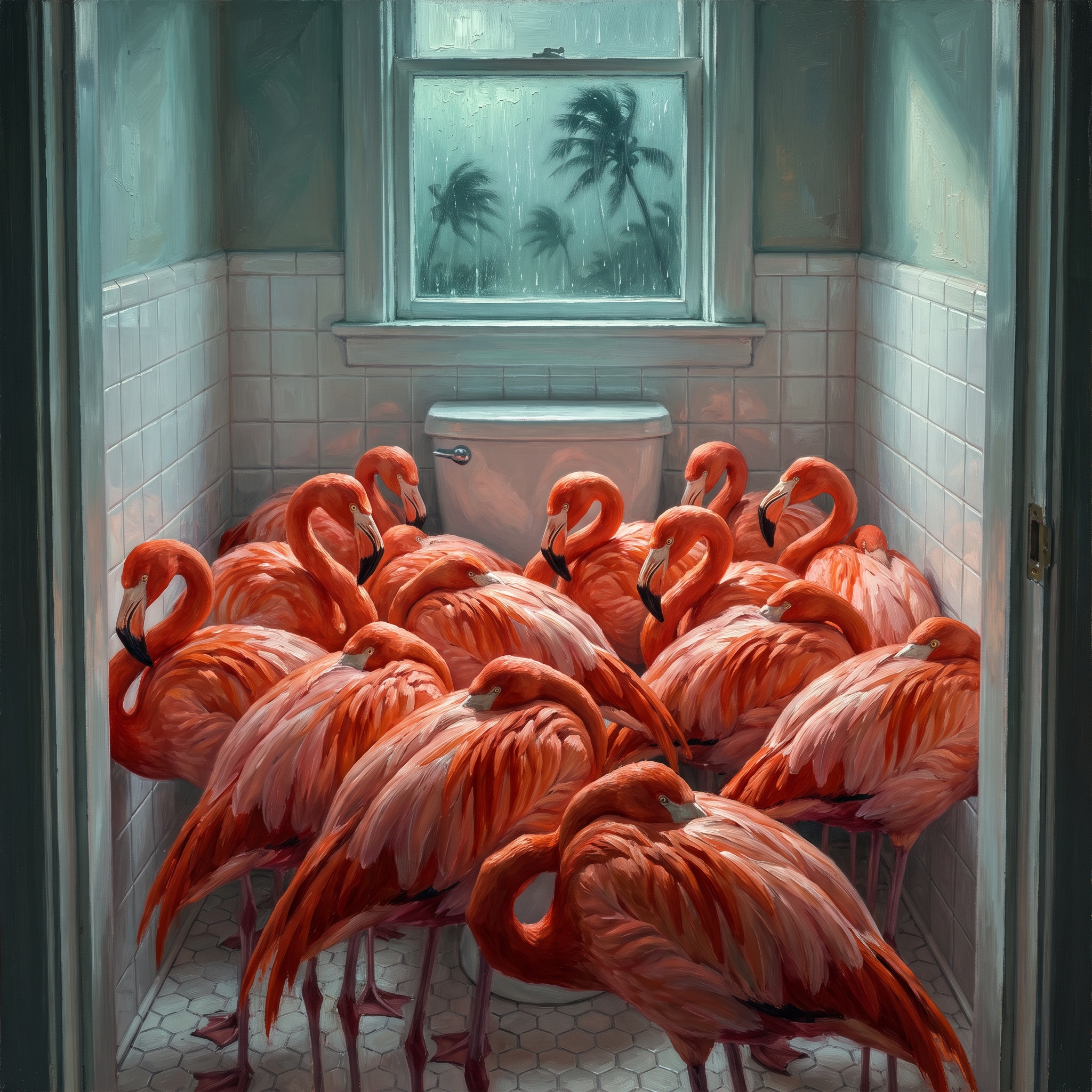
Jordan Hale: Ryan, hey — did your week get weird or was it just mine?
Ryan Castillo: Define weird.
Jordan Hale: I mean — I spent like an hour staring at a photo of flamingos in a public restroom and I still can't decide if it's the most reassuring thing I've seen or if something is deeply off about it.
Ryan Castillo: ZooWorld. Panama City Beach. Hurricane Isaias.
Jordan Hale: You saw it too — okay, good, so it's not just me. The zoo posts this video of their entire flamingo flock packed into a public restroom during Isaias, it goes completely viral, and everyone's reaction is basically... aww. But Isaias killed at least four people in Florida. DeSantis is on camera warning about ongoing flood risk. And we're sharing a photo of pink birds in a bathroom like it's a wholesome moment.
Ryan Castillo: Hold on — what stops me is that this isn't even new. Zoo Miami did the exact same thing during Hurricane Andrew in 1992. Thirty to thirty-eight flamingos, men's bathroom. That's where this playbook comes from.
Jordan Hale: Wait, 1992? So we've just been... repeating this for thirty years and calling it a protocol?
Ryan Castillo: That's exactly the question — is the bathroom the best available option, or is it just the option nobody's ever seriously stress-tested?
Jordan Hale: But stress-tested is the thing — because Ron Magill, when he went back and explained the Andrew decision, he didn't describe it as improvisation at all. He described it like an engineer would. No windows, tile floors, toilets you can clean out for fresh water. That's not a lucky accident. That's someone reverse-engineering why it worked and writing it down.
Ryan Castillo: Right — and that's the move that changes the whole story. Magill isn't saying 'we got lucky in a bathroom in 1992.' He's saying the bathroom has three specific features that make it structurally sound for this.
Jordan Hale: It's like — you know how a good camping trip works? You don't find shelter when the storm rolls in. You scout it before you leave. That's what Zoo Miami built. The bathroom was already the answer before the hurricane existed.
Ryan Castillo: And Zoo Miami formalized that into an actual shelter-in-place protocol. Not evacuation — deliberately on-site, in reinforced structures. That's an institutional choice, not a workaround.
Jordan Hale: Wait — so they've decided evacuation is actually the riskier move?
Ryan Castillo: That's their position, yeah. Transport stress, logistics during a storm — Magill's argument is that a well-prepared facility beats moving exotic animals through a hurricane. Zoo Miami even has a dedicated lightning alarm system baked into those protocols. This isn't one bathroom. It's a whole philosophy.
Jordan Hale: And ZooWorld's framing actually — I mean, this is the part that stuck with me — they said 'lockdown looks different for all of its residents.' Which tells you they're not applying one template. They're thinking species by species. The flamingos get the bathroom because that solution fits flamingos specifically.
Ryan Castillo: Which is the load-bearing point. The question is whether the species-specific logic actually holds when, say, staffing is short at 2 a.m. and the storm accelerates. Because the whole system runs on people being there to execute it.
Jordan Hale: And that's exactly the part I keep getting stuck on — like, who's doing that executing? Because Mike Terrell, the curator of animal experiences at Zoo Miami, he described something that I honestly did not expect. He walks the flamingos around the zoo on clear days. Not during a drill. Not an emergency. Just — a Tuesday afternoon, sunny, the flock does a slow loop past the maintenance building and back.
Ryan Castillo: So the conditioning is continuous. It's not a one-time training event.
Jordan Hale: Right — and the reason it works, Terrell's explanation is, I mean — wait, this is the detail — flamingos may perceive their keepers as really pale flamingos. That's almost verbatim what he said. So when a keeper leads the flock somewhere, the birds aren't resisting a human. They're following a flock member.
Ryan Castillo: Hold on — that changes the entire mechanism. The bathroom isn't the protocol. The Tuesday afternoon walk is the protocol.
Jordan Hale: Yes! Because at 2 a.m. in a Category 4, the keeper who shows up is someone they've followed a hundred times. The route feels like nothing unusual. And flamingos — you know, a flamboyance naturally clusters when a storm comes in anyway. That's just their social instinct. So you're working with the behavior, not against it.
Ryan Castillo: So the load-bearing variable isn't tile floors. It's months of accumulated trust between a specific keeper and a specific flock.
Jordan Hale: Which means — okay, this is the part that makes me a little uneasy actually — if that keeper isn't there? If staffing is short the night Isaias hits? The bathroom is still there. The conditioning isn't.
Ryan Castillo: And we don't have welfare outcome data comparing any of this to animals that just stayed in open habitats. That gap is going to matter when we look at what the viral image is actually doing to our read of all this.
Jordan Hale: Yeah — right, that's the thread I don't want to drop.
Ryan Castillo: That gap — look, that's not a minor methodological complaint. No source in any of the Isaias coverage discloses comparative outcome data. No mortality rates, no injury rates, no stress measures. Nothing that compares shelter-in-place to any alternative. We're running on the 1992 anecdote and the image going viral.
Jordan Hale: Wait — nothing? Like, across thirty years of doing this?
Ryan Castillo: Not that anyone's published. And then there's a sourcing problem that makes it worse. Some sources date the ZooWorld Isaias event to 2026. Others to 2020. Those aren't the same storm, they're not even close. And ZooWorld's actual flamingo count — never stated. The only specific number anybody has is Miami MetroZoo's 30 to 38 from Andrew.
Jordan Hale: So we don't even — I mean, we're citing ZooWorld as proof the system works, and we can't verify the basic facts of when it happened or how many birds were involved?
Ryan Castillo: And the NY Post attributed a separate flamingo-bathroom incident to Hurricane Ian in 2022. Different zoo, different storm. Which means either this tactic is spreading as genuine best practice, or the same story is just getting recycled onto different hurricanes and nobody's checking.
Jordan Hale: That's — okay, that's the one that actually lands hard for me. Because if the anecdote is traveling faster than the verification, you know, what's actually being transmitted across institutions isn't a protocol. It's a story.
Ryan Castillo: That's the mechanism. And meanwhile ZooWorld was closed Friday and Saturday for storm cleanup — two full days. That operational disruption completely disappears behind the viral photo. FPL was reporting 332,000 customers still without power while they'd only restored 43,000. The surrounding infrastructure is failing and the story we're telling is 'flamingos in a bathroom, cute.'
Jordan Hale: The photo does emotional work that the actual numbers can't do. Like, nobody shares a power restoration statistic.
Ryan Castillo: And that's the uncomfortable question the whole beat lands on — are we celebrating a system that works, or are we celebrating a story that feels like one?
Jordan Hale: And I think that's — you know, that's the thing I actually can't settle. Because the care is real. The conditioning is real, Mike Terrell walking that flock on a Tuesday is a real thing that someone thought about and built over time. And the bathroom strategy depends on all of that being in place — the staff presence, the facility holding together, the storm arriving on a schedule that lets humans actually execute. None of those are guaranteed in a Category 4 or 5. None. And I don't know how to hold both of those things at once.
Ryan Castillo: The question that doesn't go away for me is whether creativity can substitute for funding and oversight as storms get worse. ZooWorld closed two days for cleanup. That's a small facility absorbing a hit with no visible regulatory backstop. And the harder questions — what scalable infrastructure looks like, who's accountable when the bathroom strategy fails — those go completely unasked when the image doing the rounds is flamingos looking vaguely confused next to a toilet.
Jordan Hale: Yeah. I mean — I don't have an answer to that. I genuinely don't.