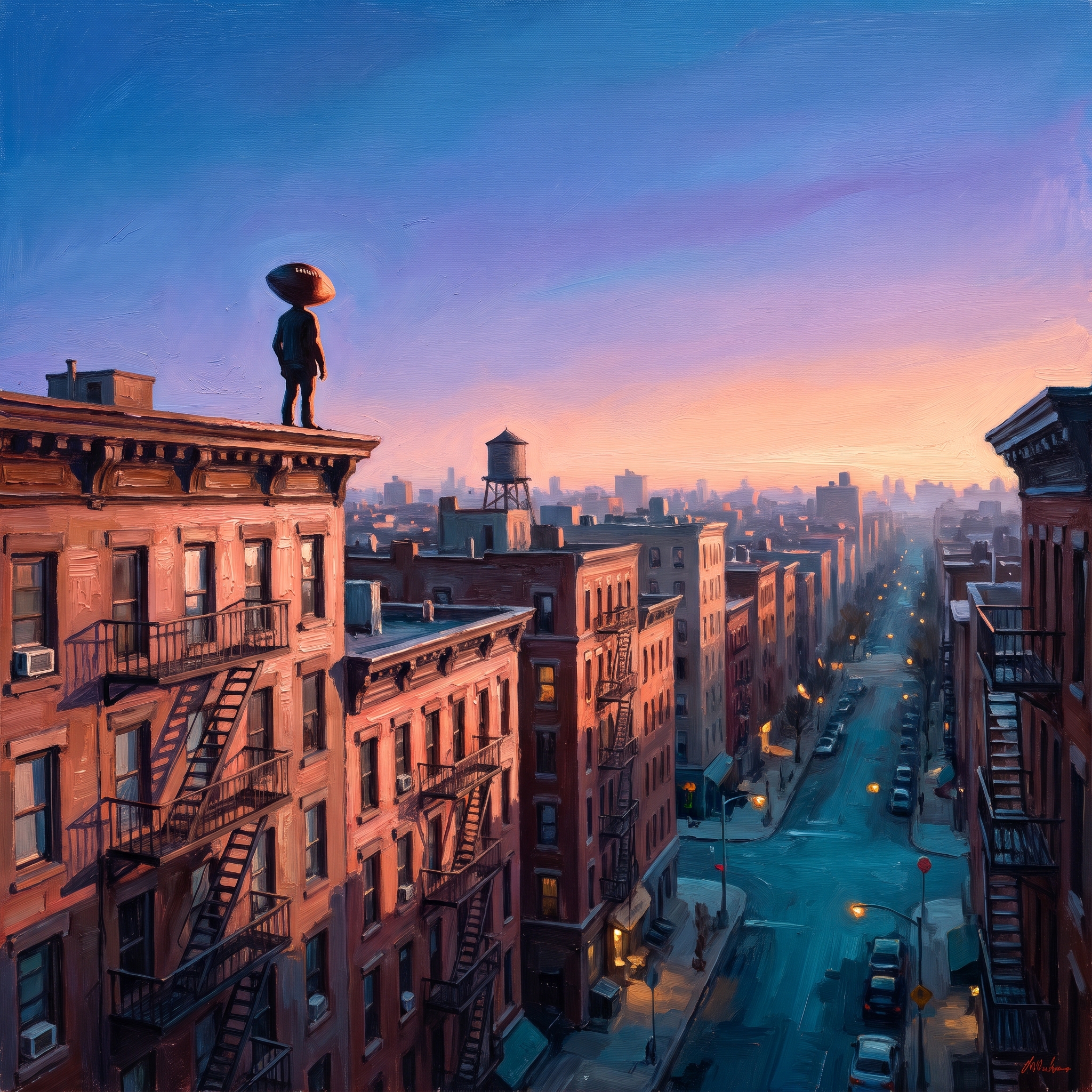
Adam: The question isn't why Hey Arnold! mattered. The question is how it got made at all.
Adam: Nickelodeon — a commercial children's network — greenlit a show about a fourth-grader navigating homelessness, addiction, neglect… parents who just vanished and never explained themselves. And ran it for five seasons without pulling the thread.
Adam: One hundred episodes. Eighty countries. October 7, 1996 to June 8, 2004.
Adam: Craig Bartlett created it. He was already inside the network — story-editing Rugrats, directing episodes of Ren & Stimpy — and in fall 1993 he pitched something that should not have survived a single notes meeting.
Adam: It survived. January 1995, Nickelodeon greenlit Hey Arnold!.
Adam: The protagonist — Arnold — was a kid whose parents were just… absent. Not a flashback. Not a funeral. Gone somewhere out in the world, and the show would not tell you where for fifteen years.
Adam: That's not a story beat. That's a wound the show agreed to carry and never set down.
Adam: Nickelodeon Animation Studio and Snee-Oosh, Inc. — that's Bartlett's production company — built the whole thing together. And what they built, inside the shell of a Saturday morning cartoon, was something closer to documentary realism. The city looked broke. The adults looked tired. The kids looked like they understood more than anyone had asked them to.
Adam: October 7, 2026 is the thirtieth anniversary of that premiere. And I think we've been misreading this show the entire time.
Adam: Here's what the 2002 film tells you about the whole arrangement.
Adam: Hey Arnold!: The Movie came out June 2002. Originally conceived as a TV movie — titled Arnold Saves the Neighborhood — and then Nickelodeon pushed it to theaters. That decision alone should tell you something about where the network's priorities were sitting.
Adam: The film underperformed.
Adam: And after it, Bartlett and Nickelodeon went into dispute over a planned second film — the one that was supposed to resolve Arnold's missing parents. The one the audience had been carrying since 1996.
Adam: He went to Cartoon Network and produced an animated TV movie called Party Wagon. Which is not a footnote. That's the man who built Hey Arnold! — the creator, the entire vision — making something for a competitor because the network that owned his show wouldn't let him finish it.
Adam: And the story just… sat there.
Adam: Season 5 had aired 'The Journal' — a two-part episode, still in 2002, that expanded everything about Arnold's parents. Miles and Stella. Where they went. Why. It set up a cliffhanger that the show had no structural ability to close, because the man who knew how to close it was no longer inside the building.
Adam: June 8, 2004 — the show ends. Officially. With the wound open.
Adam: Think about what you're asking a child to hold. A story about a boy whose parents vanished — and then the story itself vanishes. No resolution. Just absence, all the way down.
Adam: Fourteen years pass.
Adam: 2016 — Nickelodeon announces Hey Arnold!: The Jungle Movie. Bartlett returning as writer and executive producer. Original cast back. The network frames it as part of their 25th anniversary of original creator-driven animation, which is — look, you can read that however you want.
Adam: November 24, 2017. The Jungle Movie premieres. Simulcast on Nicktoons and TeenNick. Two hours. Arnold's parents found. The mystery closed.
Adam: It earned a 100% on Rotten Tomatoes. It won the 2018 Emmy Award for Outstanding Individual Achievement in Animation.
Adam: But there's one question I can't shake — and I don't have a clean answer for it. Is closure fifteen years late the same thing as closure? The kids who watched 'The Journal' air in 2002 were adults by 2017. Some of them had children of their own. The wound healed, but it healed on a scar.
Adam: Nickelodeon created the conditions for Hey Arnold! to exist. And then, when it mattered most — when the creator needed the network to hold the story the same way the story asked its audience to — they couldn't do it.
Adam: The creative freedom was real. It was also conditional. And that condition is the whole story.
Adam: October 7, 2026. Thirty years to the day.
Adam: Darryn King published a retrospective in the Los Angeles Times on that exact date. Not a nostalgia piece — an examination. The kind of writing that asks whether the thing it's covering was genius or accident, and refuses to let the question go unanswered.
Adam: And here's the question King's piece puts in the room: was Hey Arnold! a one-time institutional accident? A specific window at Nickelodeon, a specific creator who knew how to push against the grain without getting cut — and nothing else like it has come from that network since, because that window closed.
Adam: That's worth sitting with.
Adam: And then there's Jim Lang. The composer. His jazz and blues score — the thing that made that city feel like it had weather, like the streets had memory — is now being performed live. Tour announced for Texas and other venues as part of the anniversary. Which is — look, that's not nothing. That's an audience telling you what they kept.
Adam: They didn't keep the network. They kept the music.
Adam: Hey Arnold! ran in 80 countries. Its neighborhood — immigrant-inflected, broke around the edges, populated by people who were clearly from somewhere else and had not forgotten it — resonated in places far removed from any American ZIP code. That's not a licensing win. That's a document. The show was recording something true about late-1990s urban American life and people outside the country recognized it before most critics here did.
Adam: So what does it mean that the score tours while Nickelodeon has largely moved on? Craig Bartlett built the whole architecture — the city, the wound, the resolution — and the institution that housed it couldn't hold it without a fifteen-year gap and a public reckoning. The music survives. Lang's work survives. The story survived, eventually. But the conditions that produced it — those are gone. And I don't think they're coming back.
Adam: That's the anniversary. Not a celebration. A reckoning with what it took — and whether anyone has the architecture to do it again.
Adam: Craig Bartlett fought for every inch of real life that made it into that show. The parents who weren't there. The city that looked like it had actually been rained on. He fought for it inside a network that, when the moment came — when it needed to hold the story the same way the story held its audience — couldn't do it. Wouldn't. The distinction matters and I'm not sure which one it was.
Adam: The show is thirty years old. Nickelodeon has moved on. Jim Lang's score is touring. Bartlett's architecture — the city, the wound, the resolution he had to leave and come back a decade and a half later to close — that's what people kept. Not the institution. The thing the institution almost didn't let him finish.
Adam: Hey Arnold! outlasted Nickelodeon's willingness to make it. That is not a triumph.