Dr. Nathan Hayes: Before we get going — you looked at the AISB Network numbers, right? What was your first read?
Sarah Lin: Um, honestly my first read was that 20,167 is a very specific number for something that's supposedly impossible to share.
Dr. Nathan Hayes: That specificity is doing a lot of work, yes.
Sarah Lin: So — okay, what we're actually getting into today is this consortium. Five pharma companies, coordinated by the AISB Network, who jointly fine-tuned OpenFold3 on those 20,167 proprietary protein-ligand structures using federated learning — meaning none of that data left anyone's servers — and the model they produced outperformed everything public. Boltz-2 sits around 41% on high-quality interface predictions. This one hit 52.1%.
Dr. Nathan Hayes: Right. And the AlQuraishi Lab at Columbia was a scientific collaborator on OpenFold3 itself, so the model's lineage is academic, open-source. What the consortium added was the private data layer — and the Apheris infrastructure to run it without that data ever pooling in one place.
Sarah Lin: And now the trained weights are private. Only the benchmark numbers came out. Which means — and I want to sit with this for a second — they answered the question 'does sharing help' with a very clear yes, and then the answer stays inside those five companies.
Dr. Nathan Hayes: What I'd name precisely: this is closed optimization of an open-source model using private data. That's a defensible scientific choice. It is not, however, the same thing as open science — and the language used around it sometimes blurs that distinction.
Sarah Lin: So the driving question for us is — if the model stays private and the data stays private, what did we actually learn? Like, what can anyone outside those five companies do with this?
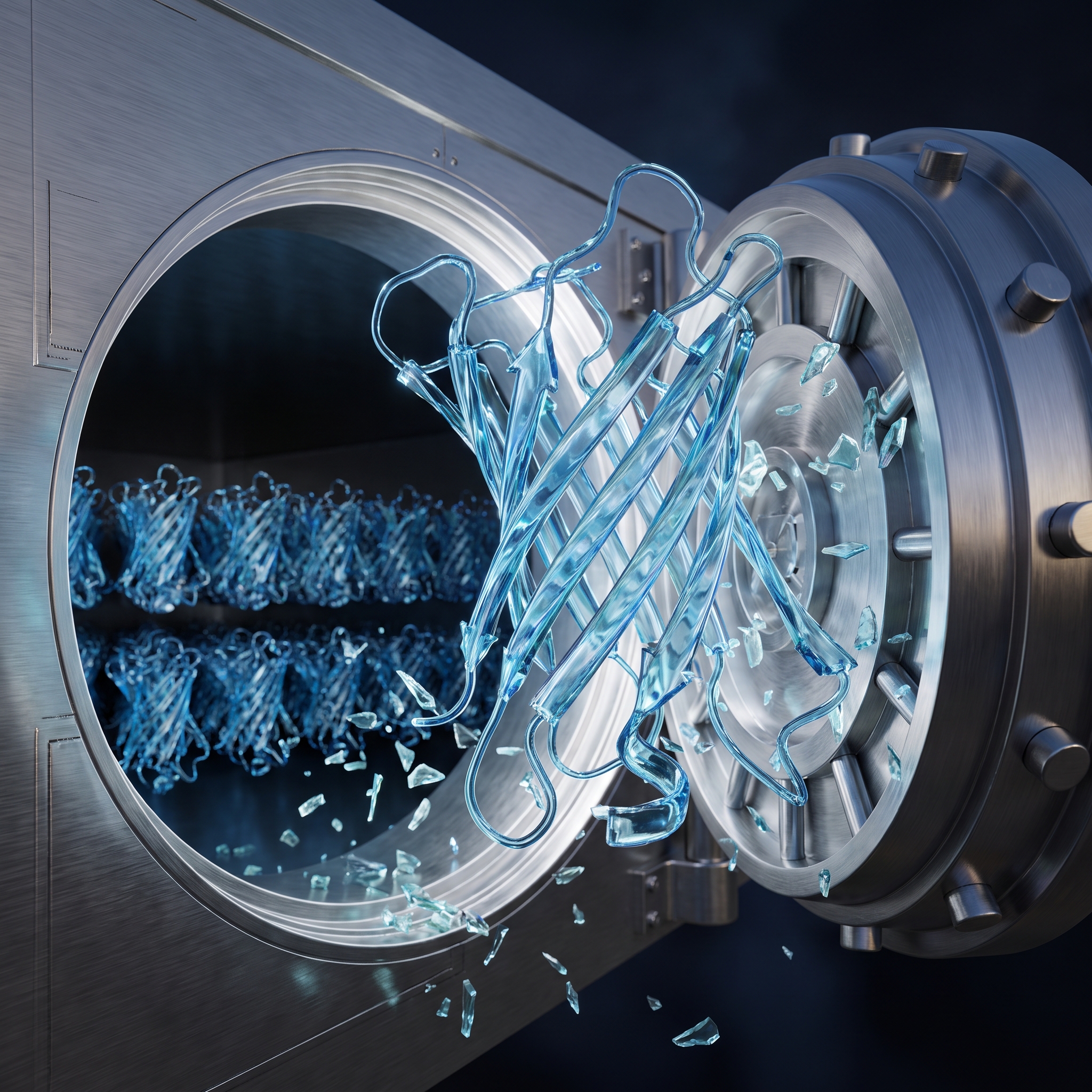
Dr. Nathan Hayes: What anyone outside can do is — actually, that question cuts right to why the data ceiling matters in the first place. Think of the Protein Data Bank like a public library. Every structure in there, a researcher donated. The problem is that the most drug-relevant blueprints — the ones showing exactly how a small molecule locks into a disease target — those were never donated. They stayed in the vault because they're the whole point of a drug program.
Sarah Lin: Wait — so the public archive we've been treating as the foundation of this whole field is actually... incomplete in a really specific way?
Dr. Nathan Hayes: Structurally incomplete, yes. Standard OpenFold3, trained only on Protein Data Bank data, hit 35.6% on high-quality interface predictions. That number is the ceiling the public library builds. The consortium's 20,167 proprietary structures — from AbbVie, Bristol Myers Squibb, Takeda, Johnson and Johnson, Astex — that dataset roughly tripled the drug-relevant protein-ligand data available for training. The model jumped to 52.1%. The library was always missing its most important shelf.
Sarah Lin: That's — the image of a library with a locked back room is doing something to me. Um. How big is the locked room?
Dr. Nathan Hayes: Now, this is where I have to hedge honestly — no one outside those companies knows. Nature reported, when they covered the AISB Network collaboration in September, that private pharmaceutical vaults may rival or even exceed the entire Protein Data Bank in scale. May. That's an estimate, not a confirmed figure. We are making decisions about AI infrastructure around a dataset we cannot see and cannot count.
Sarah Lin: Oh wow. That reversal — the public archive might actually be the smaller one.
Dr. Nathan Hayes: Right — and what makes that concrete: imagine a structural biologist who spent, I don't know, three years crystallizing a protein complex for a rare cancer target. That structure sits in a company database. She knows — because the AISB Network just proved it — that releasing it would almost certainly improve a model that could help design better drugs. The AlQuraishi Lab at Columbia, who built OpenFold3, collaborated on this specifically because even leading academic labs hit the wall without that industry data. So the ceiling isn't theoretical. It showed up in the benchmark.
Sarah Lin: And she can't share it. Legally, structurally — it's not hers to give.
Dr. Nathan Hayes: That's the collision. The ligand pose prediction number tells you the cost of that constraint — 28.9% correct under standard OpenFold3, 46.8% with the private data folded in. That gap is what lives in the locked room.
Sarah Lin: That gap — 28.9 to 46.8 — is what someone is missing right now, today. Like, not in the abstract.
Dr. Nathan Hayes: Exactly that. Picture a computational biologist at a small San Diego biotech — rare genetic disorder target, maybe a hundred patients worldwide. She opens Boltz-2, the best tool available to her. And Boltz-2 sits at roughly 41% on high-quality interface predictions. The consortium model is at 52.1%. That's not — I mean, eleven percentage points sounds like a rounding error until you remember she might be wrong about which binding pose to synthesize. Wrong synthesis costs months.
Sarah Lin: And she can't access the better model at all.
Dr. Nathan Hayes: Correct. The weights stayed private. Now — the federated architecture Apheris built, running on NVIDIA DGX Cloud, it genuinely solved the privacy problem. Gradient updates crossed company environments, not raw structures. That's technically real. But here's where I have to be careful: it did not solve the access problem. Those are different problems.
Sarah Lin: So the data never moved, but the knowledge did — isn't that exactly the point?
Dr. Nathan Hayes: The knowledge moved to the model, yes. But the model moved to — no one. Actually, that's not quite right either. It moved to five companies who already had the data. So federated learning let them collaborate without trusting each other. It did not let them share anything with the field. The benchmark numbers we have — 52.1%, 46.8% — those came from a held-out test set of 1,056 structures from that same proprietary distribution. No independent researcher can run those numbers again. The claim is unauditable.
Sarah Lin: Hold on. Unauditable how — like, we just have to trust the reported figure?
Dr. Nathan Hayes: We trust the consortium's own validation set against their own benchmark. That's what Nature published in September. And that's — I'm not saying the result is fabricated, the AlQuraishi Lab at Columbia is rigorous — but there's a meaningful difference between a self-reported benchmark and an independently reproducible one. We don't know how this model generalizes to novel targets outside that distribution.
Sarah Lin: And the part that comes later — what it means that five competitors built something none of them could build alone, and then kept it — that's the hard part to sit with.
Dr. Nathan Hayes: And that's the part that doesn't resolve cleanly — because 'cooperation' is the right word for what they did, technically. But five direct competitors building something none of them could build alone, then locking it to those five? That's not a shared advance. That's a shared moat.
Sarah Lin: A shared moat. That — yeah, that lands differently than 'collaboration.'
Dr. Nathan Hayes: Now, Nature called it a scientific milestone in September — and the AlQuraishi Lab's involvement gives it real credibility. But a milestone that's not reproducible outside the consortium isn't actually a milestone for the field. It's a milestone for those five balance sheets.
Sarah Lin: So the 'open' in OpenFold3 — that's the floor now, not the ceiling.
Dr. Nathan Hayes: Exactly. The base architecture is open. What delivers drug-discovery-relevant performance — the fine-tuned weights trained on 20,167 proprietary structures — that stays private. 'Open' describes what AbbVie and Johnson and Johnson started with, not what they ended with.
Sarah Lin: And this isn't — um, I don't think this is unique to pharma anymore. Evvy just raised 40 million dollars to build a proprietary vaginal microbiome dataset because the existing AI models are fundamentally flawed — their framing — from missing female biology data. Same structure: a gap in the public record, private money moving in to fill it, and the fill stays private.
Dr. Nathan Hayes: Right — and that's an important data point, not a tangent. It suggests the dynamic isn't a pharma-specific decision. It's what rational actors do when the public record is structurally incomplete and the gap has commercial value.
Sarah Lin: Which means — wait, is federated learning actually solving anything here? Or is it just making the secrecy feel more principled?
Dr. Nathan Hayes: It solved a real coordination problem — Apheris genuinely prevented any single company from seeing a rival's structures. That's not theater. But the access problem for everyone outside? Federated learning doesn't touch that. It was never designed to. So yes — privacy-preserving and secrecy-preserving are doing very different things here, and the language is blurring them.
Sarah Lin: That 20,167 number — I keep thinking about how specific it felt at the start. And now it feels different. Like, that specificity was the proof. They could count it because it was theirs.
Dr. Nathan Hayes: And the count staying private is — yeah. The AISB Network answered 'does sharing help' definitively. Then declined to let anyone else ask the question. I don't know if that gap, 52.1 versus the ~41% Boltz-2 ceiling, compounds over time or whether public data efforts eventually close it. Honestly? No one knows.
Sarah Lin: Mm. That's — um, that's an honest place to not have an answer.