David Sterling: You saw this before I did, didn't you.
Megan Skiendel: Midnight. The Next Web drops a code analysis and I'm texting you like it's 2019 earnings season.
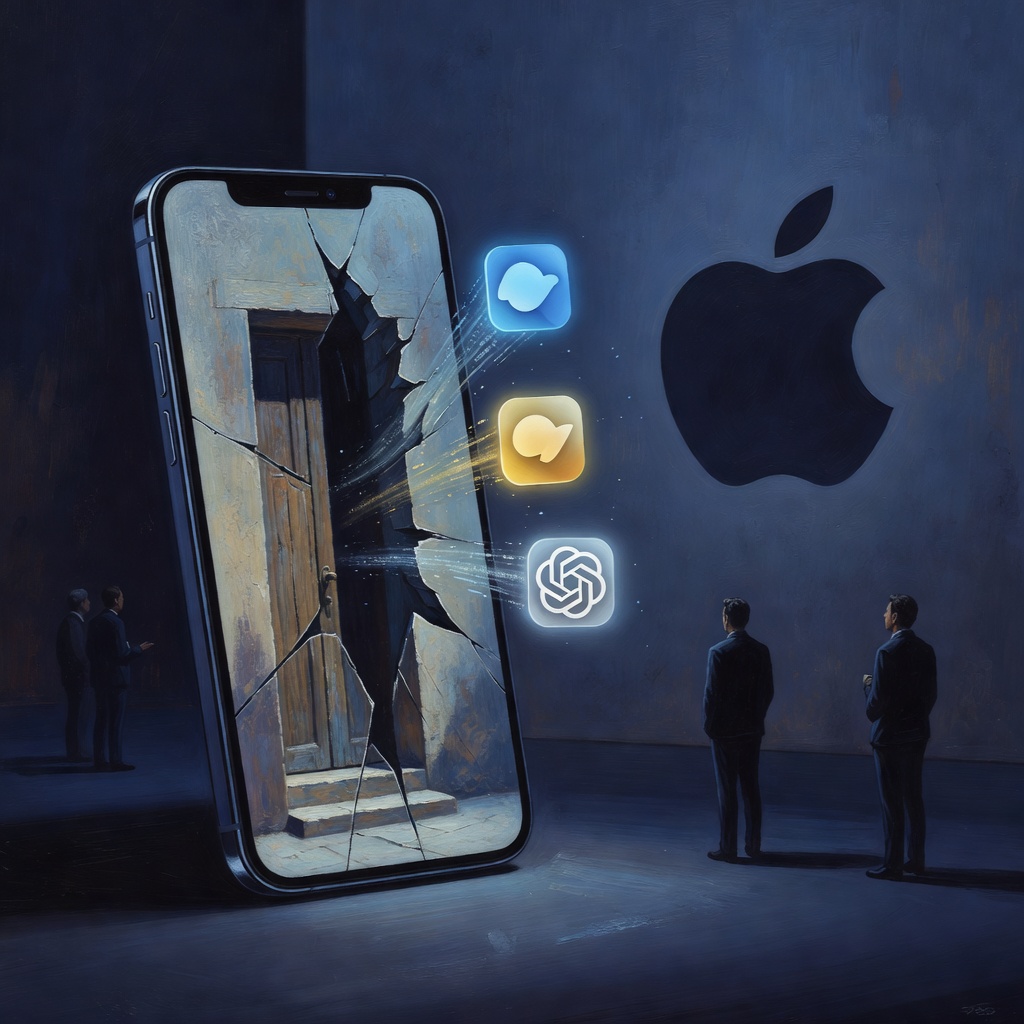
David Sterling: Right. So — Apple ships iOS 27 developer beta 1. Same day as the WWDC 2026 keynote, June 8th. And buried in the beta code is a fully functional Extensions framework. 'Default AI Service' selector in Settings. Swap out Siri's engine — ChatGPT, Google Gemini, Anthropic Claude. Works across Writing Tools, Image Playground, system search. The whole stack. And Tim Cook said — exactly nothing about it on stage.
Megan Skiendel: Not a footnote. Not a slide.
David Sterling: Disabled on the backend, though. Meaning — wait, this is the part that matters — the code is finished. Apple didn't ship a prototype. They shipped a completed feature and then flipped a switch off on their servers. Mark Gurman had the internal entitlement discussions with OpenAI, Anthropic, Google — but no announced timeline. And meanwhile Apple tells EU users: Siri AI isn't coming to your iPhone at iOS 27 launch. Cites the Digital Markets Act.
Megan Skiendel: The EU disputed that, though. Publicly. They said nothing in the DMA actually blocks the launch. So Apple's citing a regulatory wall that the regulators say doesn't exist.
Megan Skiendel: And that's the inversion that nobody's naming loudly enough. The Digital Markets Act was designed — like, explicitly designed — to mandate interoperability. Extensions is interoperability. Apple is using the law built to force this feature as the reason to block it.
David Sterling: Wait — so what's the actual new signal here? Because Extensions existing isn't the news. The EU contradiction isn't even fully new. What's the thing that changes the structure?
Megan Skiendel: OpenAI. The lawsuit threat. Because — actually, no, walk through what that means for a second — ChatGPT is in the Extensions framework. ChatGPT benefits from 1.5 billion Apple devices with no separate download required. So why is OpenAI threatening legal action over a rollout that hands them distribution they couldn't buy?
David Sterling: Preferred-provider status.
Megan Skiendel: Exactly. The objection isn't to being included. It's to Claude and Gemini and Grok being included alongside them. OpenAI had exclusive preferred-provider status in the ChatGPT-Siri deal. Extensions ends that. They go from the default third-party option to one setting in a dropdown.
David Sterling: That's — mm. That's the load-bearing fact. The Mac EU carve-out also names it — Apple drew a device line that has nothing to do with DMA scope. That's not regulatory caution. That's negotiating posture.
Megan Skiendel: The circulating take I want to kill is 'Apple is being cautious because of genuine regulatory risk.' That's the one. Because the EU already said — publicly, on record — nothing in the Digital Markets Act prevents the launch. So the regulatory wall is imaginary. Apple's legal team knows this.
David Sterling: What if the Gemini deal has contractual floors that survive user switching? Most defaults are sticky — maybe eighty percent of users never open Settings.
Megan Skiendel: Browser choice screens. EU mandated them, market share moved overnight. A visible 'Default AI Service' toggle carries exactly the same psychology — the moment it's surfaced, the Gemini billion-dollar-a-year commitment starts looking like a commodity input, not a strategic asset.
David Sterling: That's — yeah. That analogy actually holds.
Megan Skiendel: And the Private Cloud Compute piece — wait, this collapses the whole privacy argument — every rebuilt Siri query is already routed to Apple's servers regardless of which model answers it. So the 'Extensions is risky because queries leave the device' story doesn't — I mean, they already leave the device. That argument was never real.
David Sterling: Finished feature. Switched off remotely. That's not how you handle genuine legal uncertainty — that's a loaded position. September's the date. Either Extensions ships with iOS 27 and the new hardware, or it becomes the leverage in whatever Apple's negotiating right now.
David Sterling: The question that actually keeps it open — if Extensions ships in the US in September alongside the new hardware, and EU iPhone and iPad users still can't get Siri AI, Apple will have used the Digital Markets Act — the law written to mandate exactly this kind of interoperability — as the justification for withholding it. That's not compliance. That's inversion. And I don't know what the EU does with that.
Megan Skiendel: No, and — I mean, what are their options at that point? Fine Apple for not launching in Europe what Europe's law was supposed to force them to launch?
David Sterling: The other half of it: does Extensions ship at all in September. Because the OpenAI situation — nobody knows if that resolves before the iPhone launch window.
Megan Skiendel: Nobody knows. That's — yeah. That's exactly where we are.