Ben Okonkwo: Hey — I have to ask, did you get very far into your research before you hit something that just didn't feel possible?
Eleanor Crane: About thirty seconds in, actually. Johnny Carson — the Johnny Carson — made a sitcom for Fox in 1987 where he played the President of the United States. And I genuinely could not find it.
Ben Okonkwo: You couldn't find it because — what, it wasn't documented, or because it doesn't exist anywhere anymore?
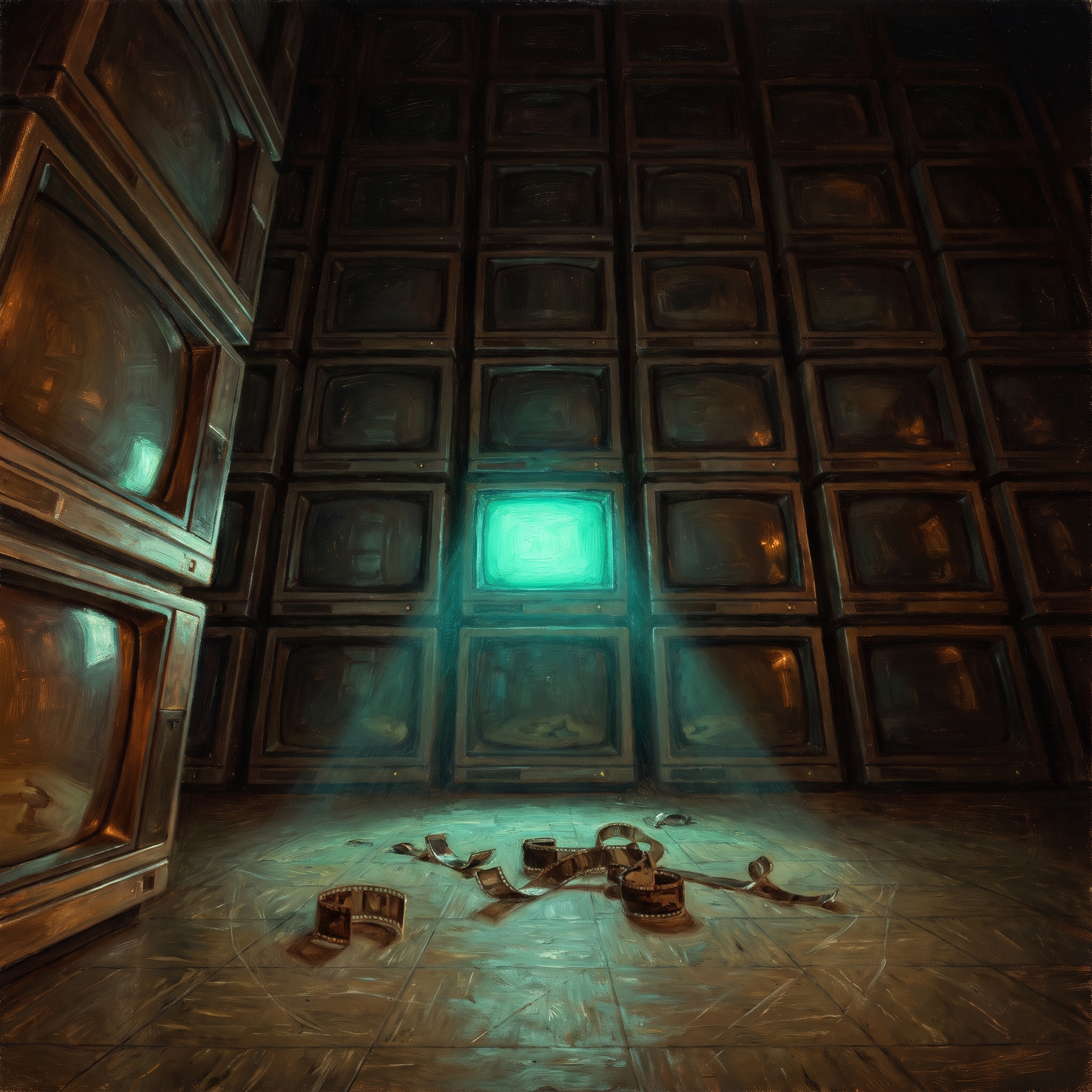
Eleanor Crane: Both, maybe. And that's the whole thing. *Mr. President*, *Something Wilder* — Gene Wilder's NBC sitcom, pulled after four episodes in 1994, three episodes left completely unaired — Jennifer Grey's *It's Like, You Know...*, twenty-six episodes across two seasons on ABC and still seven that never broadcast. Ke Huy Quan as a child in *Together We Stand* on CBS. These shows aired. People made them. Careers were staked on them. And now they live in this strange in-between — not lost, not available. Near-lost is what researchers call it.
Ben Okonkwo: Near-lost — meaning the tapes, what, exist somewhere in a building?
Eleanor Crane: Possibly. That's what makes it different from a fire. This isn't the BBC wiping Doctor Who reels in the 1960s to save on tape costs — that was genuine destruction. This is something quieter. The industry just... chose not to keep these shows in circulation. No one argued they were worth preserving.
Ben Okonkwo: And the question is whether that was negligence or just market logic doing what market logic does.
Eleanor Crane: That's it. That's the whole thing we're trying to pull apart.
Ben Okonkwo: Market logic, right — but the part that doesn't fit is that market logic implies someone ran the numbers. What I want to trace is exactly that: the mechanism. Because syndication is the whole thing. A show only gets preserved — like, someone actually maintains the rights, stores the tapes, keeps the licensing paperwork current — if there's a buyer at the other end. A station in Tulsa, a cable package, something. If that buyer doesn't exist, nobody's assigned to the job of keeping it alive.
Eleanor Crane: But couldn't someone have just held onto the tapes anyway?
Ben Okonkwo: That's — okay, picture a rights manager at NBC in, say, late 1994. Something Wilder has just been pulled after four episodes. Gene Wilder, whom the audience apparently did not buy as a suburban dad. The show gets relaunched, limps along, gets cancelled with three episodes still sitting on a shelf unaired. Now someone has to decide: do we maintain the licensing structure for this? Storage isn't free. Rights paperwork isn't free. And there is no syndication projection that makes this math work. So the answer is no. Not malice — just a ten-second decision.
Eleanor Crane: And Together We Stand is — I mean, September 22, 1986 to April 24, 1987. Seven months. You can't even build a syndication package out of that.
Ben Okonkwo: Exactly the problem. Syndication math traditionally needed around a hundred episodes minimum. Together We Stand ran one season and stopped. That's not a catalog. That's — actually, it's nothing a buyer can schedule.
Eleanor Crane: So Ke Huy Quan's entire performance in that show just... has no commercial reason to exist anywhere.
Ben Okonkwo: None. And It's Like, You Know... is the case that should trouble us most, honestly — because it ran 26 episodes across two seasons on ABC, March 1999 through January 2000. That's a real run. Jennifer Grey, real cast, DreamWorks Television behind it. And still seven episodes never broadcast. Which means the abandonment decision happened before the thing was even complete.
Eleanor Crane: Seven unaired out of twenty-six — that's not a show that failed quietly. Someone actively stopped it mid-inventory.
Ben Okonkwo: And here's what the late-90s broadcast economics tell us: ownership structure and syndication math could outweigh Nielsen numbers entirely. A show could perform adequately and still get cut because the cost-effectiveness of maintaining it just didn't clear the bar. Ratings were one input. They weren't the only input. That's what makes this systemic — it's not that these shows were bad. It's that the infrastructure was never built to preserve things the market had already moved past.
Eleanor Crane: But that systemic framing only holds if we can actually document the system working that way — and that's where I have to introduce the uncomfortable part. Two of the five shows we're discussing, Mr. President and Aliens in the Family, I mean — we can't fully verify them through current sources. We know Carson had this Fox sitcom in 1987. We cannot confirm the details with archival confidence.
Ben Okonkwo: Wait — we can't verify them, or they can't be found?
Eleanor Crane: That's the paradox. The inaccessibility that makes these shows forgotten is the same thing that makes them difficult to document. The thesis that they were abandoned is hardest to prove for the titles most thoroughly abandoned.
Ben Okonkwo: So the disappearance is its own evidence, but also its own problem.
Eleanor Crane: Right — and I think we have to be honest that those two sit in a different evidentiary category than the others. Because Peter Mehlman — a Seinfeld writer — created It's Like, You Know..., DreamWorks Television co-produced it, it ran on ABC. There's a paper trail. We can say something. With Mr. President we're working from background knowledge, not confirmed records. Carson is the most recognizable figure in American television and still, the show is — actually, no, that's not quite the right way to put it. It's not that the show is gone. It's that we can't reconstruct what happened to it well enough to make a strong claim.
Ben Okonkwo: Interesting. That distinction matters — because imagine a television researcher on a Tuesday night, trying to write a single confirmed sentence about Mr. President for a documentary. She can find Carson's name attached to it. She cannot find episode counts, airdate runs, anything auditable. So she either cuts it or she guesses. And if she guesses, and it's wrong, that wrong information enters the record.
Eleanor Crane: And then the wrong information is what survives.
Ben Okonkwo: Which is its own kind of archival failure — worse, maybe, than silence.
Eleanor Crane: And the Ke Huy Quan piece — the recovery question, what it would actually take, the Sherwood Schwartz connection — genuinely stranger territory, and we're going to get there.
Ben Okonkwo: And that's what makes the Sherwood Schwartz angle so strange to me — because Together We Stand wasn't even a fresh idea. Schwartz went back to a single Brady Bunch episode, 'Kelly's Kids,' January 4, 1974, a backdoor pilot about multiracial adoption, and built an entire series premise out of it. Ke Huy Quan, Elliott Gould, Dee Wallace — real cast, real CBS airtime — but the concept was already twelve years old before it aired.
Eleanor Crane: Living in another show's shadow from the first frame.
Ben Okonkwo: Exactly. And then it vanishes. And when Ke Huy Quan comes back after Everything Everywhere All at Once, people want to trace his career back — and they hit a wall. The show is unwatchable. The cultural memory that does survive is partial, distorted. He can name it. He can't show anyone.
Eleanor Crane: Which is where the Doctor Who comparison becomes actually instructive rather than just flattering. In 2013, archivists found eleven missing episodes — not by searching a vault, by tracking overseas shipment records. Luck and detective work, not policy.
Ben Okonkwo: But Doctor Who had — I mean, it had decades of people who refused to let it stay missing. A constituency. Together We Stand has no equivalent.
Eleanor Crane: And that gap is — actually, it's the whole mechanism, isn't it? Recovery doesn't happen because an institution decides to care. It happens because specific individuals won't stop. And for a show that ran seven months in 1986 and left no fandom behind it, who is that person?
Ben Okonkwo: Unaired episodes make it worse. Because the content may exist — on tape, in a studio vault somewhere — but that requires the same commercial logic that killed it to reverse itself. A researcher can't crowdfund their way into a network vault.
Eleanor Crane: No. And the industry built no system to prevent this. The preservation question was never asked because the answer was always assumed to be: the market will decide.
Ben Okonkwo: Which left Ke Huy Quan's early career — and frankly, the multiracial adoption premise Schwartz spent twelve years trying to get made — contingent on whether some archivist gets lucky with a shipping manifest.
Eleanor Crane: And the streaming era looks like it solved that — I mean, everything available, searchable, the long tail finally justified. Except the algorithm that decides what gets delisted is running the same calculation the network executive made in 1994. Someone at a platform looks at the numbers and decides this title isn't earning its storage cost. We've just — we've automated the indifference.
Ben Okonkwo: Outsourced the forgetting, yeah — and at a scale no single network could match.
Eleanor Crane: The next time you scroll past a title you don't recognize and keep moving — that's it. That's the gesture. A ten-second decision, repeated at scale, and the thing just quietly stops existing.