Cole Brennan: Malcolm, good to be back — I've got something for you, and I want your gut reaction before we get into any of it.
Malcolm Reeves: Go ahead.
Cole Brennan: In February 2006, Bob Iger traded Al Michaels — Hall of Fame sportscaster, the voice of the Miracle on Ice — to NBCUniversal. In exchange for a cartoon rabbit.
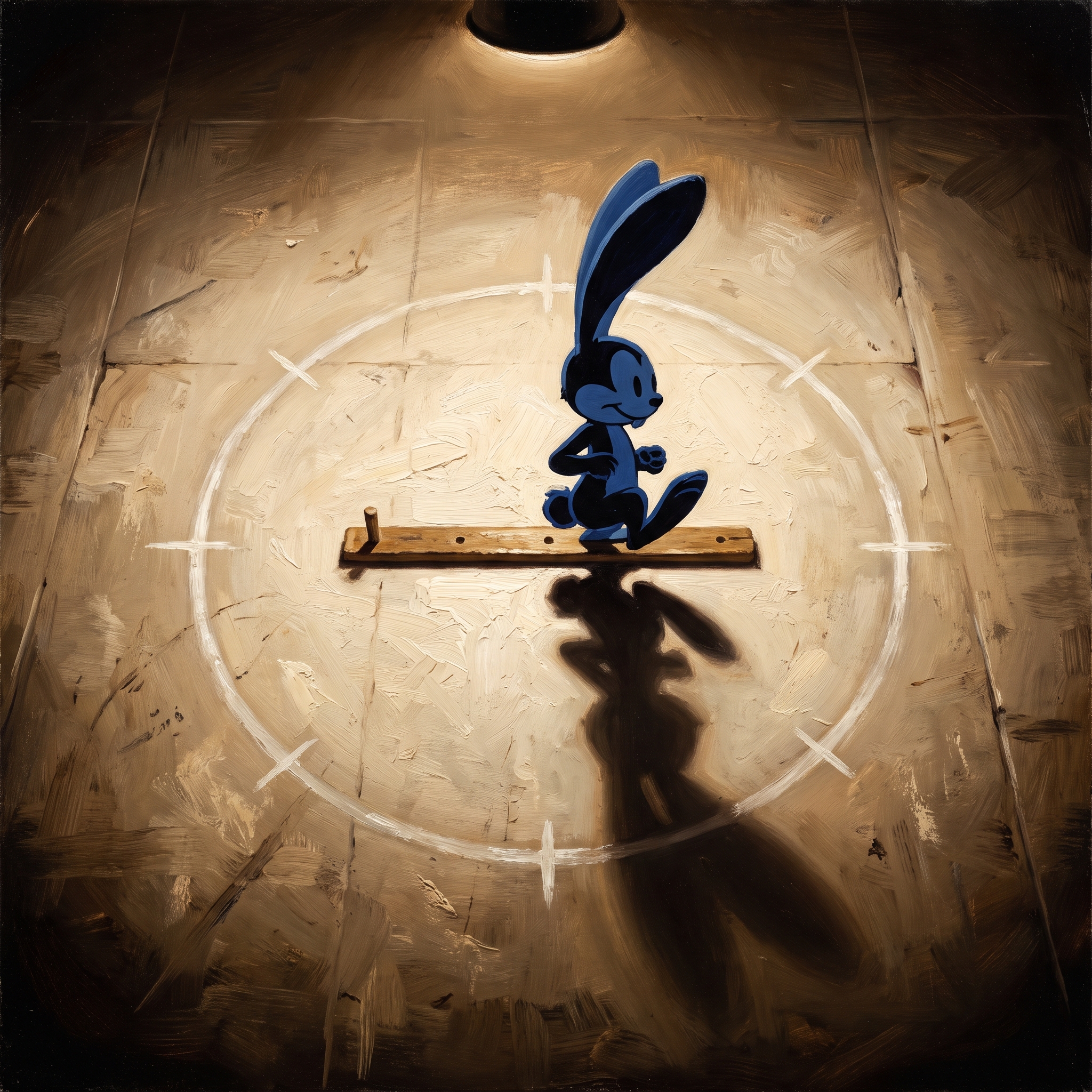
Malcolm Reeves: And not just any rabbit. Oswald the Lucky Rabbit. The character Walt Disney and Ub Iwerks created in 1927 — before Mickey existed.
Cole Brennan: Before Mickey. And Disney hadn't owned him for — I mean, seventy-eight years. Seventy-eight. And now it's August 2026, D23 in Anaheim, and they're announcing a three-part Disney+ miniseries. Jon Favreau writing, directing, executive producing. Steve Martin, Kathryn Hahn, Amy Sedaris. Premiering February 2027.
Malcolm Reeves: Which is, you see, almost exactly one hundred years after Oswald debuted — September 5, 1927, 'Trolley Troubles.' Universal Pictures.
Cole Brennan: Right — but that's the thing I keep getting stuck on. Iger makes this trade in 2006. Disney has Oswald back. And then... twenty years go by. So what changed? Why does this rabbit suddenly justify Steve Martin and a three-part prestige streaming drop?
Malcolm Reeves: That is the question. Because the trade tells you Disney believed in the value — you don't swap a broadcaster for something you plan to shelve. And yet here we are.
Cole Brennan: And yet they basically did shelve him — I mean, Epic Mickey in 2010, 'Get a Horse!' in 2013, and then nothing. Nothing prestige, anyway. Sixteen years of having him back and they just... let him sit there.
Malcolm Reeves: Now here's what I think people miss. Oswald isn't valuable because audiences love him. He's valuable because of what losing him forced Walt to do. You lose a character in a contract dispute with Charles Mintz in spring 1928, you get on a train home from New York, and — out of that loss — you invent Mickey Mouse. The wound is the origin of the entire empire.
Cole Brennan: Wait — so the story they're actually selling isn't Oswald. It's the moment Disney became Disney.
Malcolm Reeves: Exactly that. Think of it this way — imagine you built a company from one product, lost it in a bad contract, invented something bigger to replace it, and a century later got the original back. You're not making a show about the product. You're settling a debt with the story of who you were before you became who you are.
Cole Brennan: That's — yeah. That actually reframes why Jon Favreau makes sense here. He's not the Oswald guy. He's the guy Disney trusts with format-defining, legacy-defining work — Mandalorian, Jungle Book. You bring him in when the thing you're making is actually about something bigger than the surface IP.
Malcolm Reeves: Ub Iwerks co-created Oswald alongside Walt — this was a Universal property from the jump, September 5, 1927. So Disney's claim on Oswald is not clean. It's emotional, not quite legal in origin. NBCUniversal held those rights for seventy-eight years. The reacquisition in 2006 didn't restore something Disney lost — it purchased a mythology they'd never fully owned.
Cole Brennan: Huh. So when Iger trades Al Michaels for the rabbit — I mean, some people would say that trade looks nostalgic. But you're saying it's almost... correcting the historical record?
Malcolm Reeves: Reclaiming the founding wound, yes. And now February 2027 — one hundred years after 'Trolley Troubles' — they finally have the story they want to tell. The question is whether the centennial is genuinely the creative trigger, or just the marketing hook that made the greenlight feel inevitable inside the studio.
Cole Brennan: Right — because the sixteen-year gap after Epic Mickey kind of argues for the second one. If the story was always this compelling, why wait until the clock ran out?
Malcolm Reeves: The gap actually answers itself when you look at what Favreau's doing with the format. Because the format is the argument. He's not just picking a visual style — he's making a case. A 1920s-era Oswald literally walks into a live-action kitchen with middle-school kids. The hybrid isn't decoration. That collision is the whole thesis.
Cole Brennan: Wait — so the visual dissonance is intentional? Like you're supposed to notice it looks different?
Malcolm Reeves: That's exactly it. Picture a kid watching Disney+ on a Saturday morning, 2027. Oswald moves — hand-drawn lines, 2D, against a real kitchen counter. She's going to ask her parent why it looks old. And that question is Favreau's entire point made legible to an eight-year-old.
Cole Brennan: Huh. That's — I mean, that's not just production design then. That's storytelling through format.
Malcolm Reeves: And Favreau has done this before — The Jungle Book in 2016, he used photorealism to argue that animation could carry genuine emotional weight. The Lion King in 2019, same move, different register. The Mandalorian built a whole franchise around a format statement. He doesn't make small bets on aesthetics.
Cole Brennan: No, for real. And he's got the same creative authority here — writer, director, executive producer. Same structure as all three of those projects. But here's what gets me — Sergio Pablos. He's involved in this production. Hand-drawn technique, reassembled veteran 2D Disney animators. That's not a staffing choice. That's Disney saying something institutional.
Malcolm Reeves: It's an admission, actually. You don't call back veteran 2D animators unless you've acknowledged, somewhere internally, that their absence was a mistake. D23 — the social media reaction wasn't about Oswald. It was about hand-drawn animation coming back. That's what dominated.
Cole Brennan: Which means Favreau's essentially been handed a mission that has nothing to do with a cartoon rabbit and everything to do with a decade of Disney format decisions that audiences apparently resented.
Malcolm Reeves: And that's before we've even touched the cast — which is, you know, a whole separate question about what it tells you that Steve Martin, Kathryn Hahn, Amy Sedaris, Albert Brooks, and Al Madrigal are the scaffolding here. Because that ensemble doesn't say 'we trust the character.' It says something else entirely, and we should get into that.
Cole Brennan: Steve Martin, Kathryn Hahn, Amy Sedaris, Albert Brooks, Al Madrigal — that is not a kids' cast. That's not even a family cast in the normal sense. That's a prestige adult comedy lineup. Which means... I mean, who exactly is this for?
Malcolm Reeves: It's for people who have never thought about Oswald once in their lives.
Cole Brennan: Right — because Oswald has no iconic shorts. No theme park ride. Nothing that Mickey has built up over a century.
Malcolm Reeves: None. And that's not a small problem. You can't greenlight a three-part streaming series on character recognition that doesn't exist. So the cast isn't — it's not decoration. It's the actual green-light mechanism. Steve Martin's name gets you the click that Oswald cannot.
Cole Brennan: Wait — so the talent is doing credibility work the character literally cannot do on its own.
Malcolm Reeves: And here's what makes that complicated — Universal kept producing Oswald shorts into the late 1930s and early 1940s after Disney lost him. So the character had a life. Just not one Disney owned, not one that ever built cultural mass. Seventy-eight years of dormancy doesn't leave an audience. It leaves a gap where an audience should be.
Cole Brennan: Does attaching Steve Martin validate Oswald, or does it quietly admit he wasn't enough? Because those are actually two very different things.
Malcolm Reeves: Both, I think. And Disney knows it. The cast says the character needs scaffolding — but the scaffolding is good enough that nobody's going to fault them for it.
Cole Brennan: And that's the part I genuinely can't settle. Because if February 2027 comes and this thing lands — if people love it — I don't know how you figure out what actually worked. Was it Oswald? The centennial hook, the origin mythology, the fact that this is the character that made Walt invent Mickey? Or was it Favreau's format, Steve Martin's face, Kathryn Hahn's comedic timing? Like — those are not the same answer, and I don't know how you separate them.
Malcolm Reeves: No. You can't. And that's the honest weight of it. Iger made that trade in 2006 — swapped Al Michaels, believing Oswald had future value. Twenty years later, they're finally finding out if he was right. But even if it works, the thing it proves might not be what Iger bet on.
Cole Brennan: Yeah. That's — I mean, that's kind of a strange place to land. A bet that took twenty years to cash, and even then you might not know what won.