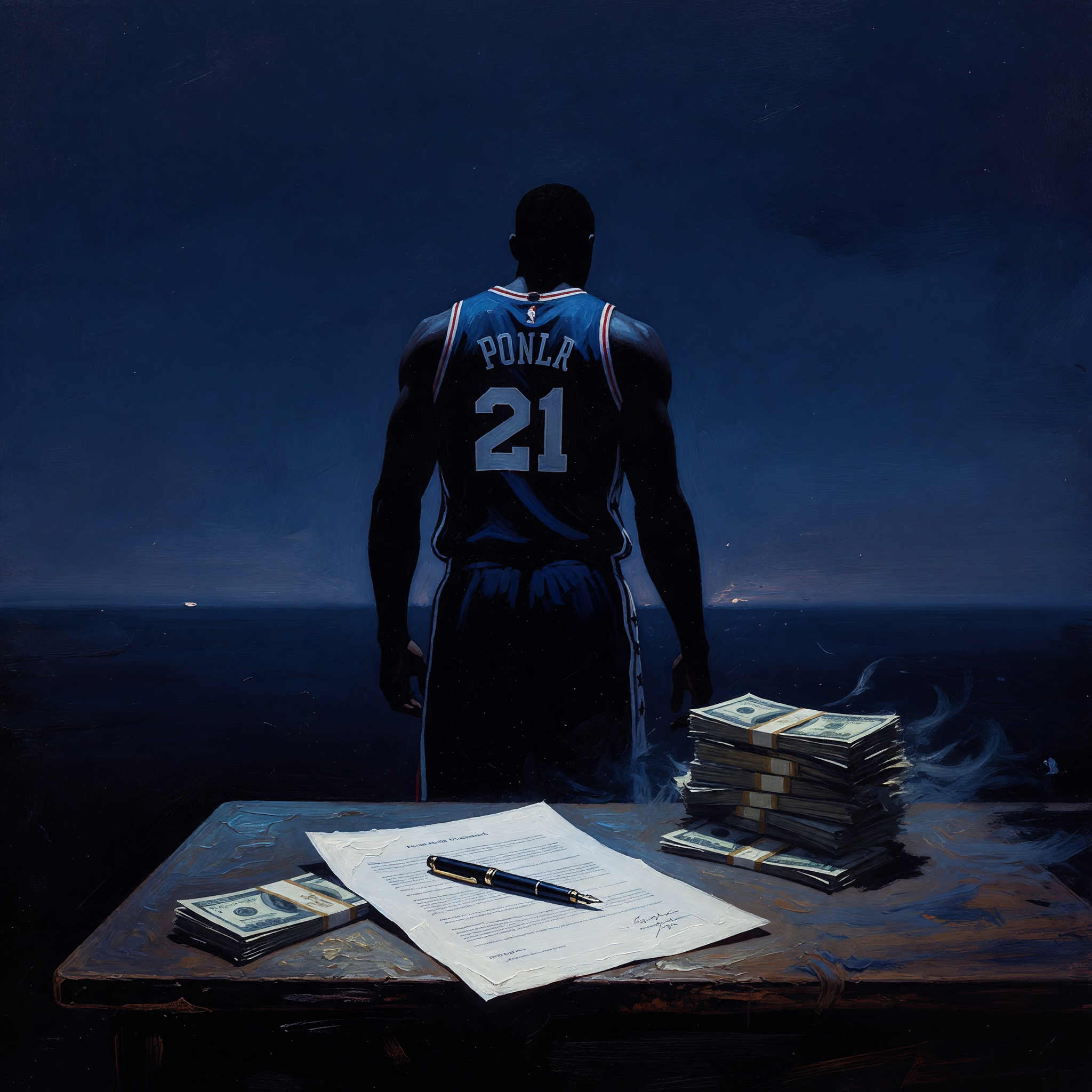
Miles Ashworth: I have a theory about Rich Paul that I think explains this entire story, and I want to see if you'll shoot it down immediately or give me a moment.
Megan Skiendel: Given the week we've had — go, quickly.
Miles Ashworth: The four-word text is the tell. 'LeBron is coming to Philadelphia.' Rich Paul — LeBron's agent, longtime friend — sends four words to the Philadelphia 76ers front office in the early hours of July twenty-fourth. Now, you don't send four words when you've spent weeks in nuanced negotiation. You send four words when the thing was decided fast and you know it will land. That text is a closing statement, not a conversation.
Megan Skiendel: Wait — early hours of the twenty-fourth? So this is a middle-of-the-night text.
Miles Ashworth: Per Dave McMenamin's account, yes. And here's what makes it stranger still — Philadelphia wasn't even on LeBron's radar until the Jaylen Brown trade happened on July first. Brown leaves the Celtics, arrives in Philadelphia, Paul George goes to Boston along with two first-round picks and two seconds, and suddenly — within three weeks — LeBron James is a 76er on a two-year, eight million dollar deal. The veteran minimum. At forty-one.
Megan Skiendel: The minimum. I keep forgetting that part — his last rookie contract with Cleveland is the last time his salary was anywhere near this low.
Miles Ashworth: Which everyone's treating as sacrifice. My reading is rather different, but — the point is, he bypassed twenty-seven other teams, Cleveland included, Miami included. He called this his 'last decision' in free agency. And the backstory, if you follow it, suggests the Lakers were quite ready to move on. So: deliberate genius, or reactive mathematics dressed up in legacy language?
Megan Skiendel: Honestly, those aren't mutually exclusive — but the Lakers being 'ready to move on' is the part that hasn't gotten enough air. That's not a footnote, that's the first domino.
Miles Ashworth: That's the part nobody wants to say plainly, isn't it. The Lakers signal they're moving on — which Rich Paul apparently read clearly enough — and suddenly LeBron isn't choosing Philadelphia. He's being redirected toward it.
Megan Skiendel: Okay, here's the analogy that actually made this click for me. Imagine you're job-hunting. You have a shortlist — a few companies you want. Then one of them suddenly hires your dream colleague, overnight. That company just became the obvious move. That's the Jaylen Brown trade. Daryl Morey didn't recruit LeBron — he built something LeBron couldn't ignore.
Miles Ashworth: Which means — wait, actually that reframes the whole thing — Philadelphia chose itself. LeBron just confirmed the math.
Megan Skiendel: Exactly — and Rich Paul said it directly. The conversations before and after the Brown trade couldn't have been further apart in tone. That's not a subtle shift. That's a before-and-after. Before: Philadelphia's not in the room. After: it's the only room.
Miles Ashworth: Good lord — he said that out loud?
Megan Skiendel: Per Dave McMenamin's account, yes. And that single quote is the whole story. The narrative being sold now is LeBron's championship vision. The actual mechanism was Daryl Morey sending Paul George to Boston and turning a play-in team into something a four-time champion would text a four-word decision about at three in the morning.
Miles Ashworth: So the new thing — the genuinely new thing — isn't that LeBron chose Philadelphia. It's that Cleveland, Miami, everyone else lost out not because LeBron evaluated them and said no. They lost because Morey moved faster than any of them.
Megan Skiendel: That's it. LeBron didn't drive this decision — he ratified it. Morey built the gravity, and LeBron fell into the orbit. That's what gets buried under the legacy framing.
Miles Ashworth: But gravity only explains so much — because the part nobody's calling noble sacrifice is actually the most revealing bit. Two years, eight million. Lowest annual salary since his Cleveland rookie deal. And everyone's treating that as proof of pure championship logic. Except — wait, actually — Shams Charania reported a fifteen percent trade kicker in that contract. And a second-year player option. Which means LeBron took minimum money and then immediately preserved every exit.
Megan Skiendel: A trade kicker on a minimum deal. That's — yeah, that's not sacrifice. That's architecture.
Miles Ashworth: Precisely. You don't negotiate a fifteen percent kicker if you're all-in on the mission. You negotiate it because you want to be compensated if they move you, or because you want leverage you can use later. That's a man keeping his options priced correctly while publicly performing the no-options gesture.
Megan Skiendel: Look, I'd push back slightly — the championship motivation and the financial architecture aren't mutually exclusive. He can want to win *and* want a safety net.
Miles Ashworth: Fine — but then the championship logic has to carry the full weight of justification on its own. Because Cleveland's gone. Miami's gone. Heat fans were publicly disappointed. He bypassed two franchises with deep sentimental history and went to a city primarily because it became convenient after the Brown trade. You can't use sentiment to explain anything here. It's all championship, supposedly. And that's where — frankly — the reported documentary deal becomes a rather sharp edge.
Megan Skiendel: The 'Last Dance' deal. Reportedly in progress around the same time as the signing.
Miles Ashworth: Think of it like a showrunner deciding where to film a prestige limited series. The basketball decision and the content decision — they're the same decision. Philadelphia gives you Embiid, Brown, a dramatic comeback story, New York proximity, rumoured helicopter commute. That's not a bonus on top of the championship logic. That IS the logic.
Megan Skiendel: Evan Cohen at ESPN said LeBron 'signed up to run with the wrong guy' — meaning Embiid. Which, honestly, is the piece this whole construction hasn't stress-tested. And that's the part that comes later, because Embiid's actual injury history is the variable that breaks or saves everything LeBron just built.
Miles Ashworth: Right — but for now, the take circulating is noble sacrifice and pure championship vision. The actual document says: minimum salary, second-year option, trade kicker, documentary deal, New York proximity. That's not a man betting everything on the mission. That's a man designing the mission so every contingency is covered.
Megan Skiendel: And that contingency-covered architecture collapses the second Embiid's knee goes — because the 495 games. Four hundred and ninety-five career games missed due to injury. He has never made a conference final. Not once.
Miles Ashworth: Never made a conference final.
Megan Skiendel: Never. And LeBron is 41, entering his twenty-fourth season, on a two-year deal. There's no third year to recover into. So picture Game 3, Eastern Conference semifinals, April 2026 — Embiid rolls his knee in the first quarter, doesn't come back. LeBron is 42 years old, carrying a roster that was built — I mean, every Daryl Morey decision was load-bearing around Embiid being healthy. Brown is there because of Embiid. LeBron is there because of Embiid. The whole thing is Embiid.
Miles Ashworth: And Morey — brilliant as he is at roster construction — cannot trade for a functioning knee. No move fixes that.
Megan Skiendel: Bob Myers said it — the former Warriors GM, in the ESPN coaches and executives piece — the risk of adding a superstar to an existing team is that you've now bet the whole timeline on everyone staying upright. And that was his framing before anyone even mentioned Embiid's specific history.
Miles Ashworth: Which means what's actually being sold as arguably the most talented roster LeBron has ever played with — and it probably is, Embiid, Brown, LeBron together — is simultaneously the most fragile. The talent ceiling and the injury floor are the same player.
Megan Skiendel: That's the variable. Not the October box scores. Not the Christmas game. It's whether Embiid plays sixty regular season games and arrives at the playoffs with actual legs under him.
Miles Ashworth: And if he doesn't — if year one becomes LeBron at forty-two carrying a broken superteam — this stops being a legacy capstone. It becomes the first time he genuinely miscalculated the late-career move. Quietly. With no sequel.
Megan Skiendel: And that's the thing I can't resolve — if the 76ers win a championship, none of this conversation exists. The reactive opportunism, the four-word text, the safety-net contract architecture — it all gets buried under the trophy. Retroactively, it becomes patient genius.
Miles Ashworth: Quite. And the inverse is just as clean. Embiid's knee goes in April, and suddenly every piece of this — the minimum salary, the documentary deal, bypassing Cleveland and Miami — gets reread as a desperate ring-chase that LeBron dressed up as deliberation. The same process, two completely different verdicts. Hostage to one player's cartilage.
Megan Skiendel: So which does the evidence actually predict?
Miles Ashworth: Well. Four hundred and ninety-five games.
Megan Skiendel: Four hundred and ninety-five games.