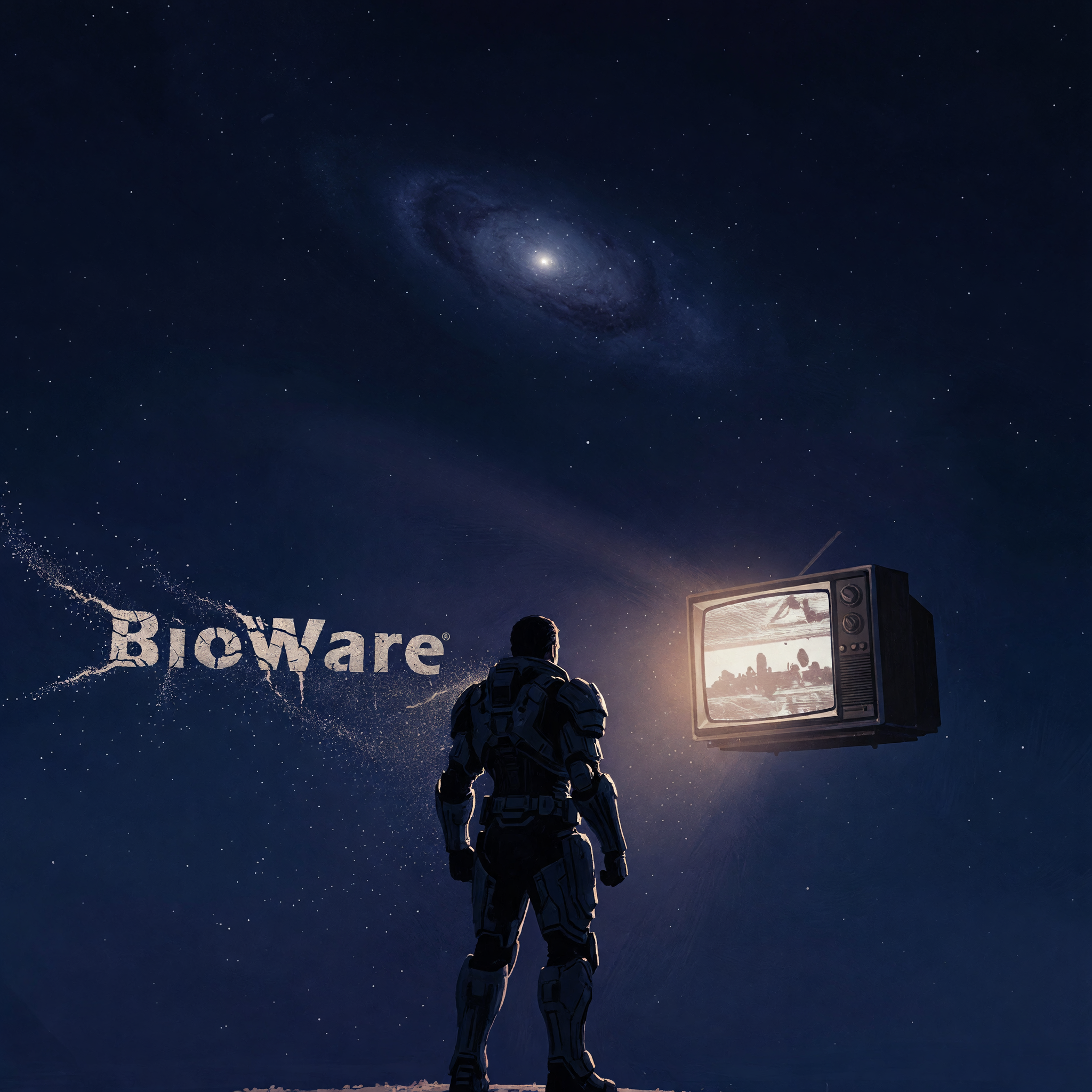
Jonathan Ingles: Tell me you saw the EA blog post.
Cole Bryant: Dude, 'Building EA's Next Chapter' — which, no, that title is doing a lot of work for an announcement where they close BioWare and cancel Mass Effect 4 in the same breath.
Jonathan Ingles: Roughly fifty people at BioWare specifically, part of a company-wide cut of about three percent of EA's workforce. October 2026.
Cole Bryant: And look, CNET described BioWare's closure as a symbolic and substantial blow to the industry — not just, like, another studio shutting down. This is the Dragon Age people. The KOTOR people. Mass Effect. That's — I mean, that's a legacy, right?
Jonathan Ingles: And yet. The Mass Effect TV show — Amazon MGM Studios, Prime Video — keeps moving. IGN confirmed it. Sources inside Prime Video say it is unaffected by BioWare's closure.
Cole Bryant: Stop — how does that work? The creative engine behind the franchise is gone. The next game is cancelled. Jason Schreier confirmed there's a real trailer for Mass Effect 4 that leads nowhere. And the show just... keeps going?
Jonathan Ingles: That's the whole question. The thing built on top of the franchise has outlived the franchise itself. Polygon and Gizmodo both ran it — the show is the last active Mass Effect project. The last one.
Cole Bryant: Which means — wait, actually that's what breaks my brain — normally an adaptation exists because the games are healthy. This one exists instead.
Jonathan Ingles: Right — but that's where 'active development' does the heavy lifting. Think of it this way: imagine you hear a restaurant is still open, but nobody can tell you the hours, what's on the menu, or whether there's food in the kitchen. That's what every report is actually saying about this show. IGN ran the story citing sources inside Prime Video — Doug Jung, Daniel Casey, Mike Gamble, Karim Zreik, Ari Arad, Jessica Jones — all still attached. That's the full personnel list. No filming dates. No scripts confirmed. No premiere window.
Cole Bryant: Wait — so the sourcing is people inside the thing being reported on?
Jonathan Ingles: Exactly. A source inside Prime Video has every reason to say it's fine. The alternative is admitting they don't know if it's worth finishing.
Cole Bryant: No but — what actually breaks it for me is Jason Schreier confirmed the leaked Mass Effect 4 trailer was real. A finished artifact. For the dead game. And for the living show we have — what, a personnel list from a friendly source?
Jonathan Ingles: That's the contradiction nobody's naming. The cancelled game has a confirmed deliverable. The active show has a press statement.
Cole Bryant: Dude. That's — that's genuinely backwards.
Jonathan Ingles: The adaptation has been in development at Amazon MGM Studios since 2024. That's two years before and after BioWare's closure, and the only concrete thing that's moved is the body count on the game side. 'Active development' is not a milestone — it's a category. It means legally the project exists. It doesn't mean Mike Gamble is on a set somewhere.
Cole Bryant: So it could be a writers' room, it could be one assistant and a Google Doc — and the headline reads identical either way.
Jonathan Ingles: Polygon and Gizmodo both ran the same framing — 'last remaining Mass Effect project' — and neither one defines what production stage it's actually in. The phrase is doing enormous rhetorical work, and nobody's asking what's behind it.
Cole Bryant: But okay — that personnel list problem actually gets worse when you layer in the Shepard thing. The show won't center Commander Shepard. Like, at all. Picture someone who played Mass Effect 3 for 80 hours, made every choice, agonized over the ending — and they see a Prime Video thumbnail in late 2026 and it's — I mean, it's the Mass Effect logo, but it's randos. New characters. None of the Normandy crew.
Jonathan Ingles: The question is whether that person clicks anyway.
Cole Bryant: No — wait, that's not even my question. My question is: when Mass Effect 4 was still alive, that decision was defensible. Two new things launching in the same window, you're building a new era together. The show does new characters, the game does new characters — fine, parallel tracks. Now the game is gone. The show lands alone. No reinforcement. Nothing to point at.
Jonathan Ingles: They're framing the Shepard absence as creative freedom. Frankly, it reads more like a licensing tell.
Cole Bryant: Wait — licensing? Like Amazon couldn't get the character?
Jonathan Ingles: EA holds the IP. BioWare's closure didn't transfer anything. So either Amazon's deal never included Shepard specifically, or — and this matters — BioWare's closure made those character assets legally complicated enough that nobody wants to touch them mid-negotiation. One of those is a business story. Nobody's saying which.
Cole Bryant: Dude. So the one hook that converts game fans into viewers — Commander Shepard, the actual reason people have franchise identity — is just absent. BioWare first teased Mass Effect 4 on N7 Day in 2020. Six years of 'something's coming.' Now nothing's coming. And the show doesn't have the one character who could have bridged that gap.
Jonathan Ingles: That's exposure, not freedom. And the IP-sale question makes it worse — we'll get to it, but Polygon's framing of how Mass Effect games could ever return involves conditions that make the whole situation considerably more unstable than 'the show is fine' implies.
Cole Bryant: No but — I don't buy 'creative freedom' as the real reason for a second. Freedom from your franchise's most beloved character, with zero companion media backing you up, isn't freedom. That's just exposure with a better press release.
Jonathan Ingles: And that exposure is permanent unless EA decides to move the IP. Which is the whole problem. EA holds Mass Effect with no active internal development pipeline — zero. BioWare's closure didn't hand the keys to anyone. Polygon is explicit about this: the only path to new Mass Effect games is EA choosing to sell, and another company willing to buy. That's it. That's the entire map.
Cole Bryant: Wait — so EA owns the thing and is actively doing nothing with it?
Jonathan Ingles: Correct. And the cruel part — the post-COVID contraction that made BioWare's closure financially rational for EA is the exact same condition making any acquisition risky for a buyer. Studios are shrinking, not expanding. The industry that would've grabbed this IP in 2021 doesn't exist at the same scale in 2027.
Cole Bryant: So the conditions that killed the franchise are also the conditions that make rescuing it hardest. That's — I mean, that's genuinely brutal.
Jonathan Ingles: Picture a licensing executive at some mid-size publisher, late 2027, opening a term sheet for the Mass Effect IP. The ask is real money for a franchise whose last game was cancelled, whose originating studio no longer exists, and whose only active project is a streaming adaptation nobody can confirm has a filming date. What's the comp? What do you point at to justify the price EA wants?
Cole Bryant: The show. The show is the only comp.
Jonathan Ingles: Which is why Gizmodo's line lands so hard. They wrote — and I'm quoting — this could be the final entry in the Mass Effect canon. That sentence was written about a streaming adaptation. Not a game. A streaming adaptation with no premiere window and a personnel list sourced from inside the project being reported on.
Cole Bryant: No but — wait, think about what that means for Doug Jung and Daniel Casey. They sat down to write a TV show set in a living franchise. Now they're — I don't know, they might be writing the last Mass Effect anything. That's a different job than the one they were hired to do.
Jonathan Ingles: The IP value persisting independently of the game franchise — that's the exception everyone's marveling at. But an exception carrying the weight of an entire canon is just a franchise in its final transmedia form. Nobody planned for the show to be the thing. It became the thing by default.
Cole Bryant: And that's — I mean, that's where we started, right? EA drops 'Building EA's Next Chapter' and the chapter is: no studio, no game, just a show nobody can confirm has a filming date. The franchise that let you decide the fate of the galaxy is now waiting for EA to decide whether to sell it.
Jonathan Ingles: The Mass Effect TV series is the sole active Mass Effect project in existence. Amazon MGM Studios is the only entity actually moving anything forward. EA holds the IP with no development pipeline behind it. That's not a franchise. That's a dormant asset with a streaming attachment.
Cole Bryant: Which is — I don't know, it's genuinely sad? Like, the honest version of where we landed is: nobody knows if 'active development' at Amazon MGM leads to a show, and nobody knows if the show leads to anything else. That's the whole map.
Jonathan Ingles: Quiet ending for something this big.
Cole Bryant: Yeah. Appreciate you working through it.