Iris Holm: Cyrus, hey — before we start, quick question: do you think a scientific consensus can be wrong for fifteen years if the contradicting data is public the entire time?
Cyrus Reed: I mean — yeah? I'd say yes, definitely yes, but now I'm nervous about where you're going with this.
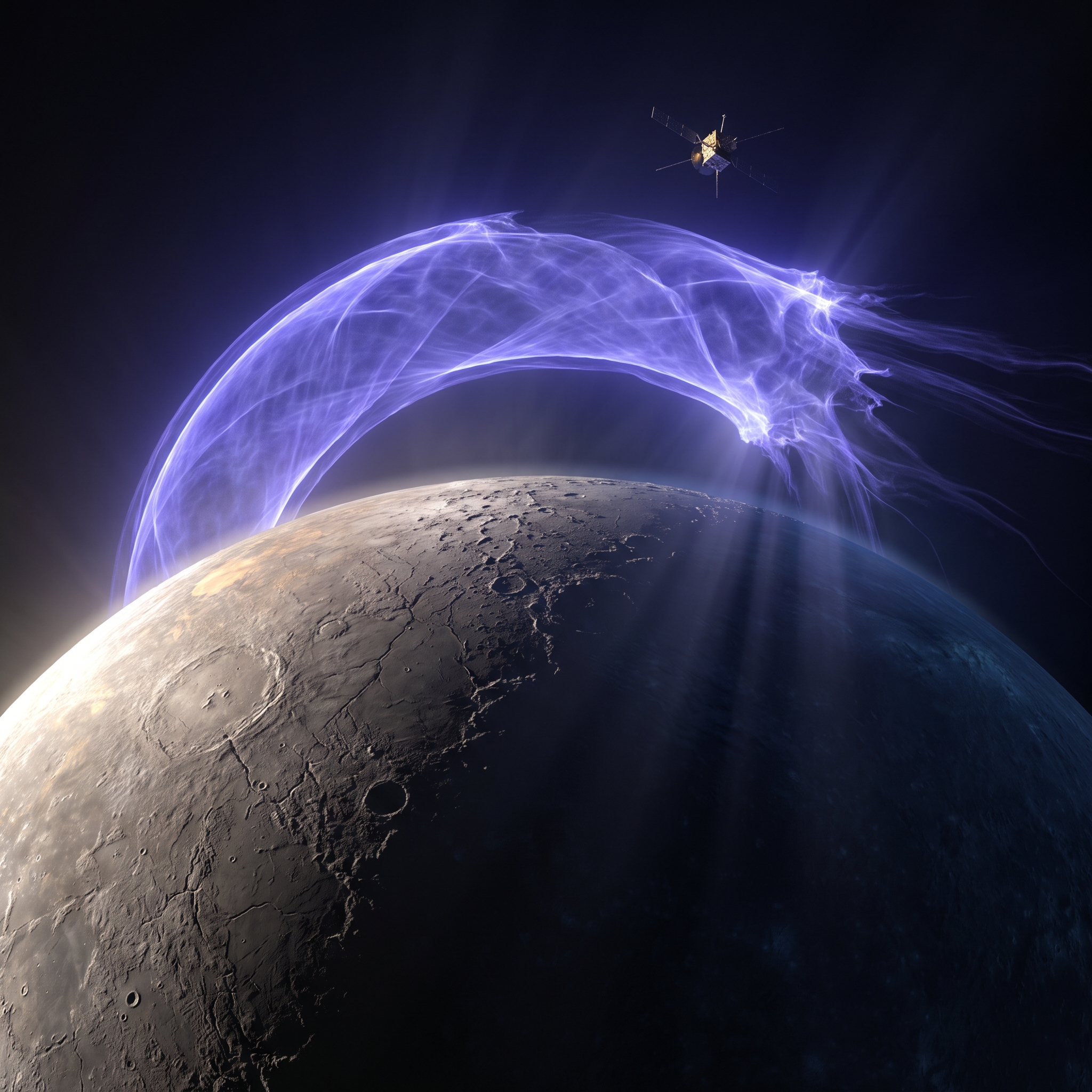
Iris Holm: Mercury. Radiation belts. July 28th, Nature Astronomy. Jiutong Zhao, University of Michigan, with UC Berkeley co-authors, reanalyzed MESSENGER's archival data and found belts. The spacecraft ran from 2011 to 2015 and NASA crashed it when the fuel ran out. Every dataset it ever produced already exists.
Cyrus Reed: Wait — hold on. MESSENGER found them and nobody noticed?
Iris Holm: Not quite. A 2011 Science paper used that same MESSENGER data to conclude — explicitly — that Mercury cannot host Van Allen-type radiation belts. Then a 2018 Cambridge University Press volume summarizing the full mission said the same thing.
Cyrus Reed: So the data that proves the belts exist was used to write the paper saying they can't exist. That's — okay, I don't even know what to do with that, that's like — wait, is that just the worst possible version of confirmation bias or is it a methods problem, because those feel really different?
Iris Holm: That's the episode. Whether this is a paradigm overturned or a fifteen-year embarrassment sitting quietly in NASA's archive.
Cyrus Reed: Yeah — and I don't think those are mutually exclusive, which might be the most uncomfortable part.
Iris Holm: But that framing — paradigm versus embarrassment — it assumes the new result is correct. That's the part I want to slow down on. Zhao's team didn't use MESSENGER's dedicated particle instrument to find these belts.
Cyrus Reed: Wait — they didn't use the actual particle detector? Then how did they — okay, how does that even work?
Iris Holm: Think of it like hearing a concert through a wall. You didn't record the music. You felt the vibrations in the plaster, then modeled what band could produce exactly that shaking pattern. That's the method. The EPPS — the Energetic Particle and Plasma Spectrometer — lacked the sensitivity. So they inferred energetic electrons from the interference those electrons caused in other instruments, then ran particle simulations and theoretical modeling to reconstruct the structure.
Cyrus Reed: Okay but — wait, so the sensitivity limit of EPPS is actually the reason this took until 2026? Like, the instrument built to find this thing couldn't find it?
Iris Holm: That's the load-bearing problem. And it cuts both ways. D. N. Baker and R. L. McNutt Jr. analyzed the same MESSENGER archive and concluded no stable belts were present. Same data. Opposite conclusion.
Cyrus Reed: No way. Baker and McNutt looked at this and said — nothing's there?
Iris Holm: And now — here's the warning I actually care about. Mariner 10. 1970s. It detected energetic electrons at Mercury. The significance was considered ambiguous then, and MESSENGER's own direct measurements later discounted it entirely. So we have a history of ambiguous signals at Mercury being misread in both directions — first discounted, now possibly overclaimed. The question isn't whether Zhao's team is wrong. It's whether alternative explanations for those interference signatures have been genuinely ruled out or just set aside because the belt interpretation fit better.
Cyrus Reed: So the concert-through-the-wall problem is — what if it wasn't a concert? What if the wall was just... shaking for some other reason entirely, and we built a whole setlist out of it?
Iris Holm: Right — and that's exactly where the hot take earns something. Because the shaking pattern isn't random.
Cyrus Reed: Wait, what do you mean not random — like, there's a structure to when the belts show up?
Iris Holm: Fifty percent near aphelion. Twenty percent near perihelion. That's not noise. That tracks directly to Mercury's distance from the Sun.
Cyrus Reed: Okay but — wait, so the belt literally has an off switch tied to orbital position? Like, it's not weak at perihelion, it's just — gone? Because the solar wind pressure at perihelion is up to thirty times Earth's, and the interplanetary magnetic field is four to ten times stronger, and that's just — that physically crushes the magnetosphere down to nothing, right, Mercury's field is already one percent of Earth's — so at closest approach there's just no room for electrons to stay trapped at all?
Iris Holm: That's the mechanism. Aphelion gives the magnetosphere breathing room. Perihelion collapses it. Episodes last eight to twelve hours typically, but under weak solar wind they can persist for several Earth days — quasi-permanent, almost.
Cyrus Reed: No way — days? That's — huh. So it's not always flickering. Sometimes it just... holds.
Iris Holm: Which is the classification problem. Van Allen belts don't blink. They're a permanent feature. So is something that exists fifty percent of the time at best actually a radiation belt, or is it a recurrent magnetospheric transient that happens to trap electrons?
Cyrus Reed: Okay, I mean — actually, no, I think that debate matters more than it sounds, because picture an ESA systems engineer in mid-August 2026. Someone slides the Nature Astronomy preprint across the table. Her shielding model for BepiColombo was finalized eighteen months ago, assumes a clean magnetosphere — and she has twelve weeks before orbital insertion in November. She can't redesign the spacecraft. So whether we call it a belt or a transient, the radiation hazard just got rewritten four months before arrival.
Iris Holm: And BepiColombo is carrying the instruments that could actually settle the indirect-detection debate — which is the part of this story we haven't gotten to yet.
Cyrus Reed: Wait — the instrument that could actually settle this is *on* the spacecraft that's arriving into the environment the instrument is supposed to settle? That's — okay, that's either elegant or terrifying, I can't decide which.
Iris Holm: Both. BepiColombo carries direct particle detectors. Unlike EPPS, they have the sensitivity range to measure trapped electrons directly — not through interference signatures. That makes the arriving spacecraft the verification experiment for Zhao's indirect method.
Cyrus Reed: But — wait, is there actually time to *use* that? Because the shielding model was built on the old framework, the one that said clean magnetosphere, no belts. November 2026 is not far away. Can ESA and JAXA even act on a Nature Astronomy paper from late July in — what, twelve weeks?
Iris Holm: Probably not the shielding — that's fixed. But the intermittency is actually — look, this is the part that cuts against pure panic. The belt is absent eighty percent of the time near perihelion. If the orbital modulation model is reliable enough to forecast, mission planners can schedule sensitive instrument passes around the hazard windows.
Cyrus Reed: Oh — so the off switch is actually the useful part. If the suppression at perihelion is predictable, you time around it.
Iris Holm: If. That's the word doing all the work. The model is brand new. We have one study, indirect detection, published four months before orbital insertion. The question is whether ESA and JAXA treat that as actionable or as a flag to monitor once BepiColombo's own detectors start returning data.
Cyrus Reed: No, I don't buy that those are the only two options — I mean, actually, no, maybe they are. Because you can't partially update a shielding model. It's either rated for what's out there or it isn't.
Iris Holm: That's the calibrated take. The belts are real enough that BepiColombo is now inadvertently the instrument that proves or refutes the method. The intermittency is real enough to be operationally useful — if the perihelion suppression holds at prediction. But the shielding is fixed, the window is twelve weeks, and the mission is flying on assumptions that are now, at minimum, contested.
Cyrus Reed: So BepiColombo doesn't just study Mercury's radiation environment — it *is* the experiment. Whatever it measures first pass either confirms Zhao or forces a third interpretation of fifteen years of MESSENGER data.
Iris Holm: And that's the thing the MESSENGER archive keeps surfacing. It closed in 2015. NASA crashed the spacecraft. There's no new data coming — and we're still learning to read what's already there. Zhao's team didn't have new instruments. They had new analysis techniques. Which means the question isn't really about Mercury anymore. It's about how many other 2011-consensus conclusions are sitting in planetary archives waiting for a method that doesn't exist yet.
Cyrus Reed: Okay — yeah. That's — I mean, I came in calling this a fifteen-year embarrassment, but that's probably too clean a word for it, actually. It's more like — wait, no, it's a fifteen-year lesson in how hard it is to read ambiguous sensor data, and the embarrassing part is just that the 2018 Cambridge summary didn't ask what the interference noise in EPPS actually meant. That one question. Eleven years of data sitting there.
Iris Holm: BepiColombo grades the homework in November. Either the indirect detection holds and radiation belts are stranger and more adaptable than the Van Allen analogy ever suggested — or the signal dissolves under direct measurement and we learn something equally important about pattern-finding in old data. Both outcomes are useful. That's actually a decent place to land.
Cyrus Reed: Yeah. It is. Thanks for not letting me just call it an embarrassment and move on.