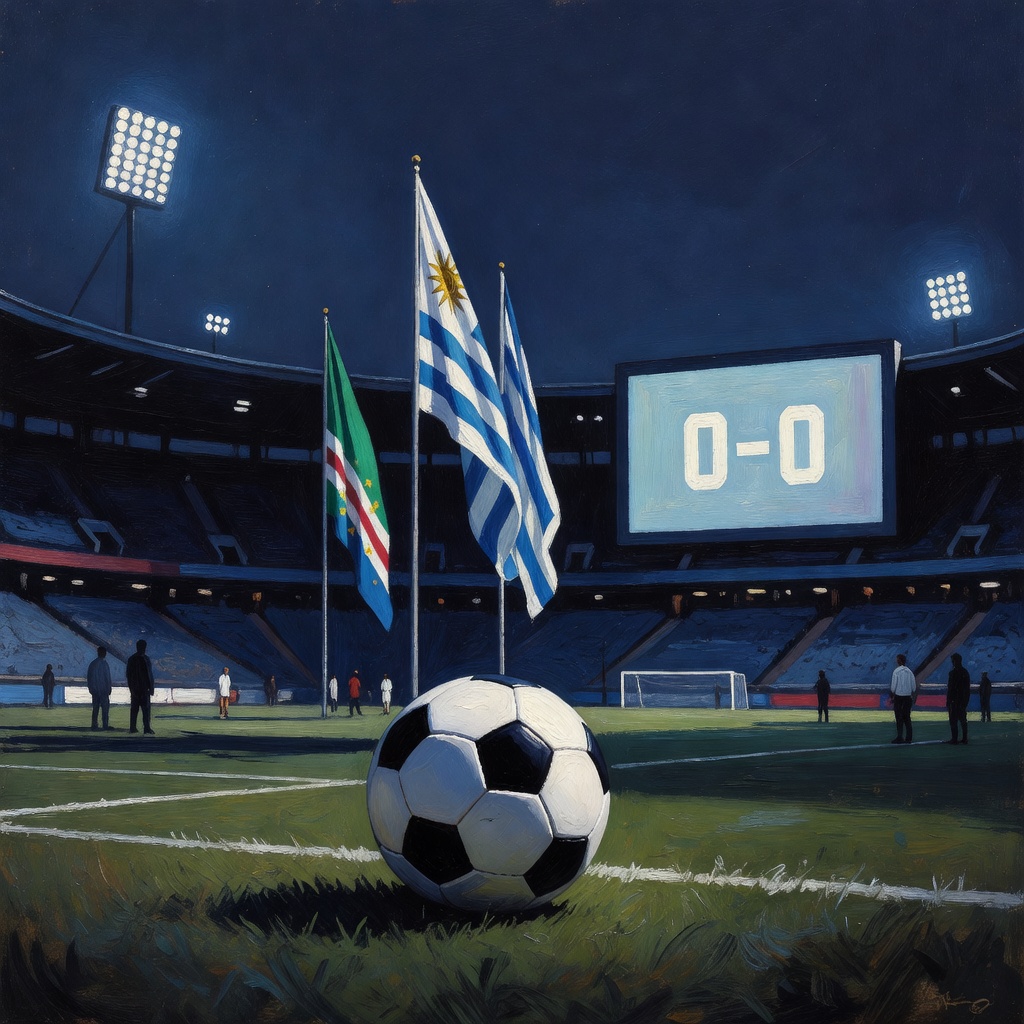
Megan Skiendel: 64,003 people in Miami Gardens watched Cape Verde — a country smaller than Luxembourg — go 1-0 up against Uruguay last night. And I don't think most of those fans knew what they were seeing yet.
David Sterling: Kevin Pina. Free kick, 30 yards, through the wall. Past Muslera. First ever World Cup goal for Cape Verde.
Megan Skiendel: And then Uruguay pull it back — Maxi Araújo in the 44th, Canobbio 51st — you think it's done, right, the favorites have reasserted, the math is restored—
Megan Skiendel: Hélio Varela. Substitute. 61st minute. 2-2. I mean — honestly — the best way I can frame this: a nation of 525,000 people just did to Uruguay what Uruguay couldn't do back. Twice in a row, if you count the Spain 0-0.
David Sterling: Opta priced this at 67.2% Uruguay. The model didn't just miss the result — it missed it by a country that had never qualified for a World Cup before this tournament.
Megan Skiendel: And now both sides are level on points, Group H, final matchday still to come. This isn't a Cinderella story anymore. It's a live qualification race.
David Sterling: The Cinderella framing is doing cover work. Cape Verde beat Eswatini 3-0 on October 13th to qualify. Their squad — Portugal, France, Netherlands. These are European-league-conditioned players. That's not a fairy tale. That's a structural advantage that the population number completely obscures.
Megan Skiendel: The diaspora pool. Nobody's pricing that in.
David Sterling: Correct. Because every forecasting model — including Opta's 67.2% — anchors to population size as a proxy for squad depth. But if your best players are developing in European leagues and you can integrate them, that assumption just breaks. Completely.
Megan Skiendel: And then there's Vozinha. Who is forty years old. Honestly — facing 27 shots against Spain and not conceding once, that's not luck, that's institutional memory. A 24-year-old doesn't hold that line. His social following exploded overnight after that match, which everyone's treating as a fun detail — it isn't, it's a signal about how this run sustains itself.
David Sterling: Wait — the Spain clean sheet actually validates the Uruguay draw, doesn't it. I mean, these aren't two separate data points, they're — no, they're the same architecture working twice.
Megan Skiendel: ESPN's own coverage asked whether Cape Verde should have had three points against Uruguay. Not whether they were lucky to get one. That's the headline the Cinderella story is burying.
Megan Skiendel: The bad take that's circulating right now is that Bielsa got it wrong. That Uruguay underperformed. That this is on Marcelo Bielsa's system. And I want to push back on that hard, because what it does is it turns Cape Verde into a passive recipient of someone else's failure.
David Sterling: Valverde, Núñez, Ronald Araújo. That's not a weakened squad.
Megan Skiendel: Exactly. So if you're blaming Bielsa's system for a 2-2, you're implicitly arguing that Pedro Brito's setup had nothing to do with it. That Kevin Pina's free kick — which, per Bubista's own system, was designed to exploit the wall gap — was just a gift.
David Sterling: Well — I'll grant Bielsa's possession-heavy structure probably does have a specific vulnerability against a compact defensive block. That's real. But here's the point: if Opta is still pricing Uruguay at 67.2% even with that structural tension baked in, the model failure isn't Bielsa. It's that every forecast model is pricing micro-nations on historical sample size. Cape Verde had never beaten a CONMEBOL side. That data point becomes noise the second you account for diaspora depth and set-piece execution.
Megan Skiendel: The 'Uruguay blew it' narrative is doing exactly that cover work. It lets everyone avoid the actual question.
David Sterling: Which is why the model was wrong. Not why Bielsa was wrong.
David Sterling: The actual question right now is Saudi Arabia. Cape Verde beats Saudi Arabia — wins, three points — and suddenly the Group H math is genuinely open. 48-team format, four sides still in contention. That's not hypothetical, that's the final matchday structure. So the thing I keep wanting — wait, no — the thing I actually need to know is: is this system repeatable against a different defensive shape, or does it only work when Cape Verde can absorb pressure and hit one set piece?
Megan Skiendel: Vozinha's forty. That's the variable nobody can model. You can price diaspora depth, you can price Pedro Brito's setup — honestly, you can build a better Opta model tomorrow. But a goalkeeper with that much institutional memory at that age, in form, at a first World Cup? That's not a system. That's a specific convergence.
David Sterling: Right. So is Cape Verde a repeatable model — diaspora pool, compact structure, set-piece execution — or is it entirely this bracket, this goalkeeper, Kevin Pina's free kick happening to split that wall?