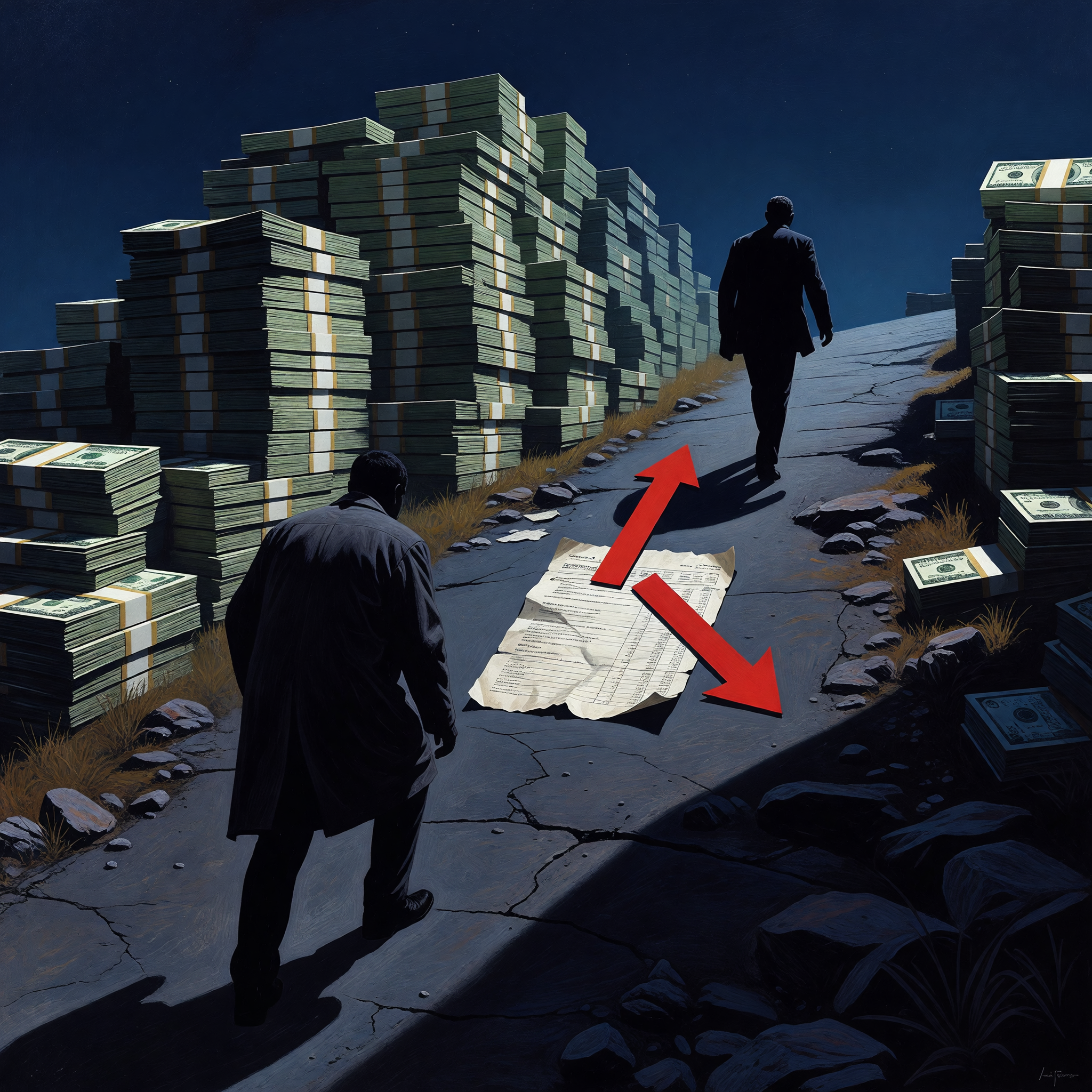
Clara Bennett: There's a number I want to give you before I explain anything. 2.44.
Clara Bennett: That's the percentage of its U.S. pretax income that Microsoft paid in federal taxes — fiscal year 2026. Over $101 billion in pretax income. $2.46 billion paid. Matthew Gardner at ITEP ran the numbers and published them July 29th, 2026.
Clara Bennett: Okay, the statutory rate — that's the rate the law says applies — is 21%. The effective rate is what's left after deductions, credits, all the preferences baked into the code. And the gap between those two numbers... that's where the whole story lives.
Clara Bennett: 21% on $101 billion is roughly $21 billion owed. Microsoft paid $2.46 billion. That difference isn't an error — it's the system working exactly as designed.
Clara Bennett: Now pair that with this.
Clara Bennett: April 6th, 2026 — the Institute on Taxation and Economic Policy puts out a report, Michael Ettlinger authored it, called 'Year One of Trump-Republican Tax Policy: The Consequences.' Middle-income Americans are paying $900 more this year than they'd have paid under prior policy. The top 1%? Receiving roughly $1 trillion in cuts over ten years under the One Big Beautiful Bill Act.
Clara Bennett: A trillion dollars. One direction. Nine hundred dollars. The other.
Clara Bennett: And ITEP's analysis goes further than that — when you factor in tariffs and the expiration of enhanced Affordable Care Act premium tax credits, all but the richest 5% of Americans face net cost increases. Not a wash. Increases.
Clara Bennett: Here's what I want you to hold onto for the rest of this: the statutory rate and the effective rate are not the same thing. They're almost never the same thing. And who benefits from that distance — that's not abstract.
Clara Bennett: 2.44% versus 21%. Feel that gap. We'll figure out what it means.
Clara Bennett: The income tax number — the 2.44%, the $900, the trillion — that's not the whole picture. And honestly that's the part I want to push on, because it actually undersells what's happening.
Clara Bennett: ITEP found that all but the richest 5% of Americans face net cost increases. Not just from income taxes. When you fold in tariffs AND the expiration of the ACA's enhanced premium tax credits — that's when the bottom falls out for lower-income households.
Clara Bennett: Think about how tariff incidence actually works. Economists treat tariffs as a cost borne by domestic consumers and importers — not by the foreign producers. The exporter doesn't absorb it. You do, at the register.
Clara Bennett: And lower-income households spend a higher share of income on goods. Groceries. Clothing. Household supplies. So when the tariff passthrough hits, it hits them proportionally harder.
Clara Bennett: July 23rd, 2026 — Chuck Schumer takes the Senate floor and names it directly. A new 50% tariff on Canada, threatened 10% tariffs on sixty countries, potential 100% tariffs on generic medicines. He's citing ITEP's findings. Senate Democrats are using this analysis as floor ammunition right now.
Clara Bennett: Compounding — that's the word Schumer used. Gas prices, grocery bills, and now another round of tariffs layered on top of the OBBBA.
Clara Bennett: Then the ACA piece. The enhanced premium tax credits — gone under current policy. For someone on a marketplace plan, that's not abstract. That's a monthly premium that just went up.
Clara Bennett: In practice these two mechanisms — tariffs and ACA credit expiration — are doing more distributional damage than the income tax rate changes alone. The income tax headline is almost a distraction from the real squeeze.
Clara Bennett: Now — and I think this part deserves honesty — the OBBBA also has populist provisions. No tax on tips. Overtime tax exemptions. Senior tax breaks. Steve Bannon has pointed to these as the working-class CORE of the bill. That's not nothing.
Clara Bennett: It complicates the clean 'cuts for the rich' framing. It's supposed to.
Clara Bennett: And there's one finding in the ITEP report that scrambles both narratives — progressive AND nationalist. Foreign shareholders in U.S. businesses received an estimated $32 billion in tax cuts in 2026. Not American workers. Not the MAGA base. Foreign shareholders.
Clara Bennett: Sit with that. If the populist argument is that this bill is for American working people — that number is a problem.
Clara Bennett: There's also a legitimate methodological question here. ITEP compares outcomes to a prior-policy baseline — what taxes would've looked like without any changes — rather than current law. That choice tends to show larger increases for lower earners. Supply-side economists contest this. It's a real interpretive disagreement, not a gotcha.
Clara Bennett: The key is — even granting the baseline debate, the tariff incidence math doesn't change. Lower-income households spend more of their income on goods. Tariffs are regressive by structure. That part isn't a methodology question — it's physics.
Clara Bennett: Now here's where the political calculation gets genuinely difficult.
Clara Bennett: Politico released polling in late July 2026 — nearly half of voters had not heard of the One Big Beautiful Bill Act, or couldn't explain what it was. And only 11% could describe it in any detail. Eleven percent.
Clara Bennett: Republicans tried rebranding it. 'Working Families Tax Cuts.' Didn't move the numbers.
Clara Bennett: And that's before you account for the fact that the law itself was a mess internally — House Republicans and Senate Republicans in what people were calling a tax bill civil war, competing versions, the Senate passing an amended bill that looked meaningfully different from what the House passed. The complexity isn't just a communications problem. Some of it is self-inflicted.
Clara Bennett: Hold that against what ITEP is actually trying to do.
Clara Bennett: Amy Hanauer runs ITEP — she's the Executive Director — and the work her organization is producing, the Ettlinger report, the Gardner post on Microsoft, these are rigorous distributional analyses. Senate Democrats are literally using them as floor ammunition. Schumer is up there citing the numbers. That's the analysis doing exactly what it's designed to do… inside the building.
Clara Bennett: Outside the building is a different story.
Clara Bennett: A distributional analysis is only a political weapon if the electorate knows what's being distributed. In practice, if half the country can't name the law, the study doesn't land — it evaporates.
Clara Bennett: The tariff piece might be different. That's what I keep thinking about.
Clara Bennett: Because tariff pain doesn't require you to know the OBBBA's name. You don't need to understand distributional analysis to notice your grocery bill. The 50% tariff on Canada, the threatened 10% on sixty countries — that's not inside-baseball. That shows up at the register. Schumer was pointing at this on July 23rd precisely because it's visceral in a way that a tax policy report is not.
Clara Bennett: The open question — and I mean genuinely open — is whether tariff visibility carries the ITEP argument with it, or whether those stay disconnected in voters' minds heading into fall 2026.
Clara Bennett: If someone feels the price pain but can't connect it to the law that ITEP analyzed… does the Democratic argument land? Or does it stay a briefing document nobody asked to read?
Clara Bennett: That disconnection — between feeling the price and naming the cause — that's where the analysis loses the room. The voter who pays $900 more this year and can't tell you what the One Big Beautiful Bill Act is… they will feel the tariff before they ever read an ITEP report. That's just true. The Schumer floor speech, the Ettlinger findings, Amy Hanauer's organization doing this work with real rigor — none of it bridges that gap automatically.
Clara Bennett: And the thing that makes this genuinely uncomfortable — not politically, structurally — is that Microsoft's 2.44% effective rate is not a loophole someone forgot to close. It is the DIRECT product of the OBBBA's provisions. Legal. Documented. Matthew Gardner at ITEP ran the numbers on over $101 billion in U.S. pretax income, $2.46 billion paid, published July 29th. That's not an anomaly. That's the architecture.
Clara Bennett: The 21% statutory rate is on the books. The 2.44% effective rate is what actually happened. Both are true at the same time. And the person who feels their grocery bill go up because of a 50% tariff on Canada — they're living inside the same policy that produced that number. They just don't have a name for it. Eleven percent of voters could describe this law in any detail. Eleven.