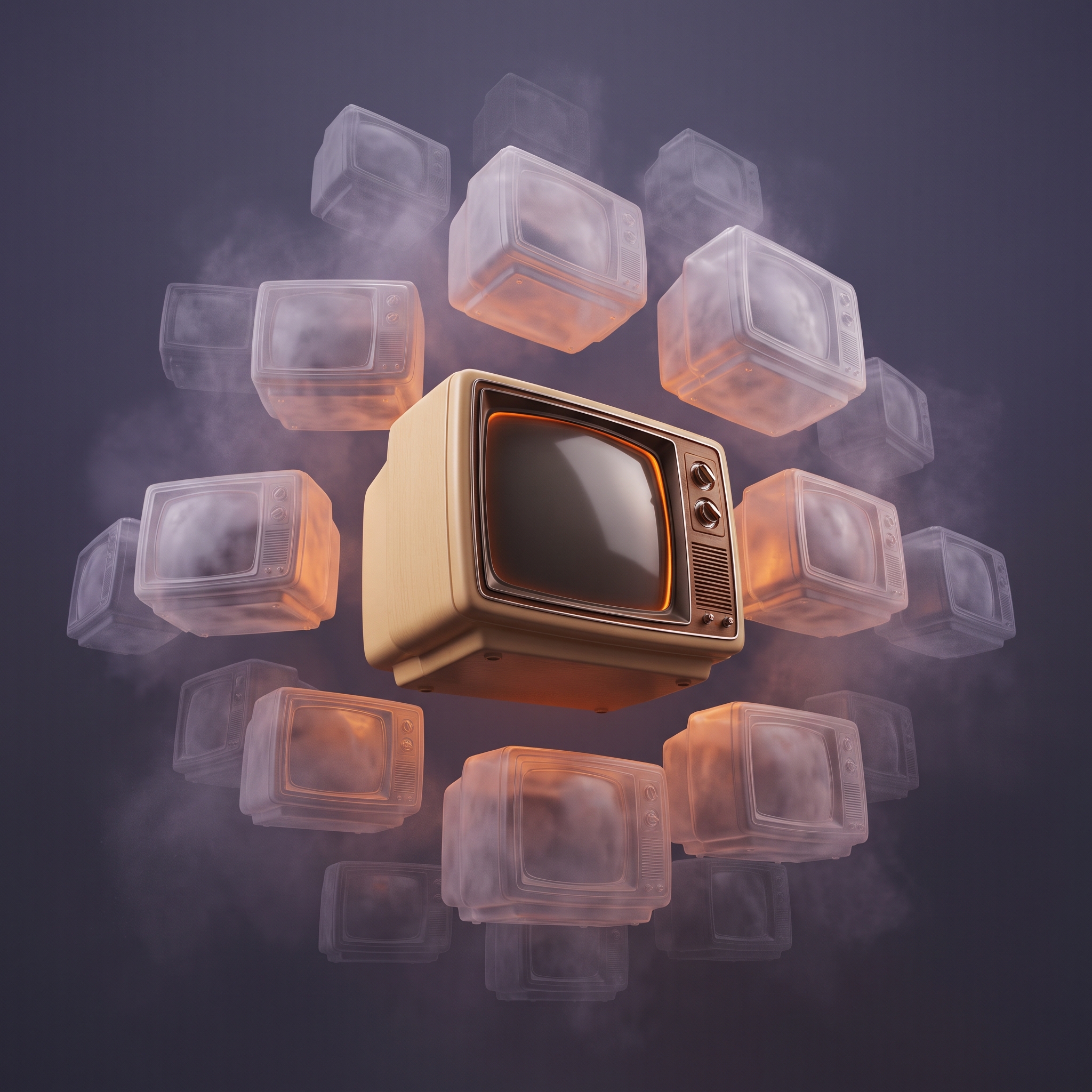
Hana Field: Can I just start in the middle of something — I've been sitting with this image and I need to put it somewhere.
Hana Field: It's 2023, and Quinton Hoover — YouTuber, 829,000 subscribers, the kind of person who has made lost Nickelodeon media his whole thing — uploads a video. And what he's uploaded is the unaired Blue's Clues pilot from 1994, 1995. The one with Steve Burns. The one that was tested with a small group of preschoolers, found wanting in some ways, had changes mandated, and then just... disappeared from public view for over two decades.
Iris Holm: Disappeared from public view — but not from Nickelodeon's files.
Hana Field: That's exactly it. Nickelodeon held the rights to that material the entire time. And a fan community is the one that surfaces it. Hoover called it 'a very important historical artifact of Nickelodeon history' — and he's right, but also, why did he have to say that? Why wasn't that the institution's line?
Iris Holm: Because to them it was a filing cabinet problem, not a preservation problem.
Hana Field: And that distinction — I think that's what this whole conversation is really about.
Iris Holm: What's the difference, in practice? Between those two problems?
Hana Field: A filing cabinet problem means nobody decided to hide it — it just stopped being someone's job to find it. But what Paramount is doing now isn't passive neglect. It's something more deliberate, and somehow colder.
Iris Holm: Walk me through it.
Hana Field: Think of it like a library that owns every book outright — not licensed, not borrowed, owns them — and the library decides some books aren't worth shelf space, moves them to a locked back room, and then a group of volunteers starts photocopying them in the parking lot because it's the only way anyone can read them. That's the Nickelodeon archive right now.
Iris Holm: And Paramount+ is the library. The owner. Not a landlord who lost the lease — the actual owner.
Hana Field: Exactly. And so March 2024 — Paramount+ removes ten Nickelodeon titles. Ten. Including Blue's Clues & You!, which is the reboot, and the 2021 Rugrats reboot, which, Rugrats premiered in 1991, so this is a show with a thirty-year lineage and they cut the revival before it had any real run. The stated reason was a shift toward, and I'm quoting, 'content with mass global appeal.'
Iris Holm: Wait — and then they did it again?
Hana Field: January 1st, 2026. Eleven more. KaBlam!, Nick Arcade, As Told by Ginger — and no confirmed return date on any of them. PopCulture.com, NickALive!, they both reported it. And this is the part that actually stops me: Paramount owns the underlying content rights outright. This is not a licensing dispute with some third party. They are choosing to make their own library disappear.
Iris Holm: So the same entity that holds the archive is the one locking the back room. There's no villain to blame it on.
Hana Field: Which is almost — I mean, it's worse, isn't it? Before 2024, if you wanted As Told by Ginger, the Nick Rewind DVD line existed, there was that Amazon made-to-order DVD deal, both of which got criticized for being overpriced and poor quality anyway. Now there's just nothing. Twenty-one titles gone across two calendar years, and the institution doing it is the only one with the keys.
Iris Holm: But here's what I keep snagging on — those shows weren't made by some pure creative collective working outside market logic. They were built by it.
Hana Field: That's the thing nobody wants to sit with. Nickelodeon in 1977 — it was Pinwheel then, Warner-Amex's commercial-free cable wallpaper — genuinely low-budget, basically inoffensive, and nobody remembers it. Then 1984 happens. MTV Networks goes public, Wall Street enters the room, and suddenly the channel has to earn money. And Geraldine Laybourne — who is a former teacher, not a synergy architect — she takes the commercial mandate and somehow uses it to argue that children are sophisticated enough to deserve actual television.
Iris Holm: Wait — she ran Nickelodeon through the whole golden age? '84 to '96?
Hana Field: The whole twelve years. And Scott Webb and Fred Seibert rebuild the channel's identity from scratch — the visual language, the branding, everything — right after the IPO. So the Nickelodeon that produces Rugrats in 1991, Blue's Clues in 1996, the Nickelodeon where Steve Hillenburg is developing SpongeBob out of the Burbank animation offices — that institution was engineered by Wall Street pressure, not sheltered from it.
Iris Holm: So the same engine. The commercial logic made it, and now the commercial logic is —
Hana Field: Dismantling it, yeah. It's the same pressure, just a different direction. Laybourne used it to say 'kids deserve research-informed programming.' Paramount uses it to say 'mass global appeal' — and As Told by Ginger doesn't clear that bar.
Iris Holm: No villain. Same engine.
Hana Field: Which is — I mean, that reframe actually makes the deletion pattern harder to prosecute, doesn't it? You can't point at a specific person who decided Geraldine Laybourne's legacy wasn't worth a server fee. It's just the logic, playing out. And what that actually means for who inherits any of this — that's the part I want to get to, because it's sharper than nostalgia.
Iris Holm: Frankly — that's where this conversation has to go next.
Hana Field: And the stakes of that — the inheritance problem — become very concrete when you actually picture it. Not abstractly. A parent, born in 1994, they want to show their kid Blue's Clues. The specific show that modeled how to slow down, sit with a problem, work through it. They open Paramount+. It's gone. They check digital storefronts — fragmented, incomplete, no full run anywhere.
Iris Holm: And then they find Quinton Hoover's channel. If it's still up.
Hana Field: That's the thing — that's the only rope left, and it can be cut overnight. One copyright claim from Paramount and it's gone. The Lost Media Wiki exists, fan communities are doing real preservation work, but legally? They're operating in a space that could collapse with a single automated DMCA filing.
Iris Holm: No public-interest framework. Nothing equivalent to what libraries get for books.
Hana Field: Nothing. And Nickelodeon's own archival record during the golden age was — I mean, it wasn't even consistent. Some titles preserved carefully, others just gone, and nobody has a clean accounting of which is which. We don't actually know the full scope of what's already lost.
Iris Holm: That's what gets me. The deletion isn't strategic — it's automated. Paramount runs a cost-per-region calculation, Blue's Clues doesn't hit quarterly targets, it becomes a line item that gets cut. No one in that room is thinking about a seven-year-old.
Hana Field: Which is — yeah, and somehow that's colder than if it were intentional. An ideology you can argue with. A spreadsheet just runs.
Iris Holm: So the precedent being set is: fan archiving plus corporate deletion is now the default infrastructure for cultural memory. And that infrastructure is legally precarious by definition. What would have to be true for that to be acceptable?
Hana Field: Nothing would have to be true — that's the answer I keep landing on, and it's not a satisfying one. If Paramount removes Blue's Clues entirely from every platform, the only thing left is fan communities with no legal standing. Quinton Hoover's channel, the Lost Media Wiki, uploads that could vanish overnight. And I think about Geraldine Laybourne, who built Nickelodeon on the belief that children were thinking people who deserved to be taken seriously — not managed, not sedated, actually taken seriously. And the question of whether that inheritance is worth preserving turns out to be the exact same question as what we decided a streaming service is for.
Iris Holm: And we answered it. Not with a policy. With a spreadsheet.
Hana Field: We answered it. And the strange thing is — we started with Quinton Hoover finding a tape in a filing cabinet, and the story ends with Quinton Hoover being the filing cabinet. That's the loop closing. The institution forgot it had the thing, a fan recovered it, and now the fan is the only archive. That's not a failure of one decision. It's the whole shape of the thing.
Iris Holm: Yeah. That's it.
Hana Field: Thank you for sitting in this with me. It got heavier than I expected.