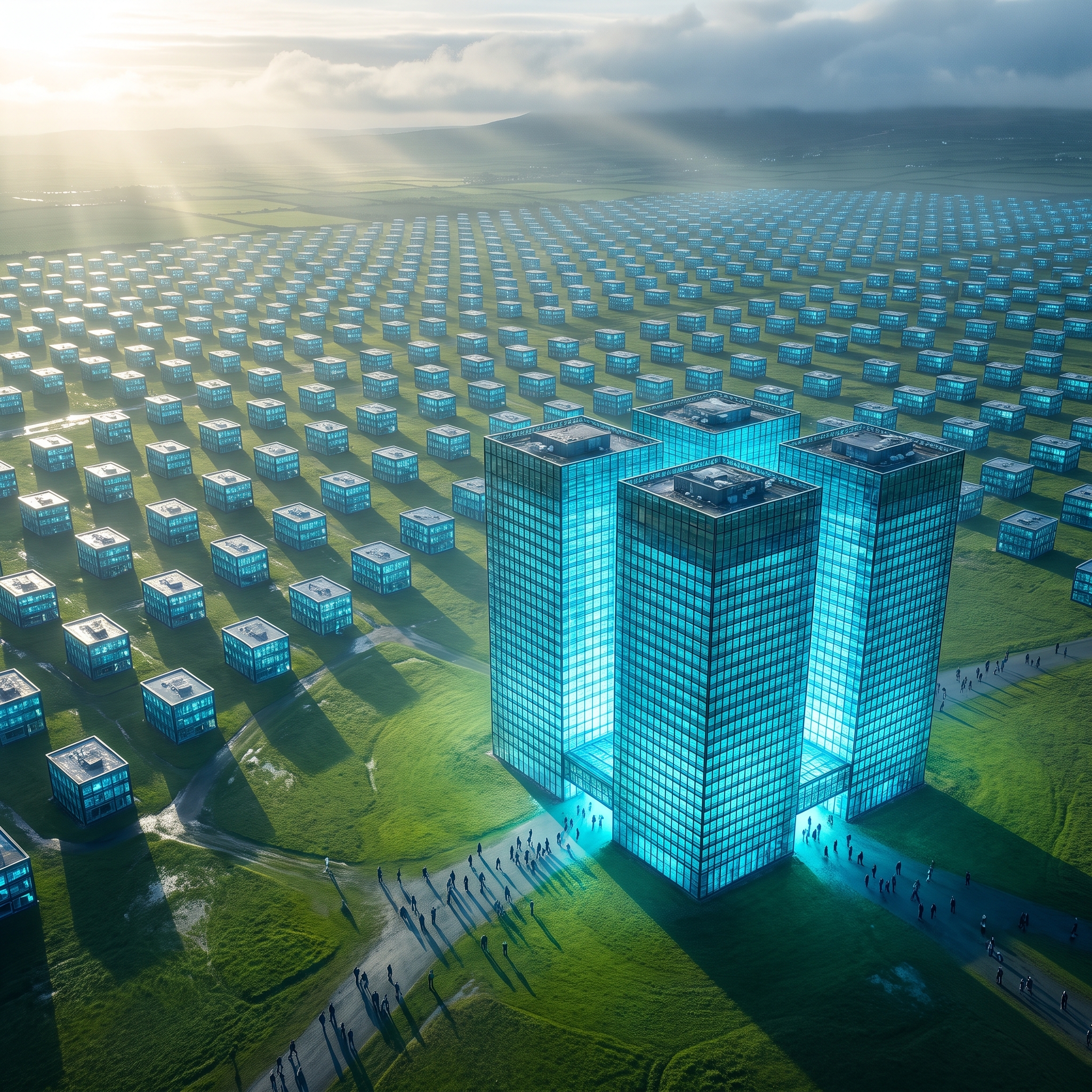
Spuds Oxley: There's this building on Sir John Rogerson's Quay in Dublin — used to warehouse tropical fruit off the ships.
Spuds Oxley: IPUT Real Estate developed it into eighty-eight thousand square feet of office space in the Silicon Docks, and OpenAI has just signed the lease.
Spuds Oxley: That's the Tropical Fruit Warehouse — OpenAI's new European Union headquarters.
Spuds Oxley: The announcement came July 27th, 2026.
Spuds Oxley: Reuters confirmed the numbers: roughly a hundred people currently in the Dublin office, two hundred and fifty new hires planned over two years, total headcount reaching around three hundred and fifty.
Spuds Oxley: OpenAI first came to Dublin in September 2023 — trust and safety, legal, security, the customer-facing European work.
Spuds Oxley: Quietly, at first.
Spuds Oxley: Now it's the EU headquarters, landing in the same docklands district where Alphabet, Meta, and Microsoft already have their European homes.
Spuds Oxley: IDA Ireland is citing the milestone that ChatGPT users in Ireland have passed one million — that's the demand signal they're pointing to as the engine behind all this.
Spuds Oxley: And you can feel the shape of that story — it's familiar, it has the cadence of good news.
Spuds Oxley: And look, it IS good news, on its own terms.
Spuds Oxley: But The Next Web has been looking at what's happening to the wider Irish tech employment picture — and the word they're reaching for is decline.
Spuds Oxley: AI-driven automation — and the company doing the hiring here is the company making the tool doing the automating.
Spuds Oxley: Now look at the actual jobs they're hiring for.
Spuds Oxley: Engineering, yes — but also sales, user operations, HR, finance, workplace functions, corporate security, privacy, legal. That is not the profile of a company planting a research flag. That is a company building the machinery that lets it exist inside a regulatory jurisdiction.
Spuds Oxley: Think about that combination. Privacy and legal and corporate security — together, in the same hiring wave.
Spuds Oxley: And then think about when OpenAI first came to Dublin — September 2023 — and what they came for. Trust and safety. Legal. Security. The compliance-heavy functions. That was the foundation. They didn't start with engineers writing code. They started with people who could navigate what the EU was going to ask of them.
Spuds Oxley: The EU AI Act enforcement is coming.
Spuds Oxley: Frontier AI systems — ChatGPT, the GPT models — they sit in the highest-risk categories under that framework. The obligations are not abstract. You need documentation, you need oversight structures, you need humans in the loop and legal entities on the ground who can actually be held accountable by European regulators. Dublin gives OpenAI that entity.
Spuds Oxley: Alphabet built the same thing here. Meta did. Microsoft did. Every one of them came to the Silicon Docks with a story about European customers and European talent — and all of that is true — but the other truth is that Dublin is where you put the legal interface between your global operation and the EU. I mean, multinational tech and pharma together now account for around eleven percent of Ireland's entire workforce. That's not coincidence. That's a structural arrangement that suits both sides.
Spuds Oxley: Ireland gets the jobs and the tax base. The companies get a stable, English-speaking common-law jurisdiction inside the EU that has spent thirty years learning how to make multinationals feel welcome.
Spuds Oxley: OpenAI is just the newest entrant to that arrangement.
Spuds Oxley: And IDA Ireland pointing to one million ChatGPT users in Ireland as the demand signal — that's a reasonable thing to say, and I don't doubt the number. But demand from users is not why you hire a team weighted toward privacy and legal and corporate security. That's not a demand story. That's a compliance story.
Spuds Oxley: The official framing and the actual role mix — they're telling different things.
Spuds Oxley: Those 250 jobs may be less the reward of OpenAI's success in Europe and more the price of ENTRY into Europe. The cost of being allowed to operate at scale in this market. The Tropical Fruit Warehouse is not a victory lap. It's a registration fee, made physical.
Spuds Oxley: Which doesn't make the jobs less real for the people who take them.
Spuds Oxley: But it does change what we're looking at. This expansion is OpenAI deciding, deliberately, that it cannot afford to be ungovernable on this side of the Atlantic. Dublin is where that decision takes up office space… and that's a quieter story than the headline, and probably the more important one.
Spuds Oxley: The pace of it is what strikes me most.
Spuds Oxley: Over fifty people in Dublin by November 2025. Around a hundred by the time the announcement lands, July 27th, 2026. Three hundred and fifty by the end of two years. That's not steady growth — that's a step change, and it's happening right now, in a very compressed window.
Spuds Oxley: Late 2026, OpenAI moves into the Tropical Fruit Warehouse.
Spuds Oxley: And late 2026 is also when the EU AI Act's enforcement machinery becomes fully operational for frontier systems — the ones at the top of the risk categories, which is exactly where ChatGPT and the GPT models sit. Those two things land at the same moment. The keys to the new office and the weight of the new obligations, arriving together.
Spuds Oxley: That timing is not accidental.
Spuds Oxley: And look — IDA Ireland is pointing at one million ChatGPT users in Ireland as the engine behind this. That number is real. But if user demand were the driver, you'd expect the headcount to track the user base — and it didn't, not for the first two years. It stayed quiet, under fifty people, building the compliance foundation. The acceleration only comes now, when enforcement is close.
Spuds Oxley: Which brings me to the thing I think is worth sitting with.
Spuds Oxley: The Next Web is documenting what's happening to the wider Irish tech employment picture — AI-driven automation reducing roles even as OpenAI adds them — and there's a tension in that, but it's not quite the irony it looks like. OpenAI can absorb the cost of a three-hundred-and-fifty-person legal and trust-and-safety structure in Dublin. They can staff privacy, corporate security, user operations, all of it, because they are the company that built the tool that's eating the other jobs. They can pay the entry price. A smaller AI company — a startup trying to reach European customers, trying to operate under the same AI Act obligations — they cannot field that team. Two hundred and fifty new hires as the price of regulatory legitimacy is a MOAT, not just a milestone.
Spuds Oxley: The 250 jobs are real — for the people who take them, genuinely real. But watch what they build. Because when OpenAI moves into that old fruit warehouse on Sir John Rogerson's Quay, it won't just be moving into eighty-eight thousand square feet of Silicon Docks office space. It'll be moving into a position that very few others can afford to occupy… and that's the quiet thing the announcement didn't say.
Spuds Oxley: And there it is, really. OpenAI is the company generating the disruption — the automation that The Next Web is documenting, the roles going quiet across the wider Irish tech sector — and OpenAI is also the company doing the hiring to make its presence in that same market acceptable to the people who govern it.
Spuds Oxley: Both things are true at once. Not in a contradictory way — in a structural way. That's what makes it worth sitting with.
Spuds Oxley: The job title that survives the AI transition may just be: person who explains to regulators why the AI is fine.