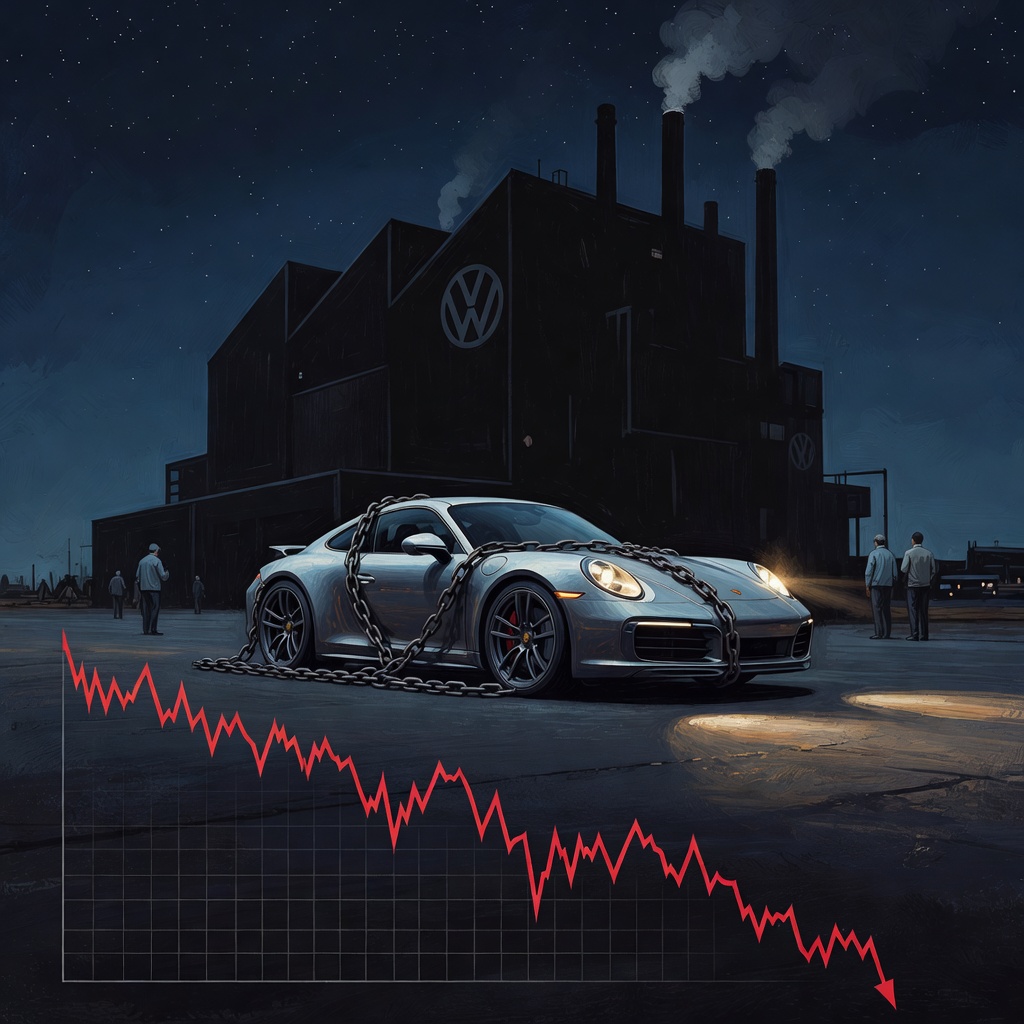
Zara Reyes: Lowkey every time I think premium brands are immune to the rules, something like this drops. Porsche. 1.1% operating margin.
Megan Skiendel: Oh, that number is brutal.
Zara Reyes: For context — they IPO'd in September 2022 on the Frankfurt Stock Exchange, one of Europe's biggest listings, and the whole pitch was 17 to 19% operating return on sales. That was the story investors bought. Now it's 1.1. That's — actually, the simplest way I can put it: they sold a luxury penthouse, delivered a studio apartment, and are currently negotiating down to a parking space.
Megan Skiendel: Look, and the full-year 2026 target Leiters is defending right now is 5.5 to 7.5%. Which is a fraction of what was promised. Frankly that's not a recovery story yet — that's a floor story.
Zara Reyes: And Deka Investment's Ingo Speich — at the June 23 annual shareholder meeting, official meeting — called it a 'pile of rubble.' To Leiters's face.
Megan Skiendel: While Q1 deliveries were already down 15% globally and U.S. tariffs cost them €200 million in that quarter alone.
Zara Reyes: The stakes are enormous. This is what a premium brand narrative breakdown actually looks like from the inside.
Megan Skiendel: But honestly, what's actually new — and I think this is where people are missing it — isn't the margin collapse. That's been visible for months. What's new is they gave it a name. Strategy 2035. 'Value over Volume.' That's the official rebrand of the crisis. And then Leiters, at the June AGM, asked investors for patience and punted every concrete detail to October 7. A Capital Markets Day four months out. When a CEO does that, it's because the specifics are worse than the headline.
Zara Reyes: Wait — October 7 is the first time we actually get the plan?
Megan Skiendel: First time. And meanwhile the twin pillars they've announced are — streamline the model lineup, deepen VW synergies. Which sounds measured until you realize 'deepen VW synergies' is basically admitting independent premium margins aren't sustainable anymore.
Zara Reyes: No but the Ferrari contrast here is — actually, wait, this is the part that kills me. Ferrari just debuted the Luce EV and immediately hired Massimo Di Silvestre, former BMW Italy president, as their new marketing chief. They're not deferring. They're moving. Porsche confirmed the 911 will never go fully electric — which, fine, that's an identity line — but you can draw a brand boundary and still need a plan for everything else.
Megan Skiendel: The 911 call is the one real clarity in all of this.
Zara Reyes: It is — and it's also lowkey the only signal investors got from that June meeting that wasn't deferred to October. Everything else is China slowdown, tariff pressure, sluggish EV adoption — cited headwinds, no actual answers. Strategy 2035 is a name. October 7 is when we find out if there's anything underneath it.
Zara Reyes: No but — the take I keep seeing, and it's wrong, is that deepening VW synergies is just smart capital allocation. Like, prudent cost management, nothing to see here. That framing is — it's doing a lot of work to hide what's actually happening.
Megan Skiendel: Okay, stress-test that. Because platform-sharing between Porsche and VW isn't new. The brand survived it.
Zara Reyes: Sure — but survived it when margins were at 14.4% and China was buying. Now you're deepening that dependency at 1.1%, while also negotiating workforce reductions with employee representatives. That's not synergy. That's admission.
Megan Skiendel: Honestly — yeah. And here's what actually breaks the 'we've done this before' logic: it's not one shock. China, tariffs, EV stall — those hit simultaneously. Platform-sharing has a different meaning when your premium story is already under pressure from all three directions at once. The customer starts noticing that the car feels like a Golf with leather seats.
Zara Reyes: Which is exactly the Ferrari problem. Ferrari picked scarcity. Porsche tried to be exclusive AND scaled enough to justify the IPO valuation. And now — they have neither.
Megan Skiendel: Ingo Speich didn't call it a pile of rubble because of a cyclical dip. That language means investors already decided the brand identity is the casualty.
Megan Skiendel: And that's actually the question I can't resolve. If Strategy 2035 works — if Leiters walks into October 7 with a real plan and margins are genuinely recovering toward something defensible by 2027, 2028 — does Porsche come out the other side as a leaner premium brand? Or does it come out as Volkswagen's luxury division that once had an independent story? Because those are not the same thing. The €75 billion IPO valuation was priced on the independent story.
Zara Reyes: No but — wait, that's the part that actually keeps me up. The market that showed up in Frankfurt in September 2022 was buying a specific story. That story is — it's gone. Even if the margins come back, the story that justified that number is not coming back. So the real question isn't whether October 7 delivers a plan. It's whether a different, smaller story can hold anywhere near the same weight.
Megan Skiendel: And honestly — has the market already permanently repriced what a luxury automaker is worth, full stop? Not just Porsche. Any of them. Because China isn't coming back the same way, U.S. tariffs aren't going away, and Ferrari is the only one who seems to have a credible answer to that question right now. So what exactly is Leiters selling on October 7?