Hana Field: Hey, you made it — I was worried you'd get lost in the parking structure again.
Iris Holm: Third level. Every time. You'd think I'd learn.
Hana Field: Okay, so I want to start with something I can't stop thinking about, and it's a little unsettling, honestly — like, in the quiet way, not the loud way.
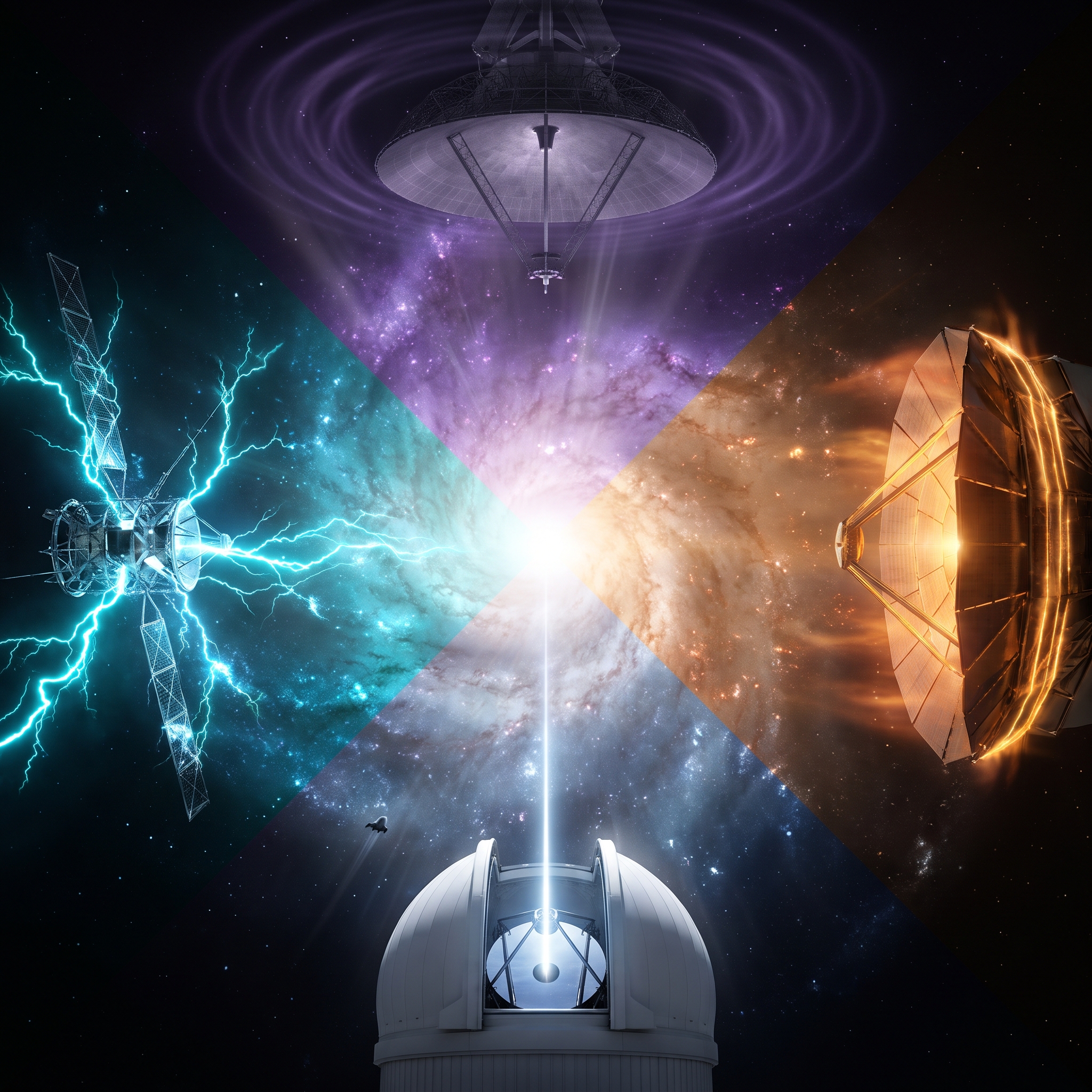
Hana Field: Until the 1960s, all of astronomy — centuries of it — was done in visible light. And visible light is roughly 0.05% of the full electromagnetic spectrum. Not a metaphor. An actual number.
Iris Holm: Wait — 0.05. Not five percent. Point zero five.
Hana Field: Point zero five. And what gets me is that the astronomers weren't wrong, exactly — they were making real observations, careful ones, and they were still missing dust-shrouded star-forming regions, active galactic nuclei, neutron stars that emit almost no visible light at all. The universe had this whole violent skeleton they couldn't see.
Iris Holm: Structurally incomplete. That's the frame I'd use. Not wrong — structurally blind in ways they had no instrument to detect.
Hana Field: Right, and the spectrum runs — so you've got radio at the low-energy end, longest wavelengths, all the way up through microwave, infrared, visible, ultraviolet, X-ray, gamma ray. Each band is literally a different physical world. And we were parked in one tiny slice of it and calling it astronomy.
Iris Holm: Which brings you to the question. What does the universe actually look like when you use the whole thing?
Hana Field: That's it. That's exactly what we're here for — and tools like JWST and ALMA exist precisely because the answer turns out to be almost nothing like what we thought.
Iris Holm: And the reason we were parked there — in that one slice — isn't arbitrary. It's temperature. That's the mechanism. An object's temperature determines which wavelength it glows in. Full stop.
Hana Field: Temperature. Not, like, what it's made of, or how far away it is — just how hot it is.
Iris Holm: Right. Your body — right now — is glowing. You're emitting light. You just can't see it because you're at 37 degrees Celsius, so it's coming out as infrared. A welding arc is maybe four times hotter, and it's blue-white. That's not a metaphor. Hotter means shorter wavelength, bluer light.
Hana Field: So the spectrum is — it's actually a thermometer. For the whole cosmos.
Iris Holm: Exactly that. And once you frame it that way, the implications cascade. Cold molecular clouds — we're talking below tens of kelvin — they emit through carbon monoxide rotational transitions, radio and millimeter signals. That's what ALMA maps. None of that, zero, is visible to an optical telescope.
Hana Field: And those clouds are where stars are being born.
Iris Holm: Star-forming regions, yes. Hidden inside dust that sits somewhere between 10 and a thousand kelvin — which means it radiates in infrared, and it absorbs visible light. Dust doesn't just fail to emit optical light, it actively blocks it. That's why JWST exists — infrared passes through the dust that stops every ground-based optical telescope cold.
Hana Field: So we weren't just missing a wavelength, we were — the thing we were missing was also hiding the thing we thought we could see. That's a little cruel, honestly.
Iris Holm: Now go the other direction. Hot stellar surfaces — millions of kelvin once you get to a black hole accretion disk — and you're in X-ray, gamma ray. Chandra sees that. Optical telescopes don't. The Crab Nebula looks like a smear of gas in visible light. In X-ray it has a pulsar wind nebula with structure. Completely different object, functionally.
Hana Field: Wait — the same object looks structurally different depending on which thermometer you're using.
Iris Holm: Because you're seeing different components at different temperatures. The cool gas, the hot plasma, the dust — they're all physically there, layered. And each one only speaks in its waveband. Which means a single optical telescope isn't incomplete the way a partial map is incomplete — it's blind to processes that are, by physics, impossible to see in visible light.
Hana Field: And that's the thing that keeps unsettling me — it's not a technological limitation we could've fixed earlier. The universe was always emitting across all of it. We just had no idea we were looking through a keyhole and calling it a window.
Iris Holm: And the keyhole-to-window problem doesn't stop at Earth's surface. The atmosphere itself is actively destroying data. X-ray astronomy, gamma-ray — you can't do it from the ground. The atmosphere absorbs the signal entirely. That's not inconvenient. It's physics. Chandra had to go to space or it wouldn't see a single photon from the Crab Nebula's pulsar wind.
Hana Field: So the fleet isn't a choice — it's structurally forced.
Iris Holm: It's mandated by the opacity of the atmosphere. Radio and visible get through. Chunks of infrared, partially. Everything else — space or nothing.
Hana Field: And that's — this Tuesday-night image won't leave my head. A graduate student at an ESO terminal, pulling optical data on a galaxy. It looks smooth, quiet, elliptical. And then they open the ALMA archive for the same coordinates, and it's — a completely different object is staring back. Cold molecular cloud nursery that the optical image just... erased.
Iris Holm: What ALMA is actually measuring there — carbon monoxide rotational lines. CO as a proxy for hydrogen, because hydrogen at those temperatures doesn't emit anything detectable. The CO is the tracer. And the ESO Science Archive is what makes that Tuesday night possible — around 40% of refereed ESO papers draw on archival data. That student isn't using last night's observation. They're using years of it.
Hana Field: Wait — CO as a stand-in for hydrogen. You can't even see the thing you're actually mapping.
Iris Holm: You're mapping the shadow of the thing. And JWST does something structurally similar — dust at those temperatures, 10 to 1,000 kelvin, radiates in infrared. The protostar forming inside the cloud? Completely invisible optically. JWST sees it because the heat comes through dust that stops optical light cold.
Hana Field: So each instrument isn't — it's not an upgrade on the others. It's a different question being asked of the same patch of sky.
Iris Holm: Different physical diagnostic. That's the frame. ALMA asks: where is the cold gas? JWST asks: where is heat hiding behind dust? Chandra asks: where is matter being torn apart at millions of kelvin?
Hana Field: And none of those questions has the same answer. The Crab Nebula is — in optical it's a smear. In X-ray it has a spinning pulsar at the center driving a wind with actual structure. You'd never know to look for that structure if you only had the optical data.
Iris Holm: Now optical astronomy has centuries of archival baseline. Infrared, radio, X-ray? Decades at best. So which gives you better long-term science? More instruments, shallower history, or one instrument with 400 years behind it?
Hana Field: Oh, that — I don't know. I genuinely don't know. And it feels like the kind of question where the answer changes depending on what you're studying, which maybe makes it worse, not better.
Iris Holm: Park it. Because there's a moment where all of this — the fleet, the atmosphere problem, every waveband firing at once — gets tested in real time against a single event, and the neutrino searches came back empty, and that absence turns out to be the most interesting data point in the room.
Hana Field: Wait — which event? What happened?
Iris Holm: August 2017. LIGO picks up gravitational waves from a binary neutron star merger. That's GW170817. And within seconds — not hours, seconds — Fermi GBM detects a coincident gamma-ray burst. Two completely different physical signals, different detectors, different physics, same event.
Hana Field: Seconds. So the gravitational wave and the gamma ray are — they arrive together.
Iris Holm: Which by itself constrains the speed of gravity versus light. But then — someone actually has to find the thing in the sky. And a team does, using a 1-meter Swope Telescope. They find an optical transient, AT 2017gfo, in galaxy NGC 4993, about 40 megaparsecs out. Within 11 hours of the gravitational-wave alert.
Hana Field: Eleven hours. And they're scanning — what, the whole LIGO error region? That's not a small patch of sky.
Iris Holm: No, it's enormous. But the point is someone made that call at that hour and the Swope found it. And then the whole fleet turns. UV through radio — every waveband contributing something the others can't.
Hana Field: That's — that's the multi-wavelength logic playing out in one night. So what makes it multi-messenger instead of just... multi-wavelength with extra steps?
Iris Holm: Same structure, extended. Gravitational waves are just another messenger — another physical diagnostic that's inaccessible to every electromagnetic instrument. LIGO isn't a telescope. It doesn't detect light. It detects spacetime curvature. And you need both to reconstruct what actually happened at the merger site.
Hana Field: And then there's the third messenger, right? The one that didn't show.
Iris Holm: Neutrinos. ANTARES, IceCube, and Pierre Auger all searched — within plus or minus 500 seconds of the merger, and then across the 14 days following. Nothing. Zero coincident detections.
Hana Field: So that's a failure? Three observatories, nothing to show?
Iris Holm: No — that's actually — wait, this is the part that changes how you think about absence. The non-detection constrains how much energy could have gone into neutrino emission. It tells you something specific about dissipation mechanisms in the relativistic outflow from the merger. If neutrinos had come out at the energy budget models predicted, IceCube would have seen them. It didn't. That's data.
Hana Field: Oh. So the silence is the measurement. You're not looking for what's there — you're bounding what can't be there.
Iris Holm: And the LIGO-Virgo-KAGRA O4 run, April 2024 through January 2025 — two of three search pipelines turned up outlier candidates for sub-solar mass mergers. Not significant enough to claim detection. But that liminal space, the thing that almost registers — that's where the frontier actually lives right now.
Hana Field: And that liminal space is — I keep thinking about who's actually living inside it. Like, not the LIGO team. The person who doesn't have LIGO. The person who opens the ESO Science Archive on a Wednesday and pulls infrared from 2019 and optical from 2016 and tries to do something true with data that was never meant to line up.
Hana Field: NITARP, yes. NASA/IPAC Teacher Archive Research Program, running since 2005. High school teachers paired with astronomers doing actual archival multi-wavelength research. Not simulation. A physics teacher in Kansas pulling real ESO data with her students on a Tuesday afternoon — and that is structurally the same move as the coordinated GW170817 follow-up. Just... asynchronous. Years apart. With no guarantee the object hasn't changed in between.
Iris Holm: And that's — wait, that's not a small caveat. The literature actually flags this. Asynchronous archival data introduces genuine uncertainty when objects vary over time. That's not a preference for real-time observation, it's a physical obstacle. If your galaxy has an active nucleus that brightened between 2016 and 2019, your two datasets aren't describing the same object.
Hana Field: Right — but then the ESO archive is contributing to roughly 40% of refereed ESO articles. That's not a consolation mode. That's just... science. The normal mode of it.
Iris Holm: I don't have a clean answer to whether those are equivalent. I genuinely don't. The physics argument for multi-wavelength astronomy — closed. The infrastructure argument, who gets simultaneous time, whose null result gets funded, what 2040 looks like if coordinated observation stays too expensive for most institutions — that's wide open.
Hana Field: We started with 0.05%. Centuries of astronomers looking through visible light and calling it the sky. And now we have JWST, ALMA, LIGO, Fermi, Chandra, IceCube — the whole fleet — and we still can't guarantee that the most important transient physics, the thing that only reveals itself in hours, lands on someone who has access to all of it at once. We traded one kind of blindness for a more complicated one.
Iris Holm: Structurally incomplete. Still. Just — different shape now.