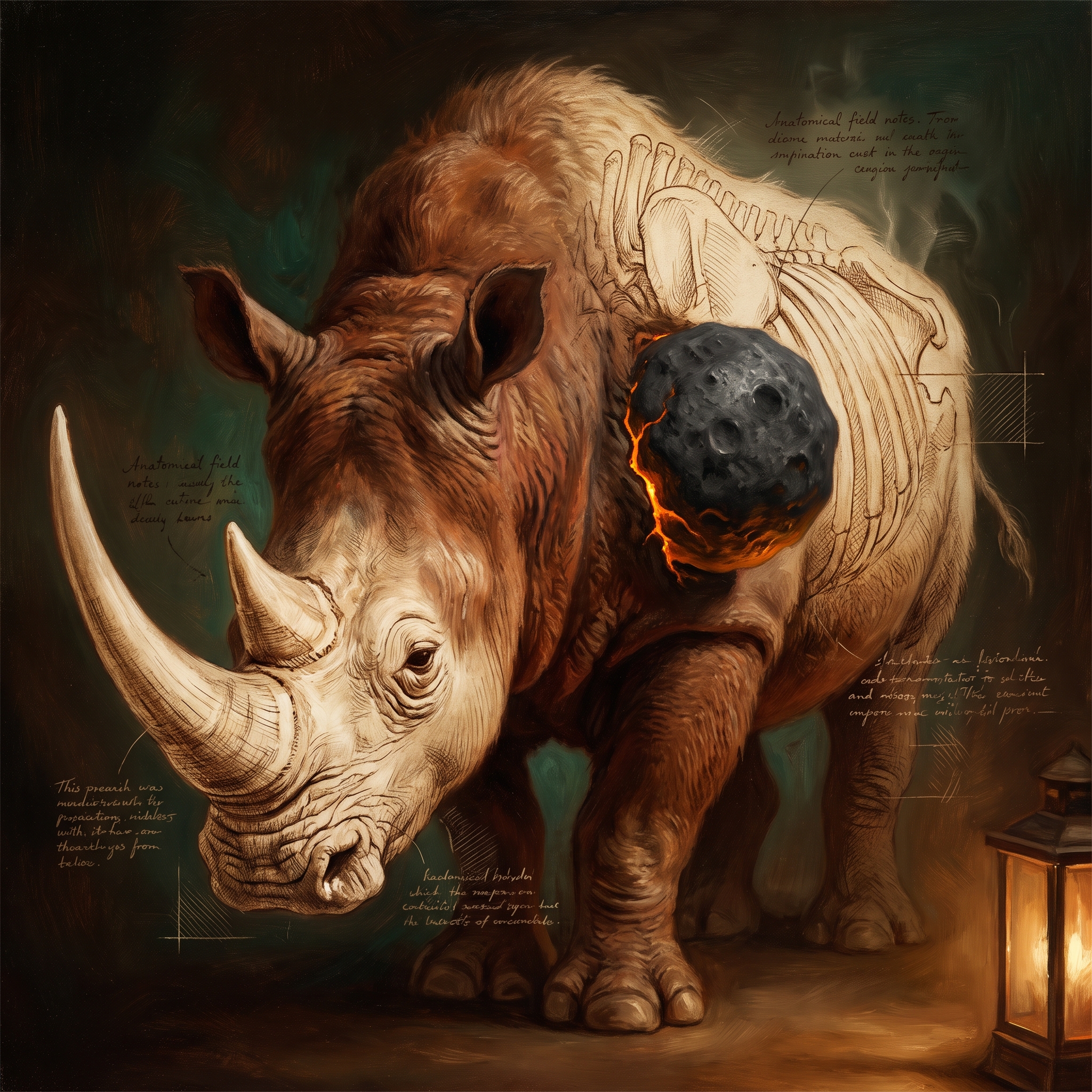
Marcus Vale: Three Javan rhinoceroses. 1740s. Sri Lanka. That's where I want to start — because the Javan rhino is critically endangered, basically only exists in one park in Java today, and apparently we had no idea there were animals being shipped across the Indian Ocean until a software researcher found it last month.
Ben Okonkwo: Hey — yeah, and that detail is the one that landed for me too, actually. So, Jesse Waites — not a domain scientist, a software researcher — he applies AI to approximately four hundred years of digitized archival records. And the framing I keep reaching for is: it's like having a librarian who never sleeps and has read every colonial shipping manifest ever printed. Except in this case the librarian also flags the anomalies.
Marcus Vale: And the anomalies are not small. A possible 1812 meteorite report in Maharashtra — if confirmed, earliest recorded fall there, predating prior records by twenty-six years. Volcanic eruptions the Smithsonian didn't have logged.
Ben Okonkwo: Right — and those volcanic eruptions being absent from the Smithsonian's global database, that one's interesting to me because the Smithsonian's database is supposed to be the authoritative global record. Missing entries there isn't a footnote.
Marcus Vale: So the records existed. Someone wrote them down. They just sat there.
Ben Okonkwo: That's the question I keep arriving at — if these documents were already digitized, already technically accessible, why did it take an AI to find them? What does that tell us about how much else is sitting in there unread?
Marcus Vale: Which is the thing — because the rhino case keeps coming back to me. Not because it's the flashiest, but because it's actually specific enough to pressure-test. A named ship. Sworn testimony. One animal dying in a horse stable in 1738. That's not a vague archival signal.
Ben Okonkwo: Right — and layered on top of that, the 1770s VOC field notes describing rhinoceros paths in the Bantam highlands. That's not a shipping ledger, that's a behavioral observation. Someone watched where rhinos walked. And that region is now completely empty of the species — Ujung Kulon National Park, the only place Javan rhinos still exist, is nowhere near the Bantam highlands.
Marcus Vale: So does this count as a discovery?
Ben Okonkwo: That's the honest question. And I think — no. Not yet. The total historical captive record for Javan rhinoceroses is only a few dozen animals. Three new records with specific provenance would be genuinely significant for conservation history. But 'surfaced' and 'confirmed' are doing completely different jobs here. The documents say rhinoceros — they don't say which subspecies. A zoologist hasn't signed off on the species ID. And the meteorite is explicitly described as a possible 1812 report. That word 'possible' is carrying enormous weight and the headlines keep dropping it.
Marcus Vale: So Waites ran retrieval. Not confirmation. The authentication is someone else's problem now.
Ben Okonkwo: Exactly — and that gap, actually, the retrieval-to-confirmation gap, that's where I think the real complexity lives. There's a peer-review question about Waites's methodology too, which we haven't even touched.
Marcus Vale: Yeah — and the authentication bottleneck turns out to be the whole story. We'll get there.
Ben Okonkwo: And the peer-review gap is actually where I want to push, because — okay, picture a conservation biologist working in Ujung Kulon National Park. She gets an email: attached is a 1740s shipping manifest, note says 'AI found this, is it a Javan rhino?' Now she has to stop whatever she's doing — population survey, genetic sampling, whatever — and chase a provenance question that might resolve and might not. The document says rhinoceros. It doesn't say which species. That determination requires a zoologist cross-referencing morphological descriptions, geographic range data, maybe isotope records. That's weeks of specialist time. Now multiply that by dozens of retrievals per month.
Marcus Vale: Retrieval is cheap now. Authentication is still artisanal.
Ben Okonkwo: That's — yeah, that's the exact mismatch. And there's a 2026 Science.org perspective piece, 'Keep AI-augmented science contestable,' that flags something adjacent — AI in research narrows the topics being studied toward data-rich areas. Which is actually the ceiling problem too: Waites's entire analysis only reaches what's already digitized. Undigitized archives are invisible to this approach entirely.
Marcus Vale: Wait — so the 1738 stable death, the 1740s transport references — those surfaced because someone already paid to digitize and index those records?
Ben Okonkwo: Right — Waites is surfing on infrastructure someone else built. And actually, that inconsistency between the 1738 stable death and the 1740s transport records — a specialist has to resolve whether those are the same animals, overlapping shipments, a clerical error in the original source. The retrieval step surfaces the conflict; it cannot adjudicate it.
Marcus Vale: And Waites's methodology — no peer review before he published this?
Ben Okonkwo: That's the honest answer: we don't know. The sources don't clarify it. And that matters — not to dismiss what he found, but because the method is load-bearing. If the retrieval logic has a bias toward certain record types, every downstream authentication effort could be chasing artifacts of the algorithm, not history.
Marcus Vale: The thing that lands for me at the end of all this — one researcher, weeks of work, and he surfaces a possible meteorite, the Smithsonian's gaps, three Javan rhino transport records. That's the retrieval win. Full stop. But none of it is a discovery yet. It's a stack of candidates waiting for a zoologist and a geologist to clear their schedules.
Ben Okonkwo: And it ends with a question — that's the honest version. The rhino records might get confirmed. The 1812 Maharashtra meteorite might get there. But right now the bottleneck isn't whether AI can find needles in four hundred years of archives. It can. The bottleneck is whether we're building anything that helps specialists confirm which ones are actually needles.
Marcus Vale: We started with three rhinos on a ship. Turns out that's still where we are — except now we know the ship exists and someone has to go verify the manifest.
Ben Okonkwo: Good place to stop. Thanks for pushing on the commercial side — that authentication-capacity question is the one I'll be sitting with.