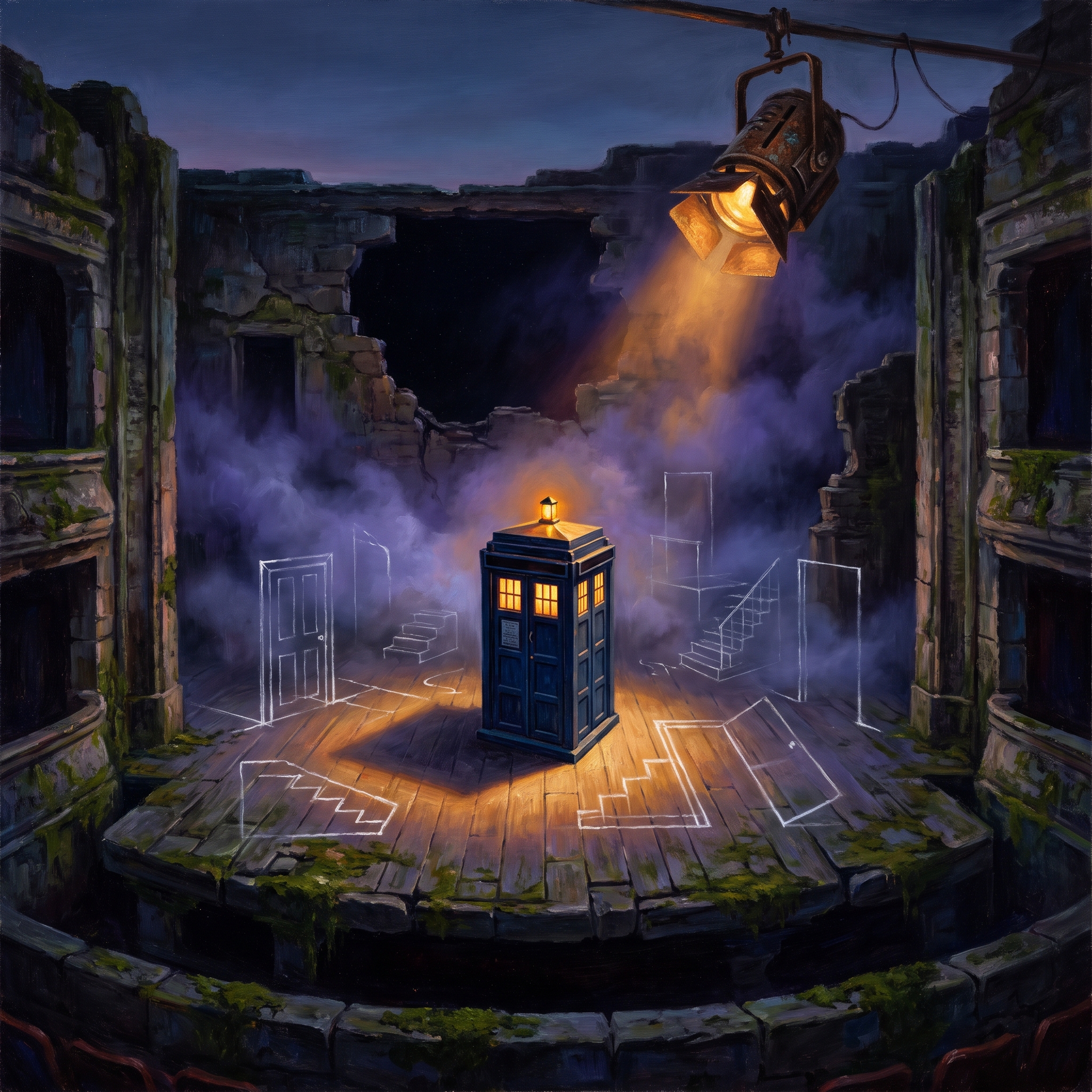
Hope Sterling: Can I ask you something? Like genuinely. What's worse — losing something that existed, or being told in extreme detail about something that never got to exist?
Finn Brooks: Oh that's — hmm. I want to say the first one but my gut says the second?
Hope Sterling: Russell T Davies just made me feel the second one so acutely. His memoir — October 2026 — he's in there describing Ncuti Gatwa's planned third series. The Dalek Christmas special. Specific story beats. All of it. The series that never got made after Disney+ walked away from the Bad Wolf deal.
Finn Brooks: Wait, he described a Dalek Christmas special that's just... not happening? In print?
Hope Sterling: In print! For fans to read! And like — compare that to the 97 wiped Hartnell and Troughton episodes. Those are gone and it's a tragedy, but there's this kind of mercy in not knowing exactly what was on those tapes. RTD took the mercy away. He described it. You know now. You just can't watch it.
Finn Brooks: And this tracks with him, actually — The Writer's Tale, all those changed drafts he made public — he's always done this.
Hope Sterling: It's a whole pattern! Making private creative work just — everyone's. And I think it's generous and also I think it might be the meanest thing a showrunner can do to a fandom.
Finn Brooks: Okay I need the Dalek Christmas special details immediately.
Hope Sterling: Okay but — before the Christmas special — can we actually talk about *why* there's a memoir entry instead of a show? Because I feel like we keep sliding past the part that explains all of it.
Finn Brooks: Yes. Yes, this is the thing I want to ground first, actually — because it's not like Davies chose not to make it. Disney+ pulled out of the partnership with the BBC. Full stop. Bad Wolf — Jane Tranter, Julie Gardner — they produced the revival, Disney handled international distribution, and when that deal collapsed, the money just... evaporated. There was no third series because there was no kitchen to cook in. The chef had the recipes, the menu was printed, and someone padlocked the restaurant before opening night.
Hope Sterling: Wait — the BBC couldn't just cover it themselves?
Finn Brooks: No! That's the whole — the BBC retained UK rights but the scale of the 2023 revival was *built* on Disney money. Without that international streaming deal, it doesn't pencil out. The BBC alone can't fund it.
Hope Sterling: Which is — okay, that's actually kind of terrifying? Like, this is the same show that got cancelled in 1989 because it stopped being commercially viable, came back in 2005 because Davies made it viable again, and now it hits the same wall just through a completely different mechanism.
Finn Brooks: That's exactly it — same commercial wall, new mechanism. Network TV cancels you when ratings tank. Streaming cancels you when a platform decides your show isn't the right asset anymore, and it can happen after the scripts are *written*. Zero filmed content. Pure potential energy, just gone.
Hope Sterling: Mmm. And like — is that actually worse than the BBC wiping the Hartnell tapes? Because at least then the show *ran*. The Gatwa third series never even got to be a mistake.
Finn Brooks: Okay — I love that framing, BUT — wait, I mean, those are almost incomparable? The archive wiping was an institution treating its own output as disposable magnetic stock. This is a platform doing a spreadsheet calculation. Both end in nothing to watch, but the *cause* is so different that I'm not sure the grief is the same either.
Hope Sterling: Erasure by spreadsheet. That's the one. That's the phrase.
Finn Brooks: But see — and this is where I want to push on what you just landed — 'erasure by spreadsheet' gets it right emotionally but it collapses two things that are actually, like, structurally different tragedies. Because the 97 Hartnell and Troughton episodes? They existed. They broadcast. People watched them in living rooms. The BBC then physically erased the tapes to reuse the magnetic stock. That's a thing that *was* and then got destroyed. The Gatwa third series never had footage in the first place.
Hope Sterling: Which is — wait, I actually think that makes RTD's memoir thing hurt *more*? Because at least with the wiped episodes, there's a physical absence. This is pure described potential.
Finn Brooks: Okay but here's what gets me — some of those wiped Hartnell episodes *came back*. Because superfans had set up tape recorders next to their television speakers in the sixties and just... recorded the audio at home. The fandom preserved what the BBC destroyed. Missing Believed Wiped, the whole BBC recovery effort — it has found things because people cared enough to save them privately.
Hope Sterling: Stop. Fans with tape recorders saved the archive?
Finn Brooks: Home audio recordings! In the sixties! And Missing Believed Wiped has no equivalent for content that was never shot — like, you can't recover a Ncuti Gatwa performance that nobody ever filmed. There's nothing to find in someone's attic.
Hope Sterling: That's — that's actually your point *and* my point landing at the same time. Because imagine: someone reads RTD's memoir description of the Dalek Christmas special, they're like, sitting on the floor of a convention, phone out, and they're reading the exact story beat that would've fixed everything about the Fifteenth Doctor's arc, and they just — freeze. Can't un-read it. Can't find it anywhere. That's a completely different grief than 'this tape got erased.' The loss is documented. It's just — it's legible now.
Finn Brooks: And that's where you get your partial win, I think — RTD describing it makes it more concretely felt than 97 silent gaps in an archive. The knowing is the wound.
Hope Sterling: But — and I need us to come back to this — we still don't actually know how concrete those descriptions *are*. Like, is it Big Finish territory? Could they adapt it? Or is it memoir-level impressions? Because that gap is... actually I think that gap might be the whole thing.
Finn Brooks: That is definitely — yeah, that one I don't want to skip.
Hope Sterling: Okay but that gap — concrete versus memoir-level — that's actually the thing I keep tripping over, because Big Finish literally adapted RTD's unmade 1985 Sixth Doctor story for audio. Like that's not hypothetical, that happened. They licensed it, they produced it. So a second life for unproduced Doctor Who material is — it's a real path.
Finn Brooks: Wait, the actual 1985 unmade script? Not a reimagining — the script?
Hope Sterling: The script! Big Finish has a whole precedent for this. And so you'd think, okay, same thing could happen with whatever RTD described in the memoir — but here's where it falls apart for me. Because we genuinely don't know if he wrote full episode scripts for the Gatwa third series or if he's just... describing planning-stage concepts. And those are wildly different things to hand Big Finish.
Finn Brooks: Right — I mean, 'there was going to be a Dalek Christmas special' is not a script. That's a pitch.
Hope Sterling: And like — this is so RTD, by the way. Rose Tyler: Earth Defence. After Billie Piper left. He had this whole spin-off concept, it never got made, it just lived in the ether as a thing he proposed. He generates ideas that outrun what production can actually do with them. So the memoir descriptions might be very much that — vivid, specific-sounding, but not a document anyone can actually hand to a recording studio.
Finn Brooks: Okay that's — that actually reframes the grief a little? Because fans are mourning something whose solidity they literally cannot verify.
Hope Sterling: That's the wound! The uncertainty is part of the loss. And even if Big Finish did pick it up — even best case — it wouldn't be Ncuti Gatwa on screen. It'd be audio. It'd be a version of the thing. A reminder that the thing existed as a plan, not a restoration of it.
Finn Brooks: A different object entirely. Not the filmed series — a... echo of what the filmed series was going to be.
Hope Sterling: And I think that's — actually, yeah, that's the calibrated take. Big Finish is real, the precedent is real, but it doesn't close the gap. The gap is specifically Ncuti Gatwa performing those stories, on camera, as the Fifteenth Doctor. That's what doesn't exist and can't be recovered. Everything else is downstream of that absence.
Finn Brooks: He didn't erase it. He eulogised it. That's somehow worse.
Hope Sterling: That's — yeah. That's the whole thing in one sentence.
Finn Brooks: My detail I'm not over — RTD revived this show from literal cancellation in 2005, built the whole modern version of it, came back in 2023, and then the loss that breaks the streak is just... a streaming deal spreadsheet. That's the one I keep sitting with.
Hope Sterling: Mine is that there are no tapes to find. No attic. No Missing Believed Wiped event that can save a Ncuti Gatwa performance that never happened. The loss is — I mean, it's sealed. By design.
Finn Brooks: To RTD writing the saddest memoir chapter in television history.