Cyrus Reed: Iris, good to be back — I've got a weird one. How many major AI releases do you think happened in roughly the same window this August that were all specifically designed to run without the cloud?
Cyrus Reed: Meta's WhatsApp Scam Alert — August 12th, on-device ML, scam detection that never sends your messages anywhere. Nvidia's Cosmos 3 Edge, four billion parameters, built so a robot can reason in real time with no network. Google's Pixel 11 with Gemini Nano running on the Tensor G6 — though that chip stat is from a single unverified source, flagging that now. And Apple, reported in May ahead of WWDC, partnering with Google and Nvidia to push AI onto the device for iOS 27.
Iris Holm: Four separate bets, same direction, same window. Frankly — that's not a trend piece. That's a signal.
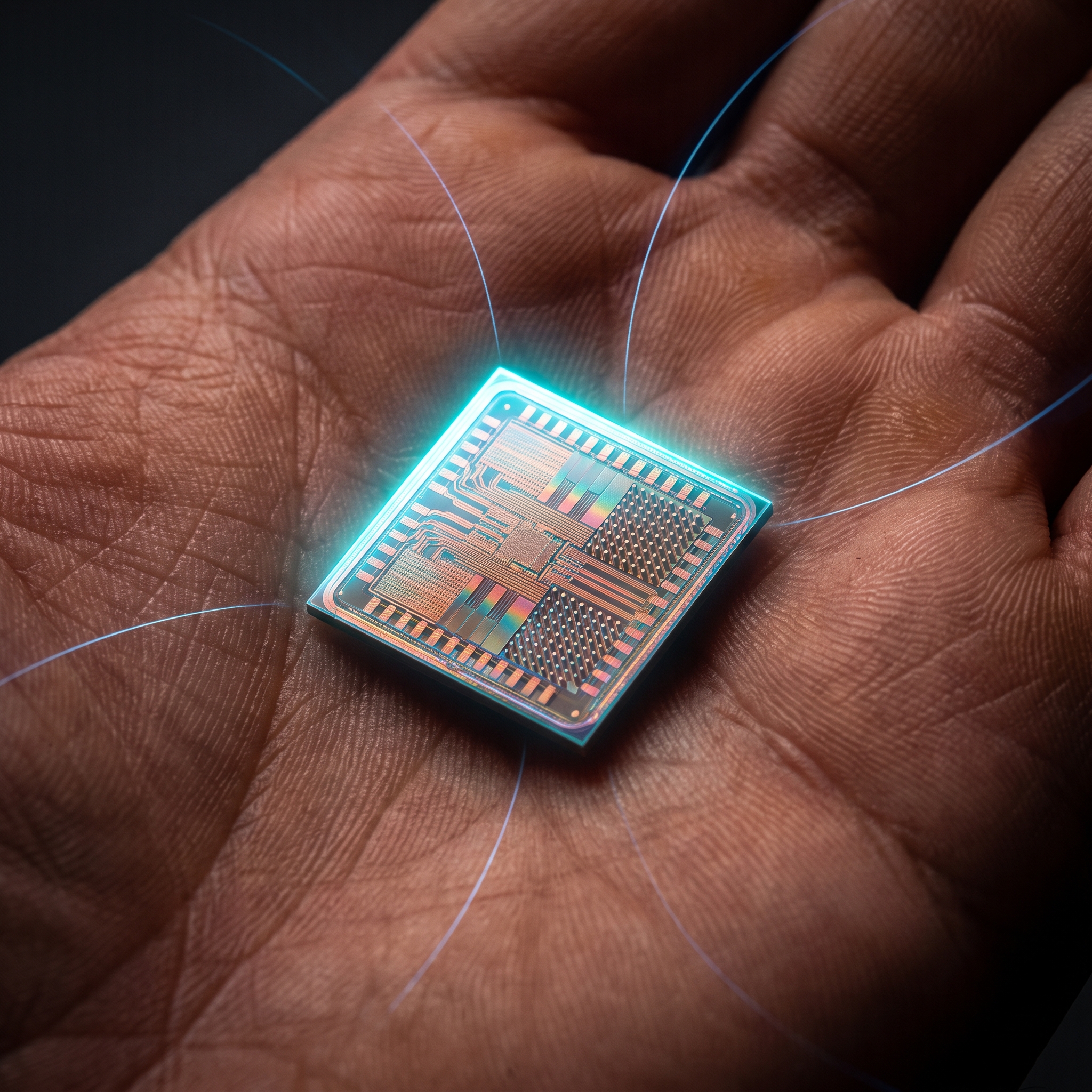
Cyrus Reed: And the word every single one of them reaches for is sovereignty. Which — okay, the plain version of what we're actually talking about is this: on-device inference means the AI computation happens on your phone or your robot, not on a server somewhere. Your device does the math. Data never leaves. It's the difference between a calculator and a fax machine.
Iris Holm: Clean. Now — why are the cloud companies selling you the calculator?
Cyrus Reed: That's — yeah, that's the whole thing. Tim Cook has positioned Apple as the privacy-first option for over a decade. And now he's running that play using Nvidia chips. That combination alone should raise some eyebrows.
Iris Holm: The chip partnership is real, but it's not the mechanism. The mechanism is model compression — quantization, pruning, mixed-precision arithmetic. That's what actually gets a model onto a phone. You're shrinking the weights until the hardware can hold them.
Cyrus Reed: Wait — but if you're shrinking it, isn't it just... worse? Like, a compressed model is a worse model, right?
Iris Holm: Depends what 'worse' means for the task. WhatsApp Scam Alert — August 12th announcement. On-device ML, scam detection, never touches a server. Now — why does that have to be on-device? Not preference. Architecture. Sending the message content to a cloud server breaks end-to-end encryption. The privacy guarantee IS the product. A 'worse' model that runs locally beats a 'better' model that destroys the thing WhatsApp is selling.
Cyrus Reed: Oh — so it's not that on-device is better, it's that for some tasks the cloud isn't even an option.
Iris Holm: Exactly that. Cosmos 3 Edge is four billion parameters — a robot doing real-time vision doesn't need frontier reasoning, it needs an answer in thirty milliseconds. Open-weight models let you run that locally, no proprietary API, no round-trip. There's a Meta 30B agent model being floated in the same cluster — I can't verify a primary source on the name, treat that with caution — but the direction it points is the same. Local, always-on, consumer hardware. The compression is the whole engineering story. And frankly — the part that complicates all of this is the ceiling question, which we'll get to: what happens when the task actually needs frontier reasoning.
Cyrus Reed: Right — but how does someone at a German hospital, say, even know which model tier their diagnostic tool is running on? Like, is that visible to anyone outside the engineering team?
Iris Holm: They don't. And that's the actual architecture. The radiologist doesn't pick — the router does. Inference request comes in, the system checks: is this data sensitive, is it simple enough for a sub-4GB model, does it need to stay inside the facility? GDPR says patient imaging cannot cross the border. So it runs locally. Cosmos 3 Edge makes that feasible for vision tasks right now. But the same hospital asks a complex differential diagnosis question — long context, ambiguous imaging history — that goes to the cloud. The on-device model has a ceiling.
Cyrus Reed: Wait — so the router is deciding what counts as 'too hard' for the edge model?
Iris Holm: Cost, capability, sensitivity. Three inputs. Analysts have put it plainly — on-device AI shifts memory demand, it doesn't eliminate cloud needs. Trivial, non-sensitive queries should still hit public cloud APIs. That's not a failure of the sovereignty pitch. That's the actual design.
Cyrus Reed: Okay but — wait, no — that means 'sovereignty' is doing a lot of heavy lifting here. Like, for most queries it's not privacy driving this, it's just... latency and API cost?
Iris Holm: For most queries, yes. The mainframe didn't disappear when the PC arrived. It became the backend for what the PC couldn't handle. Cloud datacenters are the mainframe in this story.
Cyrus Reed: So who actually benefits from calling the latency optimization 'sovereignty'? Because Tim Cook framing Apple's on-device Siri as the privacy differentiator — that sells hardware. Google's Tensor G6 with the 50% more powerful TPU running Gemini Nano locally — that sells Pixel 11 units. I mean, the companies selling both the edge chip and the cloud inference get to claim independence while keeping the cloud relationship intact.
Iris Holm: The router is their product. Both directions of the router.
Cyrus Reed: And the EU AI Act gives it just enough genuine regulatory teeth — cross-border transfers to US hyperscalers under the CLOUD Act are a real compliance risk — so the sovereignty framing isn't entirely theater. It's theater with a real foundation underneath it.
Iris Holm: Theater with a real foundation. That's the honest place to land. Not cloud versus device — just: someone now has to decide, per query, where the computation runs. That decision didn't exist as a product before. Now it does.
Cyrus Reed: And whoever builds the router — Apple, Google, Meta, Nvidia — they're not selling you independence, they're selling you the thing that decides how independent you are. Which is, I mean, that's actually a bigger position than any single model.
Iris Holm: Bigger position. Open question who gets there. Good place to stop.