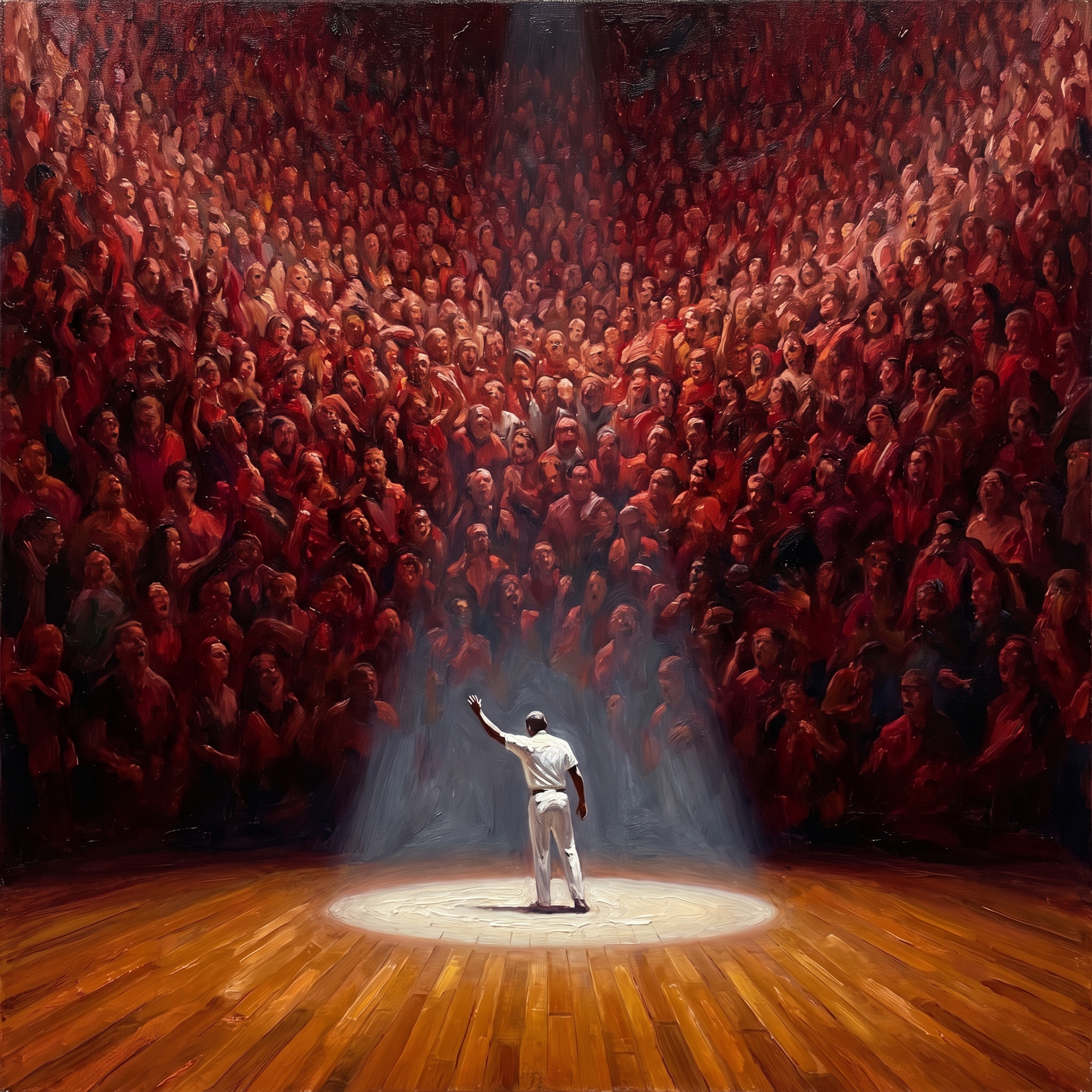
Eliza Ward: Long week — but I cannot stop thinking about empty stadiums, which is a strange thing to be fixated on.
Brian Reed: The COVID ghost games thing, yeah? Same.
Eliza Ward: Because here is what happened — professional leagues played full seasons in empty stadiums, an inadvertent controlled experiment nobody planned, and the studies come back showing referee home bias largely disappeared. Not reduced. Largely gone.
Brian Reed: Which is uncomfortable, right? Because it means officials were — not consciously, but actually — calling games differently based on who was in the seats.
Eliza Ward: And yet home advantage itself didn't vanish. Decreased, yes. Gone? No. Something else held.
Brian Reed: So the part I don't get — if you pull the crowd and the referee bias follows it out the door, what's the residual? What's still producing home wins in an empty building?
Eliza Ward: That's exactly what today is. And the anchor fact — MLB home teams, .530 winning percentage since 1945, through integration, expansion, pitch clocks. Oddsmakers price this into every spread. It's structural, not statistical noise.
Brian Reed: Unchanged for eighty years. So what is home-field advantage, actually — and which mechanism is doing the real work?
Eliza Ward: Okay but — what *is* it, structurally? Like before we get to mechanisms.
Brian Reed: Think of it like a store that has a standing discount — not a sale, not a promotion, just baked-in pricing every single day. Oddsmakers don't sit down before a Kansas City Royals game and think, hmm, how much do the home fans matter tonight. They build it in before the lineups are posted. It's a persistent baseline, not game-specific noise. That's the structural definition — in leagues with balanced home-and-away schedules, home teams win more than fifty percent, consistently, across nearly all team sports. Not sometimes. Structurally.
Eliza Ward: The .530 number in MLB — since 1945. That's through free agency, jet travel, sports science—
Brian Reed: Pitch clocks. Everything. And it hasn't moved. That's the part that I keep — I mean, if modern conditioning or sports psychology were eating into it, you'd expect some drift in the trendline. There isn't one. Major League Baseball has held that number for, what, eighty years roughly.
Eliza Ward: So stable enough that leagues *build* around it.
Brian Reed: That's the tell, actually. League commissioners structure postseason brackets so higher seeds get home games. That's not an accident or a tradition — it's an explicit institutional acknowledgment that the advantage is real and worth awarding. You earn home games the way you'd earn a better contract clause. It's leverage.
Eliza Ward: Wait — so if it's that durable, why don't we actually know what's *driving* it? That's the part that doesn't fit.
Brian Reed: Because durable doesn't mean explained. The number is clean. The mechanism — that's messier, genuinely contested. Crowd effects, travel fatigue, referee behavior — they're all in the literature, but whether they're independent levers or the same lever pulled by different hands? That's the open question.
Eliza Ward: But — wait, that's actually the part that breaks open when you look at it. Because the intuitive stories, the ones everyone reaches for? They mostly don't survive the data.
Brian Reed: Which ones are we talking?
Eliza Ward: Crowd noise as a direct performance driver. Moskowitz and Wertheim — Scorecasting — stress-tested it. The idea that noise rattles visiting players, throws off their timing, whatever. Not persuasive as a standalone explanation. They couldn't find clean evidence it was doing that work directly.
Brian Reed: Okay but here's the one that actually surprised me when I read it — the environmental familiarity theory. Cold-weather teams, altitude teams. The intuition is: the Packers in January, the Broncos at a mile high, visiting teams are just — they're not adapted. Right? Except Moskowitz and Wertheim ran that too. Green Bay doesn't show statistically significant extra home advantage in cold conditions. Denver doesn't dominate at altitude beyond what you'd predict from — I mean, the effect just isn't there. The familiarity story completely fails the data.
Eliza Ward: That one I did not expect.
Brian Reed: Neither did I, honestly. Because it feels so — like, picture a Broncos lineman who's been practicing at altitude since August. Visiting team flies in from Miami two days before. You'd bet on familiarity mattering. Except statistically, it doesn't produce the extra edge the theory predicts.
Eliza Ward: So what about travel fatigue — because that one feels different. The NBA visiting teams, the back-to-back scheduling quirk—
Brian Reed: Right, and this is actually — okay, so imagine an NBA point guard. It's midnight, he's landing in a new city after playing in Cleveland three hours ago, second game in two nights. That image is doing a lot of work in the travel fatigue argument. But the research suggests it might be the scheduling pattern that's the actual culprit — visiting teams in the NBA disproportionately draw back-to-back slots. So what looks like travel stress could be fixture congestion. Not the flight. The calendar.
Eliza Ward: Which means if you fixed the schedule, you'd shrink the effect — and that's before we even get to what the ghost games actually isolated. The mechanism that reacted most sharply when the crowds disappeared. That part genuinely changes the picture.
Brian Reed: That mechanism — referee bias — it's the one that reacted most sharply. English Premier League studies, normal conditions: away teams get more yellow cards, home teams get the favorable calls on the close ones. You run the same season without fans in the seats, that effect is gone. Not smaller. Gone. That's not noise.
Eliza Ward: Hold on. Gone entirely?
Brian Reed: Largely, yeah. And the framing Moskowitz and Wertheim put on it — referee bias as the most statistically supportable primary mechanism — that finding got weight precisely because the ghost games gave you something close to a controlled condition. Nobody planned it. It just happened.
Eliza Ward: Okay but — does the crowd cause referee bias, or does referee bias cause home advantage? Like, is that distinction even meaningful?
Brian Reed: It's actually — so this is where the Home Advantage Mediation model does real work. The crowd isn't rattling the visiting striker directly. It's working through the referee. Picture a Premier League official, seventy-second minute, home side's striker goes down in the box. Fifty thousand people are screaming for a penalty. The official isn't consciously caving — but the crowd is calibrating his read of the contact. That's the mediation. Crowd presses referee; referee adjusts the margin; home team benefits. The crowd isn't the last link in the chain, it's the first.
Eliza Ward: Which makes officiating fairness partly — wait, that's actually uncomfortable — partly a function of stadium attendance.
Brian Reed: That's the discomfort, yeah. And the structural part that remained in empty stadiums — the advantage that didn't disappear — that's scheduling, logistics, the calendar stuff we were just on. Real, but smaller. The crowd-independent factors exist; they're just not the dominant lever.
Eliza Ward: So the controllable mechanism — the one a league could actually touch — is referee bias. VAR in the Premier League, crew rotation, maybe automation at the margins.
Brian Reed: Right, and that's — I mean, that's the observable test. If VAR implementation in the EPL flattened the yellow-card gap between home and away sides, that would be a real signal. You'd have a before-and-after on the same mechanism the ghost games already isolated. That's actually a verifiable next step, not just a hypothesis.
Eliza Ward: The research on referee bias — it's concentrated in soccer and basketball. The EPL data is real. The ghost-game isolation is real. But whether that generalizes cleanly to every sport with human officials? That's still a gap. We don't have the same quality of evidence across the board.
Brian Reed: Which means the most controllable lever might be — I mean, it's controllable in principle. VAR, automated strike zones, neutral-site playoff formats. Those are direct structural responses to exactly the crowd-mediated bias the ghost games isolated. But if the finding doesn't hold uniformly across sports, you're designing policy off incomplete data.
Eliza Ward: Right — but the league format piece is already moving, whether we know the mechanism fully or not. Commissioners are designing postseason brackets around this. That's not waiting for a cleaner study.
Brian Reed: Which is the strange thing to sit with. A .530 winning percentage, eighty years, baked into the spread before the lineups post — and we're only now figuring out that the crowd was working through the official the whole time. Not the noise. The referee.
Eliza Ward: We started with empty stadiums and thought the absence of fans was the story. Turns out the fans were always the story — just one step removed. Through the person with the whistle.
Brian Reed: That's a better place to stop than most. Appreciate you working through the messy parts with me on this one.