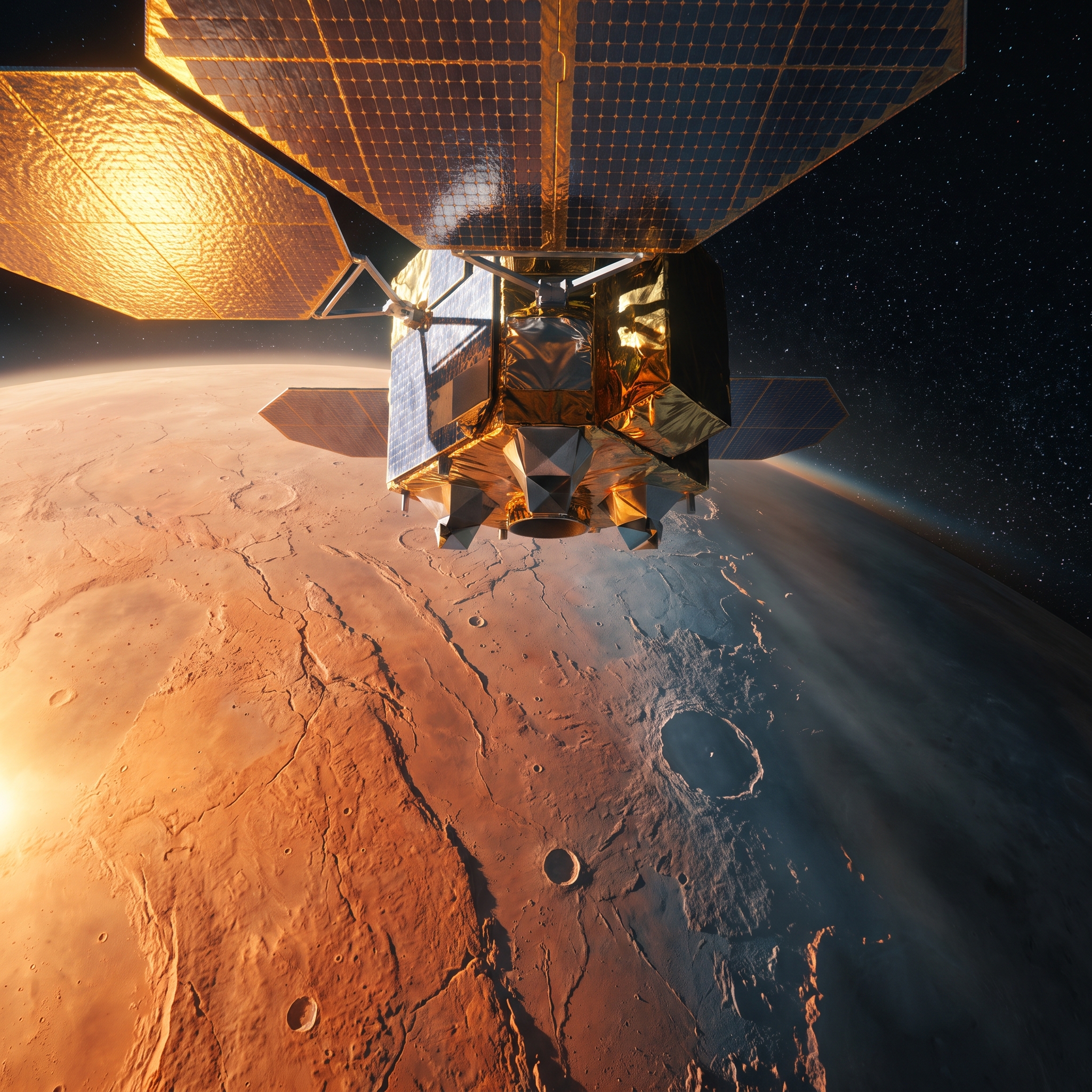
Mark Delaney: Eight January, 2025. A spacecraft skims past Mercury for the sixth time — not to stop, not yet, just to brush the planet's gravity and lose a little more speed — and then it's gone again, back out on its long arc through the inner solar system.
Mark Delaney: That was the last one.
Mark Delaney: Six Mercury flybys, done. Part of nine total — Earth once, Venus twice, Mercury six times — all gravity-assists, all of them there to shed velocity. Because reaching Mercury doesn't mean speeding toward it. You're falling toward the Sun the whole way, and if you don't slow yourself down, the planet just slides past you.
Mark Delaney: BepiColombo — ESA and JAXA's joint mission — launched 20 October 2018 on an Ariane 5 from Kourou, French Guiana. Eight-year cruise. And after that January flyby, it's now in its final approach… Mercury orbit insertion planned for late November 2026.
Mark Delaney: Only the second spacecraft to ever orbit Mercury.
Mark Delaney: The first was MESSENGER — NASA, orbiting from 2011 to 2015, mapping surface composition, finding ice at the poles, confirming a weak but genuinely active magnetic field. Hit the surface April 2015, planned impact, fuel gone. It earned its ending.
Mark Delaney: But here's what MESSENGER couldn't fully explain, and what makes Mercury worth going back to: the core. It takes up roughly 85% of Mercury's radius. That's not — I mean, that's not a rounding error, that's almost the ENTIRE planet. Iron, almost all the way out. And despite being small and presumably not generating much internal heat anymore, Mercury still has a measurable global magnetic field.
Mark Delaney: An active dynamo. In a planet this size. That doesn't fit neatly.
Mark Delaney: The mission's name comes from Giuseppe Colombo — Bepi — Italian mathematician and engineer, 1920 to 1984. He's the one who first developed the gravity-assist concept. He also explained Mercury's 3:2 spin-orbit resonance — that Mercury rotates three times for every two trips around the Sun, which nobody had understood before him.
Mark Delaney: Mariner 10 flew past Mercury three times in 1974 and 1975 — first spacecraft ever to visit — and it got there using the trajectory technique Colombo conceived.
Mark Delaney: So the man figured out how to get there, figured out how Mercury moves, and now a spacecraft bearing his name is finally going to orbit the thing.
Mark Delaney: Nine flybys. Seven years. A planet that is, honestly, kinda weird at its core — literally. That's what this is about.
Mark Delaney: And here's where BepiColombo does something genuinely different — something MESSENGER couldn't.
Mark Delaney: It's not one spacecraft. It's two. Flying together.
Mark Delaney: You've got MPO — the Mercury Planetary Orbiter, ESA's contribution — mapping the surface, studying the exosphere, probing the interior. And then Mio — that's JAXA's orbiter, the Mercury Magnetospheric Orbiter — sitting out further, watching the magnetic field environment, the magnetosphere, the solar wind interaction.
Mark Delaney: Simultaneously.
Mark Delaney: That's never been done at Mercury before. One spacecraft can tell you what the surface looks like — it can't ALSO tell you what the field is doing at the same moment, at a different altitude, in a different part of the environment.
Mark Delaney: And that gap… that's basically where the dynamo question lives. MESSENGER confirmed the magnetic field exists, confirmed it's weak but genuinely active. What it couldn't nail down is why. Why does a planet with a core that size — 85% of its radius, almost all iron — still have an active dynamo? That's the thing that doesn't fit any clean model of rocky planet formation.
Mark Delaney: If we figure that out for Mercury, we're not just solving Mercury. We're filling in something about how all terrestrial planets cool and evolve.
Mark Delaney: MPO is carrying an instrument called MIXS — Mercury Imaging X-Ray Spectrometer. It maps surface composition using X-ray spectroscopy, essentially catching X-rays that the Sun kicks off Mercury's surface and reading the chemical signature back. Professor Suzie Imber is Co-Investigator on it — she gave a public talk about the mission goals late 2025 — and the idea is that MIXS can tell you not just what's on the surface, but what the crust is actually made of, which feeds back into understanding how the planet formed.
Mark Delaney: The why, not just the what.
Mark Delaney: The MTM — the Mercury Transfer Module, the propulsion unit that's been hauling both orbiters across the inner solar system on those solar-electric ion thrusters — that detaches September 2026. Then MPO and Mio separate from each other in December, settle into their individual science orbits, and the joint science phase kicks off April 2027.
Mark Delaney: But here's where I'd pump the brakes a little — because there's a real operational tension in all of this.
Mark Delaney: Mio — the magnetosphere orbiter, the one doing the magnetic field science — faces thermal constraints during perihelion season, when Mercury's closest to the Sun and the heat load is most intense. And then power constraints during aphelion season. So the moments when you most want Mio's magnetometer running cleanly… might be exactly when it can't.
Mark Delaney: That's not a design flaw they overlooked — Mercury is just a brutal environment and you work within it. But it does mean the scientific return isn't fully guaranteed. Some of the most revealing orbital moments might be constrained.
Mark Delaney: Two billion dollars, seven years of cruise, two spacecraft built on different continents — and the most important instrument might be fighting the environment at the worst possible time. That's the thing hanging over this.
Mark Delaney: Here's what the next eighteen months actually look like — and I want to walk through it step by step, with the real months attached, because it matters.
Mark Delaney: September 2026. That's when the Mercury Transfer Module detaches. The MTM — the propulsion unit, the ion-thruster stack that's been hauling everything across the inner solar system for nearly eight years — it's done. It lets go. And from that moment, BepiColombo is committed. No more thrust. No more trajectory correction. Just two orbiters and the gravity of Mercury pulling them in.
Mark Delaney: That's the point of no return, kinda.
Mark Delaney: Then late November 2026 — Mercury orbit insertion. Both MPO and Mio slip into Mercury orbit together. And with that, BepiColombo becomes only the second spacecraft to ever orbit Mercury. MESSENGER did it first, 2011. That's it. That's the whole list until November 2026.
Mark Delaney: Now — I should flag something, because you might have seen December 2025 floating around on some institutional pages as the Mercury arrival date. That's an outdated placeholder. The confirmed figure, from Geraint Jones and colleagues at the EGU General Assembly in June 2026, is November 2026. The mission update presentation walked through all of this. November. Not December 2025.
Mark Delaney: Worth correcting. Moving on.
Mark Delaney: December 2026 — MPO and Mio separate from each other. They've been stacked together this whole cruise, remember — now they peel apart and each one goes to its own science orbit. MPO lower, tighter, surface-facing. Mio further out, watching the magnetosphere. Two spacecraft, two very different vantage points, doing their thing simultaneously for the first time ever at Mercury.
Mark Delaney: MPO then spends a few months adjusting — and by March 2027, it's in its final science orbit. Settled. Ready.
Mark Delaney: And then April 2027. That's when the nominal joint science phase begins. Both orbiters running, both transmitting, the whole two-spacecraft picture snapping into focus at once.
Mark Delaney: These are planning figures — Geraint Jones was clear that exact execution dates can still shift with operational constraints. Mercury is not a forgiving environment. But the sequence is locked: MTM detach, insertion, separation, MPO final orbit, joint science. September, November, December, March, April.
Mark Delaney: April 2027. That's when the questions — the dynamo, the core, the magnetic field MESSENGER couldn't fully explain — that's when those questions actually start getting answered. Everything before that is just getting there. April is when the work begins.
Mark Delaney: And that constraint with Mio — the thermal and power thing — it's not just a scheduling headache. It's structural. The moments when Mercury is closest to the Sun, when the magnetic environment is most compressed and most active, when Mio's magnetometer would have the most to say about the dynamo question — those are exactly the moments the instrument has to pull back. Not because of a design failure. Because Mercury itself is running at full intensity and the hardware just can't match it.
Mark Delaney: There's a strange kind of irony in that, kinda. You spend seven years — nine flybys, an eight-year cruise, November 2026 insertion, two spacecraft prying apart in December — all of it aimed at understanding why this planet has an active dynamo when nothing about its size suggests it should. And then the instrument best placed to answer that question has to go partly blind at closest approach. The environment that makes Mercury scientifically fascinating is the same environment that degrades your ability to observe it.
Mark Delaney: April 2027 is when the joint science phase starts. That's real. Both orbiters, both running, the full two-spacecraft picture. But the clearest view of Mercury's magnetic field — the one that might finally explain the dynamo, fill in what MESSENGER left open — that view is going to come through instruments that partly shield themselves from the thing they're trying to see.