Iris Holm: You look like you've been up since four.
Cyrus Reed: I kind of have been, honestly — I fell into this thing about Friedrich Wilhelm Bessel and I genuinely could not stop. Because, no wait, hear me out — it's 1838, it's winter, Königsberg, and this man has been pointing his telescope at a star called 61 Cygni for six months, watching it appear to shift against the background sky as Earth orbits the Sun. Stellar parallax. The geometric proof that Earth actually moves. And he catches it. He finally catches it after Copernicus set up that expectation roughly two hundred years earlier.
Iris Holm: Two hundred years of searching, and it ends in what — a single winter's dataset.
Cyrus Reed: Six months of observations, yeah. But here's where it actually gets complicated — Bessel wasn't alone. Thomas Henderson had been measuring the parallax of Alpha Centauri starting in 1832. Friedrich Georg Wilhelm von Struve had Vega in that same window. Three astronomers, three different stars, all closing in on the same measurement at the same moment.
Iris Holm: Wait — 200 years of searching and it was three people at once?
Cyrus Reed: Three people, same narrow window, different stars, different instruments — and Bessel's 61 Cygni gets called the landmark. Henderson and von Struve basically get the footnote. So the question I can't shake is: what does 'first' actually mean when three people arrive at the same moment?
Iris Holm: And whatever answer we gave in 1838 — we built the entire cosmic distance ladder on top of it.
Cyrus Reed: But wait — before we get into why that matters, I'm not even sure I understand what the measurement actually is. Like, what is stellar parallax, at the level of — I'm standing outside, what am I even watching shift?
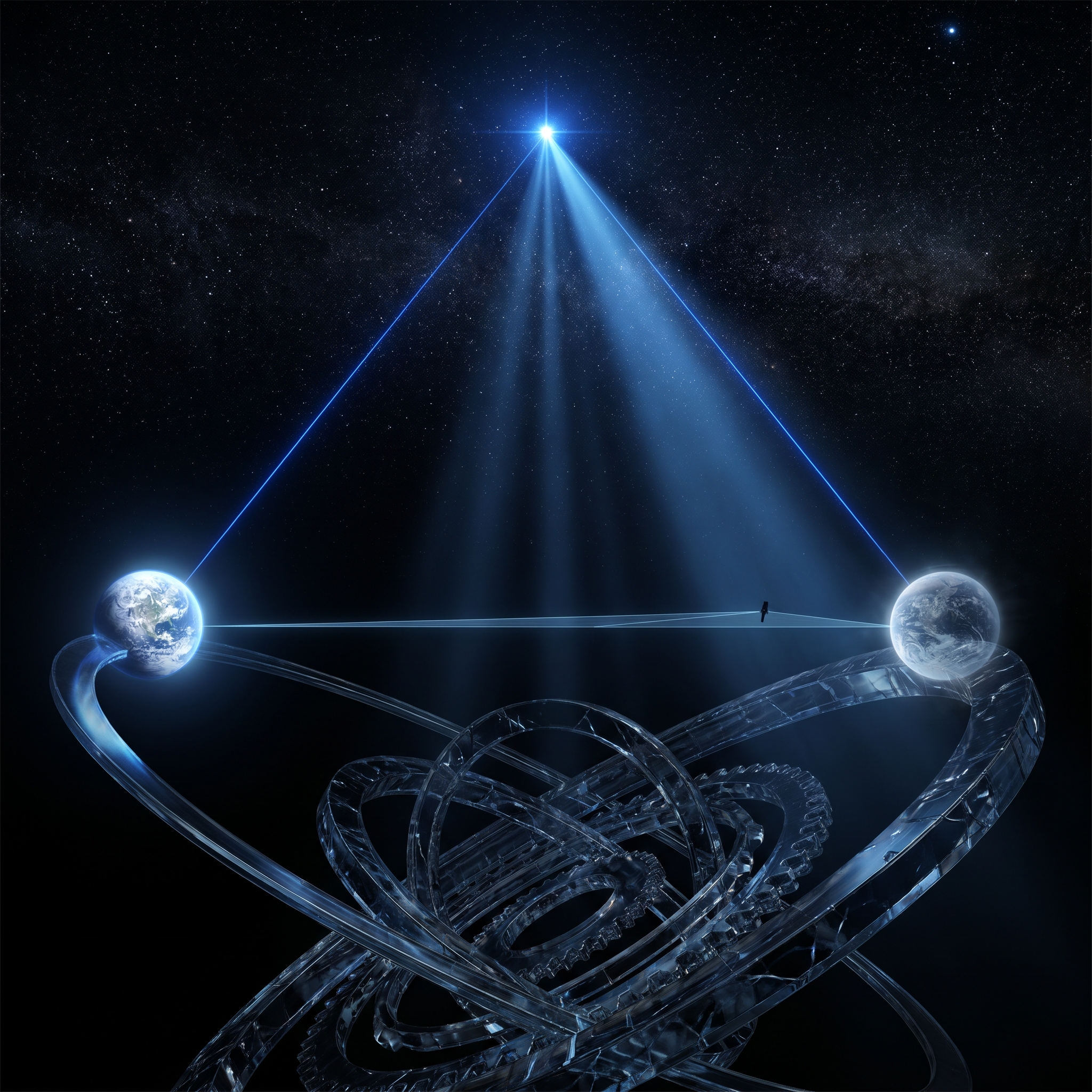
Iris Holm: Hold up your thumb. Close your left eye, then your right. Your thumb jumps against the wall behind it. That's it. Earth's orbit is the two eyes, a star is the thumb, the distant background stars are the wall.
Cyrus Reed: So it's just — we're switching eyes twice a year?
Iris Holm: Exactly that. January to July, Earth moves to the opposite side of its orbit. The star appears to shift against the background. You measure that angle — that's the parallax angle. And then the distance falls straight out of it: d in parsecs equals one over p in arcseconds. No assumptions about what the star is made of, how bright it is, nothing. Pure surveying geometry.
Cyrus Reed: Wait, and the parsec isn't — I always thought that was an invented unit, like someone just decided on it. But it comes directly out of that formula?
Iris Holm: It falls out of the geometry. One parsec is the distance at which a star would show exactly one arcsecond of parallax. You didn't invent the unit — the unit is just the geometry naming itself.
Cyrus Reed: Huh. Okay that's actually — yeah, that reframes it completely.
Iris Holm: Proxima Centauri: parallax angle of about 0.77 arcseconds. Plug it in — distance comes out to roughly 1.3 parsecs, which is about 4.2 light-years. That's the nearest star. And the angle is less than one arcsecond. Tiny. Barely there.
Cyrus Reed: No but — okay so if it's literally just a triangle, if middle school geometry gets you the nearest star — how did it take until 1838? Galileo couldn't do this?
Iris Holm: Galileo searched. His contemporaries searched. The angles are so absurdly small that no instrument in the seventeenth century could resolve them. Proxima's 0.77 arcseconds is the biggest parallax of any star — that's the easiest case — and it's still smaller than what the naked eye can distinguish by a factor of, I mean, enormous. The geometry was always trivial. The instrumentation wasn't there.
Cyrus Reed: So those failed searches — they just came back with nothing?
Iris Holm: Not nothing. They came back with stellar aberration — a different apparent shift in star positions, caused by Earth's orbital velocity combined with the finite speed of light. Completely distinct from parallax. It's still evidence Earth moves, just from a different mechanism. Copernicans didn't lose when parallax searches failed. Either you detect the parallax and Earth moves, or you fail to detect it and the stars are just vastly farther than you imagined. Both results are consistent with heliocentrism.
Cyrus Reed: Wait — so the non-detection was never falsification. It just kept pushing the universe outward.
Iris Holm: Right — and that's the thing that links directly to why Bessel's triangle doesn't just sit there as a historical curiosity. That single geometric baseline is the ground floor of everything we think we know about the scale of the universe.
Cyrus Reed: Wait, everything? Like — how far does that actually reach?
Iris Holm: All the way to the expansion rate of the universe. That's the cosmic distance ladder. Parallax gives you real distances to nearby stars — no assumptions. Those real distances let you calibrate Cepheid variable stars.
Cyrus Reed: Cepheids — those are the pulsing ones, right? The ones that blink at a rate that tells you how bright they actually are? The Leavitt Law?
Iris Holm: Exactly. The period–luminosity relation. Henrietta Leavitt's insight: the longer the pulsation period, the more intrinsically luminous the star. But you can only convert period into actual brightness if you know the distance to at least one nearby Cepheid — and you get that distance from parallax. So Bessel's geometry is literally inside that calibration.
Cyrus Reed: And then — okay, so once you have Cepheids as standard candles, you can see them in other galaxies and work out how far those galaxies are. And then from there you get to — Type Ia supernovae?
Iris Holm: Yes. Type Ia supernovae have a consistent peak luminosity, calibrated against Cepheid distances. They're bright enough to see across cosmological distances. And once you have those distances plus galactic redshifts — you get the Hubble constant. The universe's expansion rate. So the Hubble constant, the number that describes how fast the universe is expanding, traces back to Bessel measuring a wobble in 61 Cygni in 1838.
Cyrus Reed: That's — no, I mean that's actually a little terrifying when you say it that way.
Iris Holm: Think about what that means for error propagation. A structural engineer — say her name is Dayo Adeyemi, she's recalibrating the baseline survey for a bridge. Her initial GPS anchor is off by one centimeter. Every single measurement downstream inherits that offset. By the time you're placing the far pylons, you're wrong by meters. The cosmic distance ladder is the same architecture. A systematic error in the parallax foundation — even a fraction of a milliarcsecond — compounds at every rung. Cepheid distances shift. Supernova distances shift. The Hubble constant shifts.
Cyrus Reed: But wait — the ladder's supposed to be checkable, right? Each rung is independently verifiable. Isn't that the whole strength of it?
Iris Holm: That's the pitch. And it's true — each rung uses different physics. Cepheids are period-luminosity relationships, supernovae are thermonuclear explosions, they're not the same kind of measurement. But the thing is — independent rungs still share a common anchor. If the parallax base carries a systematic bias, 'independently checkable' doesn't protect you. You're just checking each rung against a floor that's already tilted.
Cyrus Reed: So has anyone actually checked the foundation — like, gone back to the ground level and asked whether Bessel's baseline is clean all the way down?
Iris Holm: That's — frankly, it's uncomfortable in a way I think the Hubble tension is only starting to surface. And what Gaia is doing to that foundation right now? That's a whole other level of the problem.
Cyrus Reed: Wait, what does Gaia actually — like, when you say billion stars, I'm not even sure I have a feel for what that means as a foundation shift versus just, more of the same thing Hipparcos was doing?
Iris Holm: Hipparcos — ESA's first space-based astrometry mission — measured hundreds of thousands of stars. Gaia launched in 2013, measures approximately one billion, at 0.00001 arcseconds precision. That's five orders of magnitude tighter. It's not more of the same. The thing stops being a ladder and starts being a geometric scaffold continuous across most of the galaxy.
Cyrus Reed: So that should have just — solved it. Right? Billion stars, that precision, the Hubble tension closes.
Iris Holm: Gaia's precision was so extreme it started detecting its own systematic zero-point errors — shifts in the entire coordinate system. Fractions of a percent. And fractions of a percent in Gaia's zero-point moves the Cepheid calibration, which moves the supernova distance scale, which moves H₀. The Hubble tension is still sitting there: local distance ladder gives you around 73 kilometers per second per megaparsec, CMB observations from the early universe give you around 67. That six-unit gap has not closed.
Cyrus Reed: Hold on — the instrument got so precise it found errors in itself?
Iris Holm: That's exactly what happened. We went from two centuries of searching for any parallax signal at all to being paralyzed by excess precision uncovering calibrations we didn't know were wrong.
Cyrus Reed: But okay, here's — wait, no, I want to push on the ladder thing because Cepheids are period-luminosity relationships and Type Ia supernovae are thermonuclear explosions. Those aren't even the same kind of physics. So why should their error bars behave like they're on the same ladder at all? Isn't that — maybe that's the wrong metaphor rather than a measurement problem?
Iris Holm: That's the sharper version of the question, yes. But here's what the different-physics argument misses: the rungs don't share error bars, they share an anchor. Every calibration chain — Cepheids, supernovae, all of it — converges back onto Gaia's zero-point. Different physics on the rungs, same floor. If the floor tilts, the ladder assumption that each rung is independent stops holding. That's not a measurement problem. That's structural.
Cyrus Reed: So the 73 versus 67 — is that an engineering failure in the parallax anchoring, or is it actually telling us the universe does something weird?
Iris Holm: That's the live debate. Position one: bad parallax anchors, systematic bias compounding rung by rung — an engineering problem, fixable in principle. Position two: the discrepancy is too large, too persistent across methods that shouldn't share systematics — it may be pointing at something like early dark energy, genuinely new physics that no local parallax measurement can reach. Gaia can't tell you which one. It can only make the discrepancy impossible to ignore.
Cyrus Reed: So Bessel catches a wobble in 61 Cygni in 1838 and we're still — we're sitting here arguing about what it means for the expansion rate of the universe. The wobble is still load-bearing.
Iris Holm: Still load-bearing. Same triangle. Earth, Sun, 61 Cygni — that geometry hasn't been replaced. Gaia runs one billion versions of it, but the version Bessel ran in 1838 is still the conceptual base.
Cyrus Reed: And if Gaia's next data release shows the parallax zero-point is off enough to shift Cepheid distances by even one percent — that doesn't close the Hubble tension. It could widen it. We get more precise and the gap gets worse.
Iris Holm: That's the part I keep not being able to resolve cleanly. The wobble Bessel caught is real — the geometry is sound. But what the wobble is telling us about everything built above it... that's still open.
Cyrus Reed: One star. One winter. And here we are.
Iris Holm: One billion stars later. Same question.
Cyrus Reed: I think that's — yeah. That's actually where I wanted to land. I didn't expect it to feel this quiet at the end of it, but it does.
Iris Holm: Good kind of quiet. Thanks for staying up since four for this one.