Ben Okonkwo: Jonathan, good to be back — I have to tell you, I went down a genuinely bleak rabbit hole this week.
Jonathan Ingles: How bleak are we talking?
Ben Okonkwo: So I'm reading about magnetic tape chemistry — specifically hydrolysis, which is the process where moisture breaks down the polyurethane binder in old videotape, the whole oxide layer starts shedding — and I'm thinking, okay, this is sad but it's physics. And then I get to the NBC section and I realize, actually, no. The physics is almost a distraction.
Jonathan Ingles: Because NBC didn't wait for decay.
Ben Okonkwo: They erased the tapes themselves, mid-1970s, deliberately. Reused the stock. Sketches, performances, chunks of their own archive — wiped because storing tape cost more than buying new tape. And that flipped something for me about how I was framing this whole problem.
Jonathan Ingles: The crisis isn't a physics failure. The physics is the alibi.
Ben Okonkwo: Mm, and that matters specifically when you look at something like the CBS News vault — over a million videotapes, most expected to be unplayable within a decade. Now, sticky-shed syndrome is real, the chemistry is real. But why hasn't anyone intervened? It's not that the baking treatment doesn't exist, it's not that digitization is impossible—
Jonathan Ingles: It's that CBS made its money. The incentive to preserve is zero once the revenue's already out the door. That's the trap — profit up front, cost of memory deferred until the tape is dust.
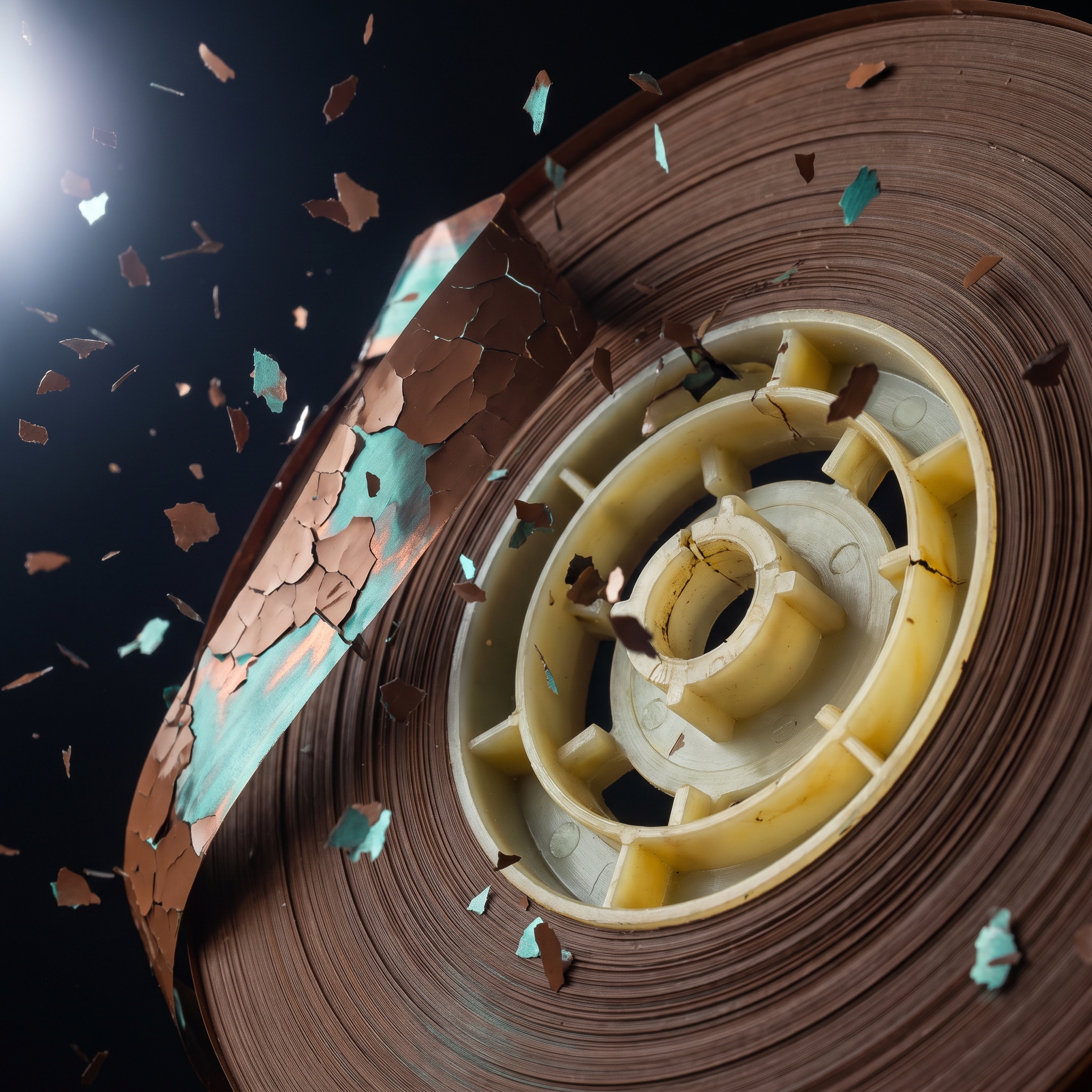
Ben Okonkwo: And the trap closes faster than most people realize, because — okay, imagine a tape librarian at a regional CBS affiliate in 1994, pulling a reel from 1971. She puts it on the deck, and the playback head immediately gums up with this sticky residue. That's sticky-shed syndrome. That's the binder failing. The rubber-band-in-a-humid-drawer version of it is almost exactly right: the polyurethane layer that holds everything together absorbs moisture over decades, the long molecular chains break down — that's the hydrolysis — and what was a smooth, flexible binder becomes gummy. And the gum takes the iron oxide particles with it when it sheds.
Jonathan Ingles: So when you say the information is gone — you mean the actual magnetic particles physically fell off the tape?
Ben Okonkwo: Literally. The iron oxide — or chromium dioxide, depending on the formulation — those particles are the signal. They're what got magnetized during recording. Once the binder fails and they shed onto the playback head, they're not on the tape anymore. That content does not exist in recoverable form. The physics is not being dramatic about this.
Jonathan Ingles: And the window for this is what — two to four decades?
Ben Okonkwo: Typically. Which is the maddening part, actually — we've known this timeline for a long time. The chemistry was well-understood by archivists. The problem was never ignorance of the mechanism. So there is a rescue intervention: you bake the tape. Low-temperature oven, carefully controlled, re-hardens the binder temporarily.
Jonathan Ingles: Wait. And then what — you get multiple plays out of it?
Ben Okonkwo: One. You get one final transfer window. Then it degrades again, and the baking treatment doesn't work a second time the same way. So everything rides on that single playback — you capture it digitally or you don't, and if you don't, it's gone.
Jonathan Ingles: One play. That's the whole rescue. And you've known this was coming for thirty years.
Ben Okonkwo: That's the part that's hard to sit with. The degradation timeline was not a surprise. The window was known — predictable, even if not precisely datable for any individual reel. And the baking treatment existed. So the question was never can we save this. It was will anyone pay to save this before the window closes. And the answer, across most of the industry, was no.
Jonathan Ingles: And here's what kills me — most of that material never even got a chance to degrade. The chemistry is almost irrelevant for the worst losses. Because NBC in the mid-1970s didn't wait for sticky-shed syndrome. Some operations manager, clipboard in hand, just checked boxes. Reuse this reel. Reuse this one. Sketches, musical performances, partial episodes — gone before any molecule of polyurethane had a chance to fail.
Ben Okonkwo: Right — so when we say something is 'lost television,' we might actually mean it was deliberately killed. Not neglected. Killed.
Jonathan Ingles: Two distinct phases. Intentional destruction first. Physical decay second. And the intentional destruction was worse, frankly, because it was a choice made inside a working institution with the archive sitting right there.
Ben Okonkwo: The DuMont Television Network is the extreme case of this — DuMont's archive was largely destroyed, and for many titles, no footage, no stills, no scripts survive. Not because the tapes degraded. Because the material was treated as having zero residual value. Faraway Hill, 1946 — early soap opera, one of the first — gone. There's nothing.
Jonathan Ingles: 1946. That's not a tape degradation story. Magnetic tape wasn't even the dominant format yet.
Ben Okonkwo: Exactly, and that's the assumption doing all the damage — television was treated as ephemeral. Analogous to live radio. You broadcast it, the audience receives it, the moment passes. The idea that you'd archive it, that someone in 2025 might want to watch a 1946 soap opera — that wasn't part of the institutional logic. So wiping felt like cost management, not loss.
Jonathan Ingles: Cost management. That's the framing that let everyone feel fine about it. And it wasn't just NBC, it was the whole UK and US broadcast system — late 1950s through the 1970s — systematic, institutional, policy-level erasure.
Ben Okonkwo: Hm, and the incentive failure is temporally prior to the physical failure. The economic logic drove active destruction decades before degradation would have claimed anything. Which — I mean, that reframes every question about who should have intervened and when. And that question of who actually owns the obligation to preserve any of this — public archives, the studios, no one — that's considerably more uncomfortable.
Jonathan Ingles: Right — and the answer is not obvious. Because the institutions that do hold surviving material, UCLA Film and Television Archive, the Paley Center, they have expertise but not blanket coverage. The gap between what's actually lost and what's just invisible in some vault somewhere — that line matters enormously for where rescue money goes. We'll get into that.
Ben Okonkwo: And that gap — lost versus invisible — is actually where the incentive failure lands hardest. Because the UCLA Film and Television Archive holds all seventeen episodes of The New People. Every single one. Never been commercially released. The show isn't gone. It's just... sitting there, unindexed, inaccessible.
Jonathan Ingles: So material we'd call 'lost' is sometimes just... nobody's bothered to catalog it.
Ben Okonkwo: Which distorts everything. If you're triaging rescue money — baking treatments, transfer costs — and you're working from a list of 'lost' titles that's actually mixing truly gone with merely undiscovered, you're solving the wrong problem first. The Paley Center holds thousands of researcher-accessible hours. The Library of Congress has its own holdings. Coverage is uneven, overlapping in some areas, absent in others. No single institution has anything close to comprehensive.
Jonathan Ingles: Which means the rescue priority list is built on bad data.
Ben Okonkwo: Potentially, yeah. Now — and this is the part I want to push on — the studios know this. When a rights-holder does migrate something, it's the commercially promising titles. The stuff with licensing upside. The bulk of the library, the regional programming, the one-off documentaries — that stays undigitized because there's no revenue model attached. Selective preservation isn't an accident. It's the incentive structure made visible.
Jonathan Ingles: And the cultural cost of that choice lands on the public. Not on the rights-holder.
Ben Okonkwo: Completely externalized. The rights-holder extracted the revenue at broadcast, deferred the preservation cost indefinitely, and if the tape fails — the public loses the historical record. The studio loses nothing it was counting on.
Jonathan Ingles: So who actually owns the obligation? UCLA patches. The Library of Congress patches. The Paley Center patches. But nobody is legally required to preserve any of this.
Ben Okonkwo: Nobody — and I think that's by design, not oversight. The framework that let NBC wipe tapes in 1975 is the same framework operating today. No mandate, no liability for loss, costs externalized. The archives are doing heroic work with genuinely limited budgets, but they're patching a system that was never designed to remember.
Jonathan Ingles: And then you digitize it all — and what, exactly, has changed? The Internet Archive is already staring at the same trap. Format obsolescence, institutional budget cuts, no one legally obligated to migrate the files in 2065. The physics shifts from sticky-shed syndrome to bit-rot. The economics don't move an inch.
Ben Okonkwo: That's actually — yeah, that's the thing that clicked for me through all of this. Front-loaded extraction, back-loaded cost. Swap oxide for bits, the sentence reads exactly the same.
Jonathan Ingles: So in 2070 someone's asking what we decided was worth saving from the 2020s. And the answer is: whatever had a revenue model attached. Same as it was for DuMont in 1946. That's the pattern — and I'm not sure there's a clean way out of it.