Malcolm Reeves: Cole, good to be back — quick question for you before we get going. What's the most expensive thing you've ever thrown away without using?
Cole Brennan: Huh — I mean, there was this gym membership, honestly embarrassing, but why?
Malcolm Reeves: Because I was looking at something this week that made my gym membership feel very modest. The broadcast networks — CBS, NBC, Fox, WB — spend roughly a hundred million dollars every year on television pilots that never reach an audience. That's the annual figure. A hundred million. Gone.
Cole Brennan: Wait, they made them and just... didn't air them? Like, not a single episode?
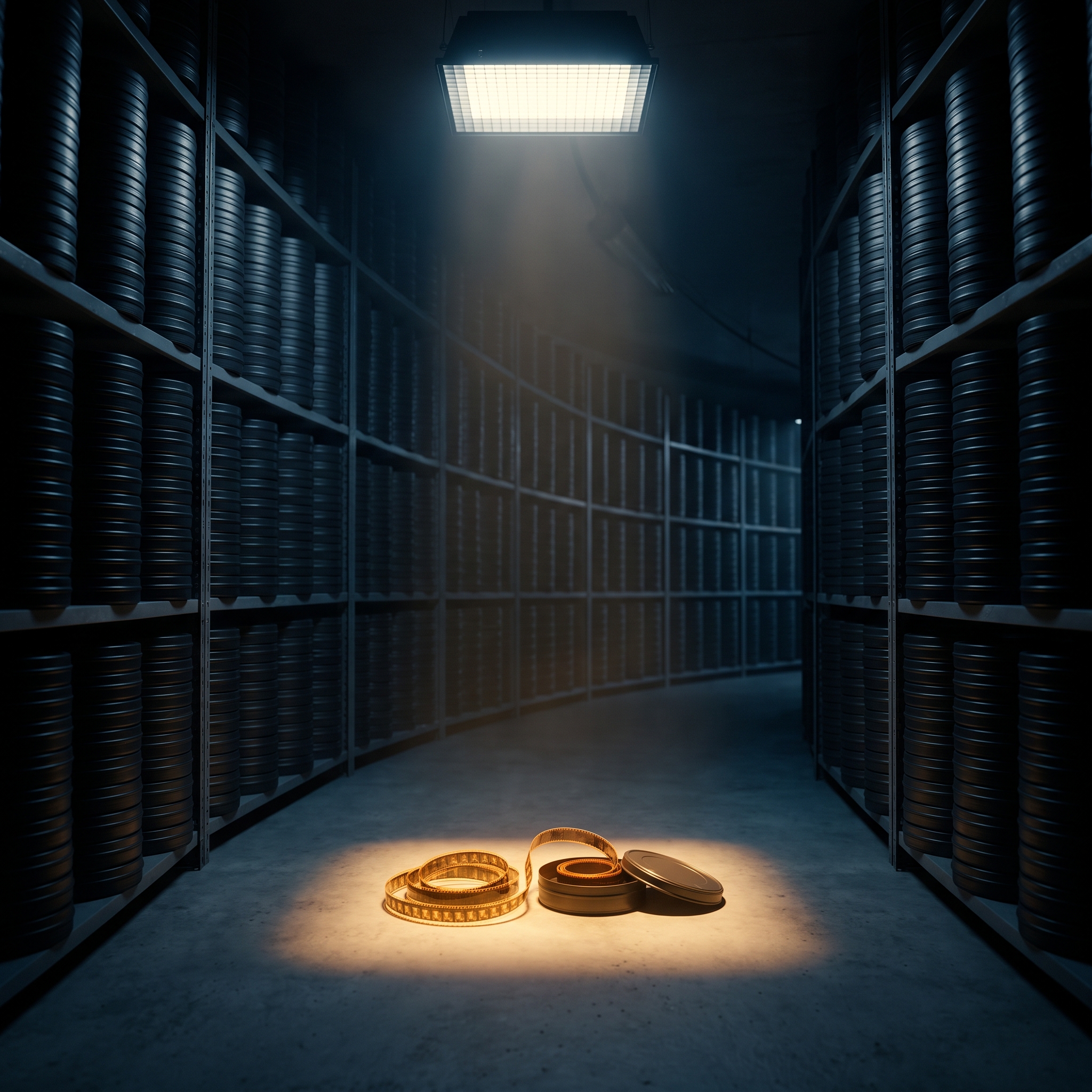
Malcolm Reeves: Never broadcast. Now — an unsold pilot, what the industry calls a busted pilot, it's a completed episode. Not a script. Not a rough cut somebody abandoned. A finished product that cost anywhere from one to five million dollars to produce. And it goes straight into a studio vault.
Cole Brennan: So — wait, actually — is this a quality problem? Like, the network watched it and said this isn't good enough?
Malcolm Reeves: That's the assumption, and it's wrong more often than you'd think. A pilot is a proof-of-concept built for one audience — executives picking what fills the schedule. The ones that go to the vault didn't lose a quality review. They lost a slot competition. There are only so many positions in a broadcast week, and that ceiling is fixed regardless of how many pilots were made.
Cole Brennan: That structural gap — between something being made and something actually airing — that's what this whole thing is about.
Malcolm Reeves: And the consequence of that gap is — think of it this way. A publishing house commissions ten book proposals, pays to print all ten as finished hardcovers, and then only puts two on the shelf because that's all the display space they have. The other eight sit in a warehouse. Nobody reads them. The print cost is just gone.
Cole Brennan: Oh — so the pilot isn't the show. It's the audition.
Malcolm Reeves: That's exactly the mechanism. Networks are buying an option — the right to evaluate and compare. The one-to-five million dollars isn't a down payment on a series. It's the fee for the right to look.
Cole Brennan: Okay but — wait, who are they comparing it against? Like, what's actually in the room when that decision happens?
Malcolm Reeves: Executives are laying pilots against schedule slots — and those slots are the hard ceiling, that's the thing. You have a finite number of half-hour and hour-long positions in a broadcast week. That number does not move. So they're not asking 'is this good?' They're asking 'does this fit a Tuesday at nine, does it match what an advertiser wants in that window, does it hit the demographic we need there?' A pilot can be genuinely excellent and still lose that race because another pilot fits the slot better.
Cole Brennan: So the criterion is fit. Not quality.
Malcolm Reeves: Fit. And here's where it becomes structural rather than accidental — CBS, NBC, Fox, they commission multiple pilots simultaneously, knowing most are structurally destined not to air. Before a frame is shot. That's not a failure of planning. That's the plan.
Cole Brennan: Man, so the waste is — I mean, it's not a bug. It's just built in from the start.
Malcolm Reeves: Built in. The vault isn't where mistakes go. It's where the options go after they've been evaluated. And the ones that land there didn't lose a quality review — they lost a scheduling race that was never really about them.
Cole Brennan: That vault though — like, I keep trying to picture what it actually is. Physically. Because CBS figured out this was a big enough problem that they created a whole strategy around it — CBS Summer Playhouse. You know what that was?
Malcolm Reeves: Anthology series. Summer rerun season, late eighties — CBS packaged rejected unsold pilots and just... aired them. Filled the dead summer slots with content they'd already paid for. Partial cost recoupment. And the remarkable thing is that strategy acknowledged something out loud: the vault was big enough to build a scheduling block around.
Cole Brennan: Hold on — they were basically admitting the pile was enormous.
Malcolm Reeves: Publicly, yes. Now — why it didn't stick as standard practice is, I think, the sharper question.
Cole Brennan: Right, because — wait, actually the I Love Lucy thing cracks this open in a completely different direction. The 1951 pilot. Unaired. Everyone thought it was just gone. Lost. Until 1990, when the widow of the actor Pepito Pérez found a copy in her personal archive — not a studio vault, her house — and then it got broadcast. Decades later.
Malcolm Reeves: And that's the distinction worth holding. CBS Summer Playhouse is the network acknowledging the vault. The I Love Lucy pilot is the vault becoming invisible — content that escapes institutional control entirely, survives in a private collection, and resurfaces only by accident.
Cole Brennan: Or the Buffy pilot — half-hour format, totally different cast, Willow played by Riff Regan instead of Alyson Hannigan — that one just... circulated at conventions. No official release. Ever. And what it shows is how far the aired show diverged from what was vaulted. Like, it's almost a different premise.
Malcolm Reeves: Which is the thing that complicates the scheduling-casualty framing. Because some of what's in those vaults — and we'll get to how this content actually escapes, through leaks, estate finds, convention bootlegs, and why that matters — some of it may genuinely be there for creative reasons, not just because a slot ran out.
Cole Brennan: So fit isn't always the whole story.
Malcolm Reeves: And that's precisely where the system breaks down — because the vault was never designed to let anything out. No designed exit. The same institution that produced the content built no mechanism to release it.
Cole Brennan: Which is how you end up with Bill Lawrence — creator of Scrubs — watching his rejected WB pilot for Nobody's Watching get leaked onto YouTube in 2006 by someone who just... put it there. Not WB. Not a network decision. A leak.
Malcolm Reeves: And audiences found it. Industry interest briefly revived. The system didn't provide that second chance — an unauthorized upload did.
Cole Brennan: Marc Romanek's Locke & Key pilot for Fox in 2011 — same thing. Leaked online, then pulled down. Audience access came through unauthorized channels and then got shut off again.
Malcolm Reeves: Trio — the cable network — actually produced a whole documentary, Brilliant But Cancelled: Pilot Season, narrated by Paul Rudd, specifically to excavate this archive. Because the networks weren't releasing it. Someone outside the system had to go digging.
Cole Brennan: Wait — Paul Rudd narrating a documentary about buried pilots is, I mean, that's a very specific kind of cultural archaeology.
Malcolm Reeves: But now — now here's the complication you can't flatten. The original Game of Thrones pilot. HBO's own. David Benioff called the screening one of the most painful experiences of his life. Called the pilot itself a steaming pile. That one was in the vault for creative reasons, not because a slot ran out.
Cole Brennan: So the vault contains both — actual scheduling casualties and genuine misfires — and there's no label on the box telling you which is which.
Malcolm Reeves: No label. Estate discoveries, YouTube leaks, convention bootlegs — they surface the content without surfacing that distinction. You get the artifact. You don't get the verdict.
Cole Brennan: And Netflix and Amazon looked at all of that — the vault, the leaks, the Paul Rudd documentaries — and said, skip the pilot entirely. Straight to series. Just order the whole thing. So... they fixed it?
Malcolm Reeves: They moved it. Now you're not shelving a three-million-dollar pilot — you're shelving a fifty-million-dollar season that's fully produced, and it happens with even less public acknowledgment. The structural gap between production and distribution didn't close. The dollar amount just got bigger. And the A-list talent they attracted to skip the pilot stage? They're attached to content that can still disappear before anyone sees it.
Cole Brennan: So the pilot was never really about the show. It was about the decision. And when you remove the pilot, the decision doesn't go away — it just happens later, and it costs more when it goes wrong.
Malcolm Reeves: That's it. And I keep landing back on — you started this whole thing asking what's the most expensive thing you've thrown away unused. A gym membership. The answer for CBS, for Netflix, for all of them, is: a lot of television. Every year. By design.
Cole Brennan: Hundred million a year. And my gym membership. Yeah. Good talk.