Iris Holm: You look like someone who spent the last three days down a rabbit hole.
Cyrus Reed: I absolutely did, and I need to tell you a thing that I cannot get out of my head — TV networks deliberately erased their own archives. Not because the tapes were failing. Because storing them cost money.
Iris Holm: Deliberately. As in someone signed off on it.
Cyrus Reed: As in it was — wait, this is the part — it was treated as standard operating procedure. Ephemeral broadcast culture, basically. The assumption was that a broadcast was like live theater, it happens once and then it's over, nobody's going to want to watch it again. So the BBC wipes Doctor Who. ABC erases sitcoms and news. Johnny Carson's first decade on The Tonight Show just — gone.
Iris Holm: No way. The Tonight Show.
Cyrus Reed: Reportedly. And the BBC didn't even adopt a formal archiving policy until 1978 — that's twenty-five years after television was standard broadcast infrastructure. Before that, wiping was just the done thing. Nobody thought they were doing something wrong.
Iris Holm: That reframes everything. It's not a chemistry problem. It's an institutional incentive problem.
Cyrus Reed: Which then becomes a chemistry problem — because once you didn't preserve it deliberately, the tapes started doing what tapes do. So now the question is whether, even if the networks had kept them, the physical media would've held.
Iris Holm: But that's the question — would they have held? Because the chemistry doesn't care who's in charge.
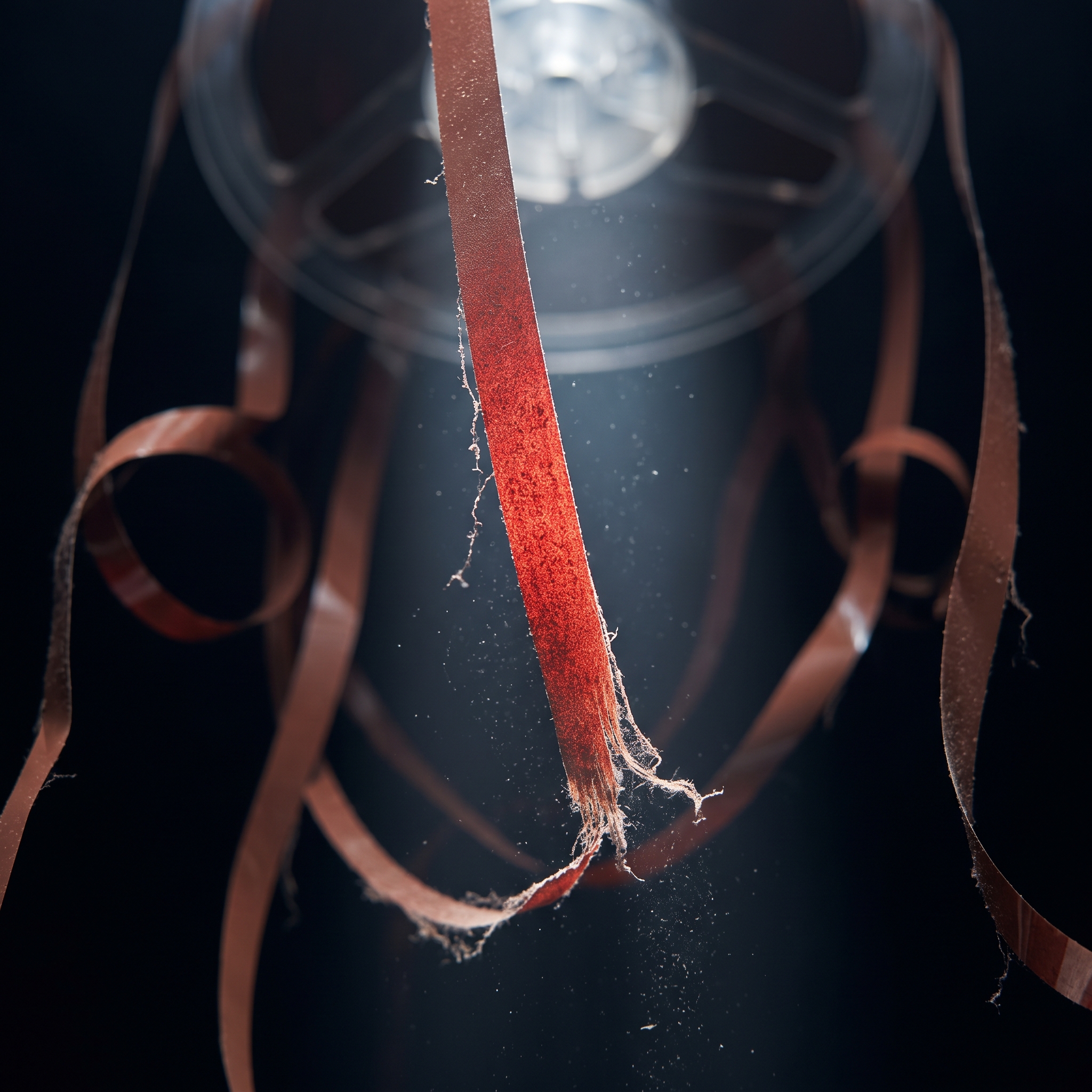
Cyrus Reed: Right, so — okay, think about a rubber band left in a junk drawer for thirty years. It doesn't snap dramatically. You reach for it one day and it's just... not a rubber band anymore. It's a different material. Tape does that, but in two separate chemical processes running at the same time. The first one is vinegar syndrome — the base of the tape, cellulose acetate, starts releasing acetic acid. The whole structure warps, goes brittle. You get that smell, which is literally the tape digesting itself. And once that starts, the National Film Preservation Foundation is pretty unambiguous: it cannot be reversed. That's not a 'we haven't figured out how yet' — that's the chemistry. It's done.
Iris Holm: And the second process?
Cyrus Reed: Binder breakdown — sticky shed syndrome. Separate thing entirely. The glue holding the magnetic particles onto the tape surface starts failing. The actual signal, the recorded information, it just... sheds. Physically falls off. So you could have vinegar syndrome making the base brittle while binder breakdown is erasing the content from the surface. Both. At once.
Iris Holm: Cold storage stops that, though. Doesn't it?
Cyrus Reed: Slows it — wait, that distinction actually matters a lot. Cold storage buys you time. It does not close the window. The decay is baked into the chemistry of the material. You're extending the deadline, not canceling it.
Iris Holm: So there's a real closing deadline. And institutions mostly missed it.
Cyrus Reed: That's the digitization window — and it's narrowing. Because it's not just about whether the tape survived. It's whether the playback equipment did. Two-inch quadruplex machines are basically museum pieces now. Once the tape crosses the decay threshold and the machines are gone, migration to digital becomes permanently impossible. Those aren't separate problems compounding each other — they're the same deadline arriving from two directions.
Iris Holm: Decay is the default. Preservation is the thing you have to keep choosing.
Cyrus Reed: And that's what I keep getting stuck on — because the tape surviving chemistry is almost beside the point now. Say it does. Say you've got a reel of two-inch quadruplex tape, chemically stable, sitting in a vault. An archivist picks it up in 2003. No vinegar smell, no warping. Totally intact. And she cannot play it. There is no working playback head within five hundred miles.
Iris Holm: The machine is the missing piece.
Cyrus Reed: Four rotating heads across a two-inch-wide tape — you need that specific mechanism spinning at that specific tolerance, and the engineers who could service it, they retired. The ones who actually knew how to thread the machine, calibrate the heads — gone. So the tape outlived its own readability. That's a completely separate death sentence from vinegar syndrome, and we almost never talk about it that way.
Iris Holm: So which kills more content — the chemistry or the hardware?
Cyrus Reed: Honestly — wait, I don't think that's actually the right frame. Either one closes the window permanently. It doesn't matter which arrives first. And DuMont is the case that makes this visceral for me, because — no, actually, the Rocky King Detective situation is worse. The original negatives, physically dumped into Upper New York Bay in the 1970s. Not chemistry. Not hardware failure. Someone chose to throw them in the water.
Iris Holm: Upper New York Bay. Physically.
Cyrus Reed: DuMont never built institutional preservation infrastructure, so when the network folded, there was nobody to object. The content just — dispersed. And kinescope recordings that did survive that era face the same hardware trap as the tape, because kinescope depended on motion picture film infrastructure that also went obsolete. Different format, same cliff.
Iris Holm: The format outlives the means to read it. Every time.
Cyrus Reed: And what I haven't told you yet — the part that makes all of this feel less like history — is that digitization isn't actually the escape hatch we think it is. That failure is already happening, right now, and the institutional commitment gap is identical. We'll get there.
Iris Holm: So digitization just reloads the problem onto a different substrate. The institutional dependency doesn't go away — it migrates.
Cyrus Reed: That's exactly — wait, okay, think about Fox's show Fling. Seven unaired episodes. Shelved. And no one deposited the masters at the UCLA Film and Television Archive, not the Library of Congress, nowhere public. Chemistry is irrelevant. Obsolescence is irrelevant. The institutional decision just... didn't happen. That's the whole story.
Iris Holm: Seven episodes. No deposit. Full stop.
Cyrus Reed: And UCLA and the Library of Congress holding what they hold — that's not the system working. Those are exceptions. Survival required someone to actively choose it, case by case. Which means the scale of what's still unmapped is — huh, actually, that's what the Doctor Who recoveries tell you. Some of those episodes turned up in Nigerian relay stations. Nigeria. Nobody had catalogued that those prints even existed.
Iris Holm: Nigerian relay stations.
Cyrus Reed: Which means confirmed lost doesn't mean gone. It means unmapped. The private hands, the foreign archives — nobody's finished that audit. So the real floor of what's recoverable is still unknown.
Iris Holm: Now apply that logic forward. Born-digital content from 2005 — the codec is proprietary, the server configuration is gone, the company that hosted it folded. The tape problem, different noun.
Cyrus Reed: And no one has committed to migrating it. That's — no, that's the identical gap. The BBC at least eventually formalized a policy, in 1978, badly late but it happened. I'm not sure the equivalent moment has arrived for digital archives yet.
Iris Holm: Loss is the default. Someone has to keep choosing otherwise. And right now, for born-digital, nobody's chosen.
Cyrus Reed: And that's — wait, that's actually where the whole thing lands for me. Because I came into this thinking it was a chemistry story. Vinegar syndrome, binder breakdown, the physics of decay. And it is that. But the chemistry is almost like... it's the enforcer. The institution makes the choice to walk away, and then the chemistry just — collects.
Iris Holm: The scary part is knowing all of this doesn't fix it. Someone still has to decide, every budget cycle, that it's worth the cost. That's not a technical problem anymore.
Cyrus Reed: No. And they might decide no. Rationally. The same way ABC decided no in 1975, and it wasn't irrational — tape was expensive, no syndication model existed. The logic was sound. The loss was just... a consequence nobody priced in.
Iris Holm: You walked in here three days deep in a rabbit hole. I think you found the bottom.
Cyrus Reed: I did. And the bottom is just — it's people, all the way down. Not chemistry.