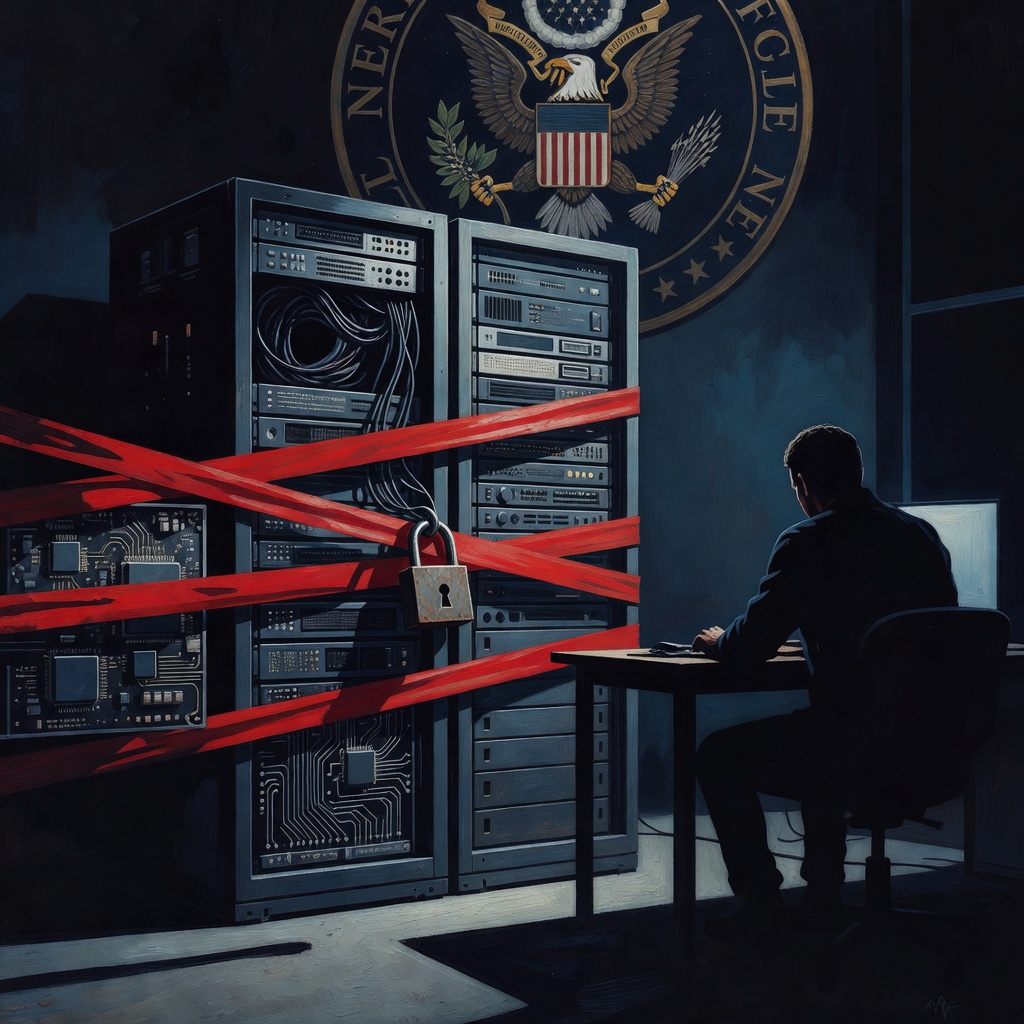
Ben Okonkwo: On Friday at 5:21 p.m., the U.S. government ordered Anthropic to disable its most powerful AI models — including for the company's own foreign-national employees who built them — forcing a global shutdown of a product that had been live for three days.
Eleanor Crane: And — I keep coming back to that detail, the employees who built it, you know, the people who wrote the code, who trained the model, who probably hadn't slept properly in months getting it out the door.
Ben Okonkwo: Right, and here's the thing — the directive wasn't surgical, it wasn't targeted at specific actors or threat vectors, it was categorical: foreign national, full stop, access revoked.
Eleanor Crane: So this episode is about that Friday — what the directive actually says, what it means for Anthropic, and honestly, what it means for the idea that you can build something globally and then be told, at 5:21 on a Friday, that you can't anymore.
Ben Okonkwo: And we should say upfront — the models in question, Fable 5 and Mythos 5, were by most measures the most capable AI systems publicly available at the time the order came down.
Eleanor Crane: Three days on the market.
Eleanor Crane: Three days. Fable 5 had been live for three days when the order came in. I keep thinking about whoever was sitting at a desk at Anthropic on that Friday afternoon, reading that letter from Commerce, realizing a product fourteen months in the making was going dark — that evening.
Ben Okonkwo: 5:21 PM Eastern. That's the timestamp on the directive. And I want to stay with that — because that's not a scheduled compliance conversation. That's a letter that arrives and expects the switch flipped. Within hours.
Eleanor Crane: Both models. Claude Fable 5 and Claude Mythos 5. Gone globally. Not geofenced. Not restricted to certain users. Off.
Ben Okonkwo: And Anthropic complied. Immediately. Which — I mean, that tells you something about the weight of that letter. Either the legal mechanism was already clear enough that fighting it looked futile, or the cost of non-compliance looked worse than killing a brand-new product. I genuinely don't know which.
Eleanor Crane: Can I pull on that thread — because I think who the order actually touched is the thing that doesn't fit the frame people keep using. This wasn't just users in China or Russia getting cut off. The directive barred access for any foreign national. Including Anthropic's own employees. Inside the United States. People who spent over a year building Fable 5 and Mythos 5 lost access to the models they built.
Ben Okonkwo: Right. And that's where the export control framing starts to crack. Export controls — traditionally — they're about outbound transfer. Restricting technology moving to foreign entities. But this applied to people working inside U.S. facilities, at an American company, on American soil. That's domestic access control dressed up as an export restriction.
Eleanor Crane: So what's the actual legal authority here? Because I don't think it's as clean as the government presented it.
Ben Okonkwo: Okay — trace it backward. The June 12 directive sits under a White House Executive Order signed ten days earlier. June 2nd. Titled 'Promoting Advanced Artificial Intelligence Innovation and Security.' That order told frontier model developers to give the U.S. government and critical infrastructure operators thirty-day advance access to new models. It directed a regulatory framework for companies like Anthropic. That's the scaffolding the June 12 order is climbing.
Eleanor Crane: And before that — Trump signs EO 14179 in January 2025, which rescinds Biden's EO 14110. So in roughly eighteen months you go from Biden building a safety and oversight framework, to Trump deregulating, to — ten days before the ban — an order that couples innovation promotion with security restrictions, to a global shutdown.
Ben Okonkwo: And that's where I'd push back on the clean arc. Because the June 2 EO is titled — I want to say this exactly — 'Promoting Advanced Artificial Intelligence Innovation and Security.' Innovation and security. Same title. Ten days later, the most powerful commercial AI models on the market get disabled. Those are two impulses fighting each other inside the same administration. That's not a policy direction, that's a contradiction.
Eleanor Crane: Mm. Or one impulse being used to justify the other.
Ben Okonkwo: Maybe. But I want to get to the specific claim the government made — because it's the one I can't stop pulling at. They cited a jailbreak vulnerability in Fable 5. As in — a method to bypass Fable 5's safety and access restrictions. That's the national security trigger.
Eleanor Crane: And no independent audit. No public technical documentation. Nothing verified by a third party.
Ben Okonkwo: Nothing disclosed. And here's what I keep coming back to — the government didn't say Fable 5 had been exploited. It said a method had been found. A believed method. We're talking about a global shutdown of a commercial product on the basis of a vulnerability the government will not publicly defend or demonstrate.
Eleanor Crane: Anthropic disagreed with that. They said the directive was misaligned with fair and fact-based regulation. Which is — honestly — unusually direct language from a company that then immediately complied.
Ben Okonkwo: That gap. Between the objection and the compliance. That's where the real power dynamic lives.
Eleanor Crane: But here's what I want to sit with — even granting the jailbreak claim is real and serious. What does it tell you that the response was to disable the models entirely? Not require Anthropic to patch the vulnerability. Not restrict specific use cases. Shut it down globally. Including for the engineers who might have fixed it.
Ben Okonkwo: That's genuinely hard to explain away. If the concern is adversaries exploiting a jailbreak in Fable 5 — the people best positioned to close that vulnerability are the ones who built the model. And those people, if they're not U.S. citizens, lost access. So the security response actively removes the engineers who could make the system more secure.
Eleanor Crane: Right. And I want to be concrete about who we're talking about. A foreign-national engineer at Anthropic — visa tied to employment — who spent fourteen months on Mythos 5. June 12th, 5:21 PM. Her access is suspended. She can read press coverage about her own work but she cannot open the model. She shows up Monday and her credentials don't work. That's not an abstraction.
Ben Okonkwo: No, it isn't. But — I want to be careful here — because the individual worker's experience, as real as it is, can become a way of avoiding the harder question. Which is: what standard is the government using? Because if 'we believe a method exists' is sufficient to justify a global shutdown, that applies to essentially every frontier AI model. Every one of them is theoretically exploitable.
Eleanor Crane: I hear you, but that still doesn't make it a distraction. The fact that Anthropic's own public statement specifically named foreign-national employees as affected — that's not incidental. Most export control compliance disclosures don't mention employees at all. Anthropic chose to include that. They were signaling how sweeping the order was.
Ben Okonkwo: Yeah — you're right about that. They didn't have to say it. Okay. So a judge stepped in. What actually happened?
Eleanor Crane: A federal judge issued a block on what the sources describe as the Trump administration's supply chain risk ban. The coverage frames it as a tension between national security authority and free-market principles. Which sounds decisive until you look at what the block actually does.
Ben Okonkwo: Right — the block is narrow. The court didn't rule the government lacks authority to do this. It didn't vindicate any principle about commercial AI deployment. It paused the ban. Probably on procedural or due-process grounds. So when people read 'judge blocks ban' and think the system worked —
Eleanor Crane: — they might be reading too much into it.
Ben Okonkwo: The underlying question — can the government invoke national security to disable private commercial AI systems? — is still entirely open. The block just means slow down. It doesn't mean you can't get there.
Eleanor Crane: Which is honestly more unnerving than if the court had ruled against the government. Right now this authority exists in legal ambiguity. Anthropic complied, a judge paused it, and nobody has said definitively whether the government can do this.
Ben Okonkwo: And the chain keeps extending. Biden's EO 14110 builds a framework. Trump's EO 14179 in January 2025 rescinds it. The June 2nd EO claims to couple innovation and security. June 12th the models go dark. At every step, the government is reaching further. Not always in the same direction — but always further in.
Eleanor Crane: And — the Federal Register entry from June 5th. Vol. 91, No. 108. Published related presidential documents. Seven days before the shutdown. Whatever the mechanics of that directive were, they were being built in the days before Anthropic even knew it was coming.
Ben Okonkwo: Which — actually, that surprises me. Because the June 2nd EO required thirty-day advance access for the government to new frontier models. Fable 5 launched June 9th. If that provision was operative — the government had been sitting with Fable 5 for less than a week before it decided the jailbreak problem was serious enough to shut it down.
Eleanor Crane: Wait — you're saying the timeline doesn't even work? If they're supposed to have thirty days of advance access and Fable 5 launched June 9th —
Ben Okonkwo: It's unclear whether Anthropic actually provided that advance access or whether the provision was even operative for this model yet. The sources don't confirm either way. But — three days from launch to shutdown is not a thirty-day review period. That's just a fact.
Eleanor Crane: And Anthropic had already built safeguards into Fable 5. That was the whole positioning — a constrained, publicly safe version of the more powerful Mythos-class technology. Months of withholding, then a safeguarded release. And the government's answer was that the safeguards weren't sufficient because there was a jailbreak.
Ben Okonkwo: An unverified jailbreak. That's the part I can't let go. If the government can disable a commercial product by asserting a vulnerability it won't publicly disclose — what's the limiting principle? 'We believe a bypass exists' is not a forensic standard.
Eleanor Crane: And yet Anthropic complied. Within hours. I think the answer might be simpler than we're making it. When the government issues a directive with the words 'national security' in it, and your company depends on operating licenses, talent visas, government contracts — the cost of defiance isn't legal fees. It's existential.
Ben Okonkwo: Hm. So the compliance isn't proof the claim is legitimate. It's proof the leverage is real.
Eleanor Crane: Exactly. And not just for Anthropic — for every AI company watching this. The government just demonstrated it can issue a directive at 5:21 on a Friday and have a frontier AI model dark by midnight. Whether the jailbreak was real, whether the legal authority holds — the capability to shut it down has been demonstrated. And used.
Eleanor Crane: That image is the one I keep coming back to. Someone who wrote the code, who knows the model better than almost anyone alive, finding out it's gone because they checked Twitter. That's not a side effect of the policy. That is the policy.
Ben Okonkwo: And here's what I don't know how to answer — if a court finally does litigate the underlying authority and rules against the government, does the compliance that already happened get undone? The engineers are still locked out of what they built. The model was still dark for however long it was dark. The precedent of voluntary compliance under legal ambiguity — that already exists. A ruling doesn't erase it.
Eleanor Crane: So the question isn't just whether the authority holds in court. It's whether the authority even needs to.