Maya Chen: Nathan. Hey. Long week?
Dr. Nathan Hayes: Longer than it needed to be. You?
Maya Chen: Mm, same. I've been kind of... I kept opening my phone this week and just feeling that thing where the app already knows exactly — anyway. That's actually why I wanted to start here today. I have a finding I need to hand you, and I want your honest reaction.
Dr. Nathan Hayes: Go ahead.
Maya Chen: Wait, no. The setup matters. During the 2020 U.S. election, Facebook and Instagram took thousands of actual users, consenting users, and switched them off the algorithmic feed — back to straight reverse-chronological. And they measured what those people saw, and they measured how polarized those people were. And the content exposure changed substantially. Less uncivil stuff, more moderate sources on Facebook. Real measurable difference in the feed.
Dr. Nathan Hayes: And political polarization.
Dr. Nathan Hayes: Right. That's the one.
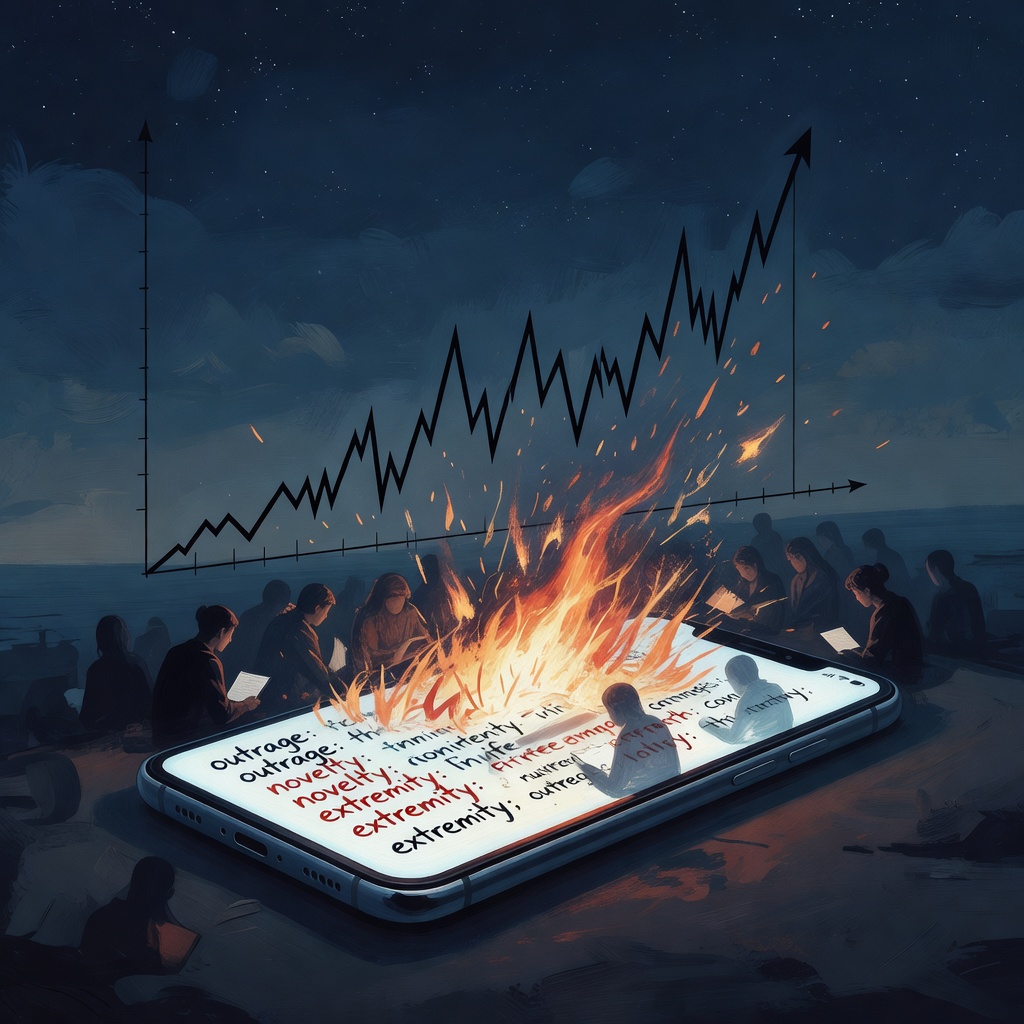
Maya Chen: And that's what we're in today. Because on one side you have — I mean, Meta's own internal research showed outrage fuelled engagement, and then in March 2026 the BBC reported more than a dozen insiders from Meta and TikTok saying the platforms knew, and kept the policies anyway. So the mechanism looks airtight. And then the experiment just... doesn't confirm the downstream effect. That's a genuinely strange place to be.
Dr. Nathan Hayes: What troubles me is that most people have the mechanism slightly wrong before we even get to that contradiction. So I want to back up — just briefly — to circa 2009, when Facebook introduced algorithmic feed ranking in the first place. Replaced reverse-chronological. That's the foundational move. Because once you're optimizing for engagement metrics — clicks, watch time, shares — you've handed the editorial decision to user behavior. And user behavior, it turns out, has a very specific shape.
Maya Chen: The negativity bias shape.
Dr. Nathan Hayes: Exactly. So the algorithm isn't injecting outrage. It's reading what humans already click — and humans click fear and anger at higher rates than calm analysis. That's the mechanism. Now, whether that mechanism produces radicalization at the individual level... that's where the 2020 study complicates everything.
Dr. Nathan Hayes: Think of it like a vending machine that learns what snacks you buy — not what you wish you'd eaten. Every pause on something alarming, every extra second on something that makes you angry, that's the only signal it has. It's not reading your mind. It's reading your thumb.
Maya Chen: Mm. And it never asks which snack you'd choose if you were thinking clearly.
Dr. Nathan Hayes: Never. And this is where William Brady's work at Yale becomes important — because he actually measured the mechanism inside the content itself. Moral-emotional language. Words that carry both a moral charge and an emotional charge simultaneously. Brady found that each one of those words in a post increases the retweet rate. Not the post overall — each individual word. That's not a nudge. That's a structural advantage for outrage content baked into the scoring.
Maya Chen: Wait — each word? Like, additively?
Dr. Nathan Hayes: Additively. So content that's already emotionally charged gets scored higher, shown to more people, generates more engagement, gets shown to more people again. That's algorithmic amplification — not as a metaphor, as a literal feedback loop.
Maya Chen: Right, and — I mean, Tristan Harris put it really plainly when he was still at Google. Anger and fear don't just drive clicks, they reliably drive clicks. Which means if you're optimizing for engagement metrics, you're not accidentally boosting outrage. You're... the math basically requires it.
Dr. Nathan Hayes: That's precisely the point. It's a structural inevitability, not a design decision.
Maya Chen: Which is what makes Tim Kendall's acknowledgment so strange to sit with. He was inside Facebook. He said directly that the platform was optimizing for user attention. And — yeah, I mean, he knew what that meant.
Dr. Nathan Hayes: Now, here's the complication — and I want to be precise about this. Optimizing for attention via negativity bias is the mechanism. But the mechanism being real doesn't automatically prove the downstream causal claim. Those are two separate things, and popular discourse collapses them constantly.
Maya Chen: The downstream claim being — this makes people more extreme.
Dr. Nathan Hayes: Yes. The feed clearly warps what you see. Whether it warps what you believe — that's where we run out of clean evidence.
Maya Chen: Hmm. So the exposure change is real, the emotional manipulation is real — sort of structurally baked in — but the belief change is the gap.
Dr. Nathan Hayes: That's the gap. And it matters enormously for what we think the fix actually is.
Maya Chen: But I keep getting stuck on something more intimate than the belief change question. Like — okay, Tuesday morning. You open the app to check one thing, a calendar maybe, and thirty seconds later your pulse is up and you're reading something that made you furious, and you didn't... exactly choose that. But you did pause on it. That pause was a data point.
Dr. Nathan Hayes: That pause is the revealed preference.
Maya Chen: Right. And the thing that unsettles me is — the algorithm never met the version of you that, if asked, would say 'I want accurate, nuanced information.' It only ever met the version of you at 7am who stopped scrolling for two seconds on something alarming.
Dr. Nathan Hayes: And that's not a failure of the algorithm — that is the algorithm working. It has no access to your stated preference. Pew data, internal platform research, they all show the same split: users report valuing accuracy and thoughtful discussion, but the click behavior tells the system something categorically different. Those two signals don't even overlap cleanly.
Maya Chen: So it's optimizing for your impulsive self. Specifically.
Dr. Nathan Hayes: Systematically. And X and Twitter ran the same logic — political content ranking, algorithmic amplification of high-engagement posts. Same revealed preference gap, different interface.
Maya Chen: YouTube too. The radicalization story around YouTube is the one that always gets cited as proof the algorithm is dangerous. But from what I understand, researchers who've looked at it carefully are saying the causal mechanism hasn't actually been established the way people assume.
Dr. Nathan Hayes: Overstated is the word I'd use. Yes, YouTube hosts extremist content. Yes, the recommendation system can surface it. But the jump from 'surfaced to you' to 'radicalized you' requires evidence of actual belief change attributable to the feed. That hasn't been established rigorously. Those are two separate problems — hosting the content, and the algorithm pushing it as cause.
Maya Chen: Hmm. Though — I don't want to let the hosting part disappear entirely. YouTube profits from that content existing regardless of what the recommendation algorithm does with it.
Dr. Nathan Hayes: Agreed. Those are genuinely separable questions and conflating them muddies both.
Maya Chen: And then there's the reshare thing on Facebook, which — wait, this is the part that really got me. When researchers removed resharing, partisan news clicks went down, misinformation exposure went down. Which sounds like a win. But news knowledge overall also dropped. People just... knew less.
Dr. Nathan Hayes: So suppressing the amplification mechanism isn't a clean intervention. You lose the outrage-driven content and the informational content together because the algorithm never learned to distinguish them — it only learned what got reshared.
Maya Chen: Which is sort of the whole problem in miniature, isn't it. The system learned from the impulsive you, and the impulsive you apparently wanted some real things mixed in with the outrage, and now you can't pull one out without pulling the other.
Dr. Nathan Hayes: Now this is genuinely uncomfortable. The 2020 study — the actual experimental result — found no statistically significant change in political polarization at the individual level. Full stop. That's not a soft finding. Thousands of users, a live presidential election, measurably different information environments... and the polarization needle didn't move.
Maya Chen: Which should be the headline, honestly.
Dr. Nathan Hayes: It should. But then — and this is the part that complicates everything — critics of the study argue Facebook made emergency algorithm changes during the study period itself. Which would mean both the treatment group and the control group were operating in a shifting environment. So the confound isn't theoretical. It's... the company potentially altered the conditions while the experiment was running.
Maya Chen: Wait — during the study? Their own study?
Dr. Nathan Hayes: That's the allegation, yes. And I want to be careful here — contested methodology doesn't flip the finding. It means we can't be confident in it. Those are different things. We don't know if there was a real effect that got masked, or genuinely no effect.
Maya Chen: Hmm. So the study that was supposed to settle it... sort of opened a larger uncertainty.
Dr. Nathan Hayes: Exactly. And that uncertainty is doing enormous work in policy debates right now. Because if you can't prove the feed caused polarization — actually prove it — the regulatory argument shifts. It's not 'this mechanism demonstrably radicalized people.' It becomes something harder to legislate.
Maya Chen: Which is where YouTube comes back in, I think. Because — mm — the Science Advances research characterizing the radicalization fears as overstated, that's not saying extremist content doesn't exist on YouTube. It's saying the causal story we've been telling about how users get there is... we assumed it, basically.
Dr. Nathan Hayes: Right. Hosting extremist content and algorithmically recommending it as a radicalization mechanism — those are two separate claims requiring separate evidence. We conflated them because they felt like the same problem.
Maya Chen: Yeah, and that conflation matters because — I mean, if you're designing the fix, which problem are you actually solving?
Dr. Nathan Hayes: So this is where prosocial re-ranking becomes the real test. We can actually build feeds that optimize for well-being or accuracy instead of raw engagement — that's engineered, it works mechanically, it reduces uncivil content exposure. But the research suggests it requires sacrificing engagement metrics. Not marginally. Meaningfully. Which is a direct commercial disincentive for any platform to do it voluntarily.
Maya Chen: So the EU Digital Services Act — is that actually the lever? Because TikTok's search recommendation transparency is specifically flagged in that framework, and that's... I mean, that's at least external pressure the platforms can't internally rationalize away.
Dr. Nathan Hayes: It's the most credible external pressure we have. Whether transparency obligations change the underlying commercial logic — that's still unresolved. You can compel disclosure without compelling different optimization. But the gap we keep circling is real: the mechanism is proven, the amplification is real, the causal chain to actual belief change is not yet secured. And that gap is the thing policymakers have to decide whether to wait on.
Maya Chen: The thing that keeps sitting with me — and I don't think I've said this cleanly yet — it's not actually the radicalization pipeline that unsettles me most. It's something quieter than that. The algorithm didn't necessarily change what most people believe. It changed who gets heard. The loudest, most emotionally charged voices got disproportionate reach, not because most people chose them, but because engagement metrics selected for them. And that's... I mean, that's a different kind of damage.
Dr. Nathan Hayes: A warped visibility landscape rather than a radicalization pipeline. Yes. And importantly — we can't fully evaluate even that claim right now. The opacity is the problem. Platform transparency doesn't exist at the level independent research would require. The EU Digital Services Act is beginning to create conditions for disclosure, but beginning is the operative word. We're still largely theorizing about systems we cannot audit.
Maya Chen: Which means we built systems that maximized one metric — engagement — and we're only now starting to ask what else we optimized for in the process. And we're asking with incomplete information, from the outside.
Dr. Nathan Hayes: That's where I land, honestly. The mechanism is structurally sound. The amplification is real. The causal chain to belief change is not yet secured. And we may never secure it cleanly if platforms don't open the data.
Maya Chen: Yeah. It's a strange kind of unresolved — like, the unease is completely justified, and the proof is just... slightly out of reach.
Dr. Nathan Hayes: Which is, candidly, a very uncomfortable place to make policy from.
Maya Chen: Mm. Thank you for sitting in that discomfort with me rather than resolving it into something tidier.