Mark Delaney: Michael, long week, man — but I kept thinking about this one thing, and it's kind of been nagging at me since I started reading into today's topic.
Michael C. Vincent: Name it.
Mark Delaney: Picture a guy — some engineer at NBC, maybe 1968, Tuesday morning. He's got a stack of reels in front of him, and he just starts erasing. Johnny Carson episodes. The Tonight Show. One by one. And he's not — he's not panicking, he's not conflicted, he's just doing a job, because each reel of tape cost something like four hundred bucks and the studio needed it back.
Michael C. Vincent: And in that mundane Tuesday, most of the first decade of Carson disappears.
Mark Delaney: Right — but here's what's wild to me, uh, only about five percent of all network television since 1948 got preserved. Five percent. And a lot of what did survive exists only as kinescopes — which, for anyone just joining us, is basically someone pointing a film camera at a TV monitor during the live broadcast.
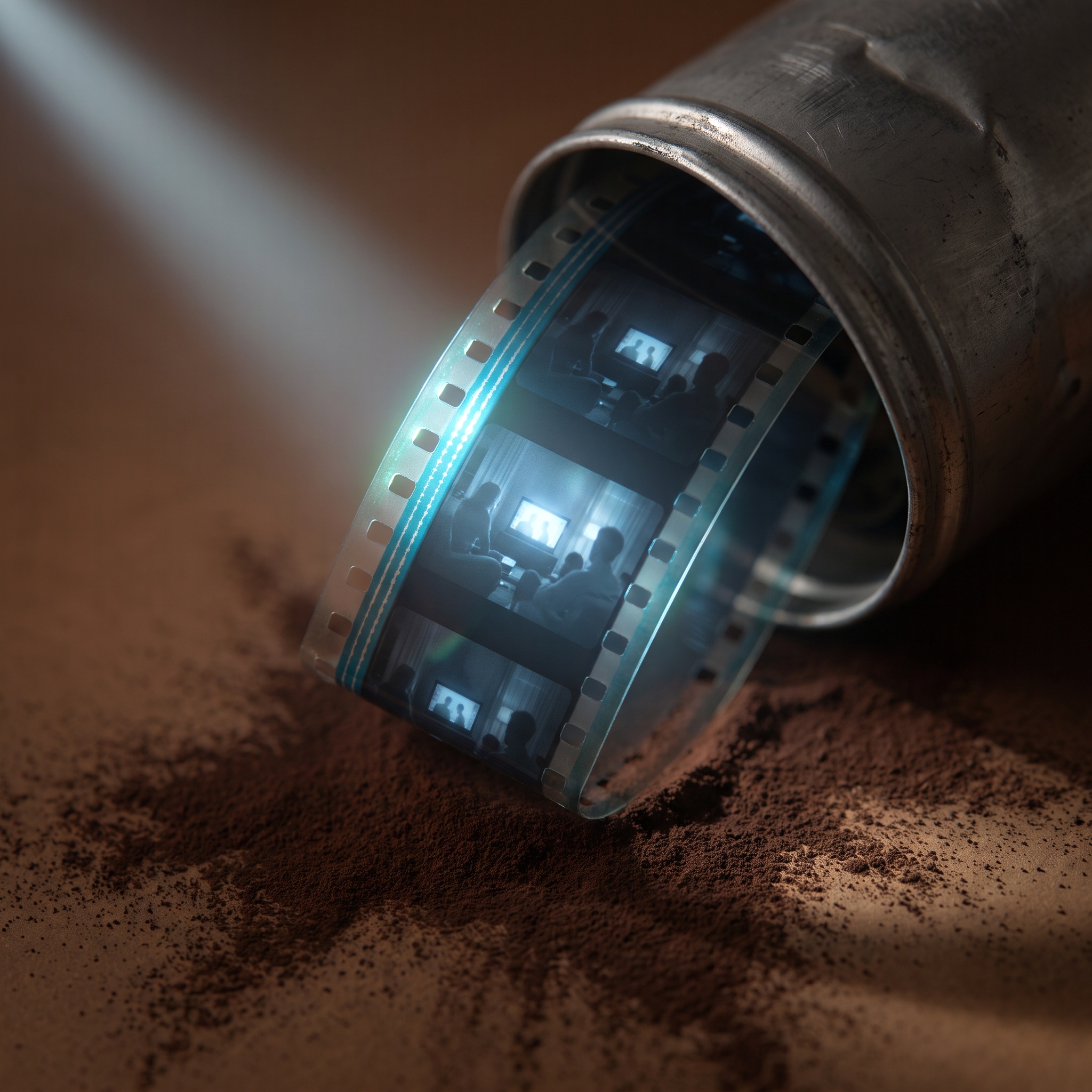
Michael C. Vincent: A 16mm camera, pointed at a glowing monitor. That is the kinescope. The industry called it a stopgap, a necessary evil. Ampex changed all of that in 1956 with quadruplex videotape — suddenly kinescopes were obsolete, obsolete and forgotten.
Mark Delaney: So — forgotten meaning sitting in a vault somewhere, not destroyed?
Michael C. Vincent: Sitting in vaults. Degrading quietly. And that neglect, as it turns out, is exactly what saved them. The tape got erased. The kinescopes got ignored. And there is the paradox we're trying to pull apart.
Mark Delaney: And that paradox — I keep getting stuck on what the thing actually was. Like, physically. You said pointing a camera at a monitor, but I mean — that's kind of insane, right? That's literally what we did as kids when we wanted to bootleg something off the TV.
Michael C. Vincent: That is exactly what it was. You want to save a television program — you point a 16mm motion picture camera at the screen while it's broadcasting live, and you press record. That's a kinescope. The whole elegant myth collapses into that one sentence.
Mark Delaney: Wait — so the picture quality must have been — ugh.
Michael C. Vincent: Terrible. Gregory Lukow at the Library of Congress described them as exactly that — filmed records made by pointing a 16mm camera at a monitor. Signal-to-noise ratios below 40 dB. Visible scan lines. A kind of ghostly haze over everything. And yet — nobody was making them for posterity. The reason kinescopes existed was purely operational. September 1947, the process gets introduced in the United States, and the immediate problem it solves is time zones. East Coast broadcasts were live. The West Coast audience was three hours behind. No real-time transmission across the continent, so you film the monitor in New York, ship the reel to Los Angeles, and replay it that evening.
Mark Delaney: So it was basically — uh, it was logistics, not archiving. Not 'let's save this for future generations,' it was 'we need to fill three hours of West Coast airtime.'
Michael C. Vincent: Exactly that. And the earliest evidence of it in practice — Mary Kay and Johnny, one of the first sitcoms on American television, begins using kinescopes in 1948. Today only one complete episode survives, held at the Paley Center for Media. One. Out of a run that stretched to 1950.
Mark Delaney: The people making those reels in 1948 — they weren't thinking 'this is history.' They were thinking 'does this get to the affiliate on time.'
Michael C. Vincent: A projectionist in a Los Angeles affiliate station, probably 1949, threading a reel he just received by air freight — he cares whether the sprocket holes are intact, not whether civilization will want it in seventy years. That indifference is, you see, the whole story.
Mark Delaney: But — okay, that indifference thing, I want to push on it a little, because the easy version of this story is 'they erased history and that was a catastrophe.' And I kind of want to say that. I want to be outraged. But you're telling me that's the wrong read?
Michael C. Vincent: It is the wrong read. Picture the accounting, not the archive. That Ampex quadruplex tape introduced in 1956 — a single reel cost roughly four hundred dollars. The studio gets it back, it records next week's broadcast, problem solved. There was no institutional mandate to preserve old talk shows. None. No Library of Congress requirement, no federal archival rule. That engineer with a stack of Tonight Show reels isn't erasing history — he's doing inventory management.
Mark Delaney: Right — but the part that doesn't fit is, what about the tape they didn't erase? Surely some of it survived.
Michael C. Vincent: Magnetic videotape is unstable — humidity, oxidation, temperature swings. Tapes that were kept, not erased, often degraded anyway. So the 'just keep the tape' option wasn't actually safe storage. It was slow-motion erasure instead of fast erasure.
Mark Delaney: Huh. So the tape rots even if nobody touches it.
Michael C. Vincent: Dark Shadows is the case I keep returning to. Twenty-six episodes — gone from tape, survived only as kinescopes. Not because someone decided to erase them deliberately, you see. The masters are simply lost. Decayed, mislabeled, discarded somewhere between a vault and a move. The kinescope, that despised film-of-a-monitor, is now the primary record.
Mark Delaney: And kinescopes had — I mean, Pete Hammar called the whole process something like 'people were desperate for a replacement.' That was the format that outlasted the replacement that was supposed to fix everything.
Michael C. Vincent: Signal-to-noise below 40 dB, scan lines you could read like tree rings, synchronization drift. Everyone hated them. And they're what we have. Which is — well, that irony is almost too neat, except it's completely real.
Mark Delaney: And I'll say — what it actually takes to pull usable footage off one of those surviving reels today, the digital restoration, there's apparently something they can recover from the film that nobody even knew was there. That part gets a lot stranger before it gets better.
Michael C. Vincent: That 'stranger' is chroma-dot color recovery. You take a black-and-white kinescope that filmed a color broadcast, and buried inside those film frames — invisible, latent — are residual color signals. The 16mm emulsion captured them without anyone intending it. Modern digital tools can partially reconstruct the color from that. Not perfectly. It's archaeology, not surgery.
Mark Delaney: Wait — color information, just sitting in a black-and-white film frame? For fifty years?
Michael C. Vincent: Dormant. And the result when you pull it out is a best-effort reconstruction. Some frames recover cleanly. Others are — well, guesswork dressed up as data. You're not watching the broadcast. You're watching the closest approximation the algorithm can build from a degraded copy of a filmed monitor.
Mark Delaney: So pulling a reel out of a vault — that's not the finish line, it's kind of barely the starting gun.
Michael C. Vincent: Not even close. The film itself — it's got scratches baked into the image, synchronization drift between the camera and the monitor, signal artifacts that no digital tool fully removes. CBS digitized something like 34,637 programs under a contract with Mark Goodson Productions, around 2,700 of those originating on 16mm kinescope. That's an enormous institutional operation, and even then you're producing a cleaned-up approximation.
Mark Delaney: 34,637 — I mean, that's not an intern with a scanner, that's a whole — uh, that's an infrastructure problem.
Michael C. Vincent: And then, you see, there's the legal wall. The Library of Congress and the Smithsonian Audiovisual Media Preservation Initiative hold significant kinescope collections. Physical reels, readable, sitting there. And some of them cannot be published. Copyright in the content separated from ownership of the physical reel — decades ago, different hands, different deals. The institution holds the object. Someone else holds the right to show it. Those two parties may never find each other.
Mark Delaney: So a reel can exist, can be legible, the color can even be partially recovered — and it's still just locked in a drawer because two lawyers can't agree on who owns the show.
Michael C. Vincent: Locked in a drawer, yes. And the count of what's in those drawers — what's lost versus what's findable — that number is still moving. Episodes of Dark Shadows kept surfacing for decades. Collectors' garages, British archives, places nobody filed a report about.
Mark Delaney: Wait — still surfacing? Like, we don't actually know the final number of lost episodes?
Michael C. Vincent: The boundary between television history and television oblivion is still being drawn. Kinescope reels went out to syndicators, foreign broadcasters, overseas affiliates. Some survived entirely outside institutional channels — a private collector in Leeds, a film vault in Australia. Nobody catalogued them. They just... existed.
Mark Delaney: So what we think early television was — how people talked, how a variety show was structured — that's just, uh, whatever happened to be kinescoped and then happen to survive. That's not a representative sample of anything.
Michael C. Vincent: Survivorship bias, down to the bone. We study what the vault gave us, not what was actually broadcast.
Mark Delaney: And I mean — streaming feels permanent. The files are just there. But we thought tape was permanent too, and a guy with a checklist erased it for four hundred dollars a reel. Whatever gets quietly dropped in the next format reshuffling — that's the kinescope we haven't made yet.
Michael C. Vincent: And we won't know which one until someone opens the door fifty years from now. Good talk.