Finn Brooks: Juniper, hey, quick confession before we start: I'm weirdly mad at a network that died before I was born, and I need you to talk me down.
Juniper Vale: Ha, okay, I'm listening. Who wronged you?
Finn Brooks: CBS! The Edsel Show was the first entertainment videotape program recorded at Television City, and it exists mostly because one person chose to keep it. One person!
Juniper Vale: Mm-hm, and I'd flip it. At CBS, reusing tape was so routine that preserving was the exception. Nobody at the time felt they were destroying anything.
Finn Brooks: Okay, I want to believe that, but walk me through it.
Juniper Vale: Think of theater. You watch a play once and the night ends. Television was seen the same way, so taping over a show was like taping over a cassette once the party's over.
Finn Brooks: Fine, but someone had to say wait, shouldn't we keep this?
Juniper Vale: Well, someone did, and that's the thing. Before tape, nobody even had the option, so let me back up for a second. There's a thing called kinescope. You point a film camera at a television monitor and shoot the picture off the screen.
Finn Brooks: Wait, you filmed a TV? With a camera? Like a screen recording, but in 1950?
Juniper Vale: Pretty much. And it wasn't for keeping anything. Before 1956 it was mainly for delayed regional broadcasts. The show goes out live in New York, and the West Coast gets the film three hours later. Then the film gets used up.
Finn Brooks: Okay but film is film. Film lasts. Why wouldn't they just shelve it?
Juniper Vale: Because it looked bad, and it was never the point. Blurry, flickery, a copy of a copy. You don't build an archive out of that. It was a delivery truck, not a vault.
Finn Brooks: Okay okay okay. So then Ampex shows up, and tape is the new shiny thing. Was wiping a brand-new decision?
Juniper Vale: No. That's what I'd push on. Ampex brought out practical two-inch quadruplex videotape in 1956, and it replaced kinescope fast. But the habit was already there: you record it to get it on air, then the recording's done its job. Tape just made that habit cheaper.
Finn Brooks: Cheaper how? Tape was pricey, right?
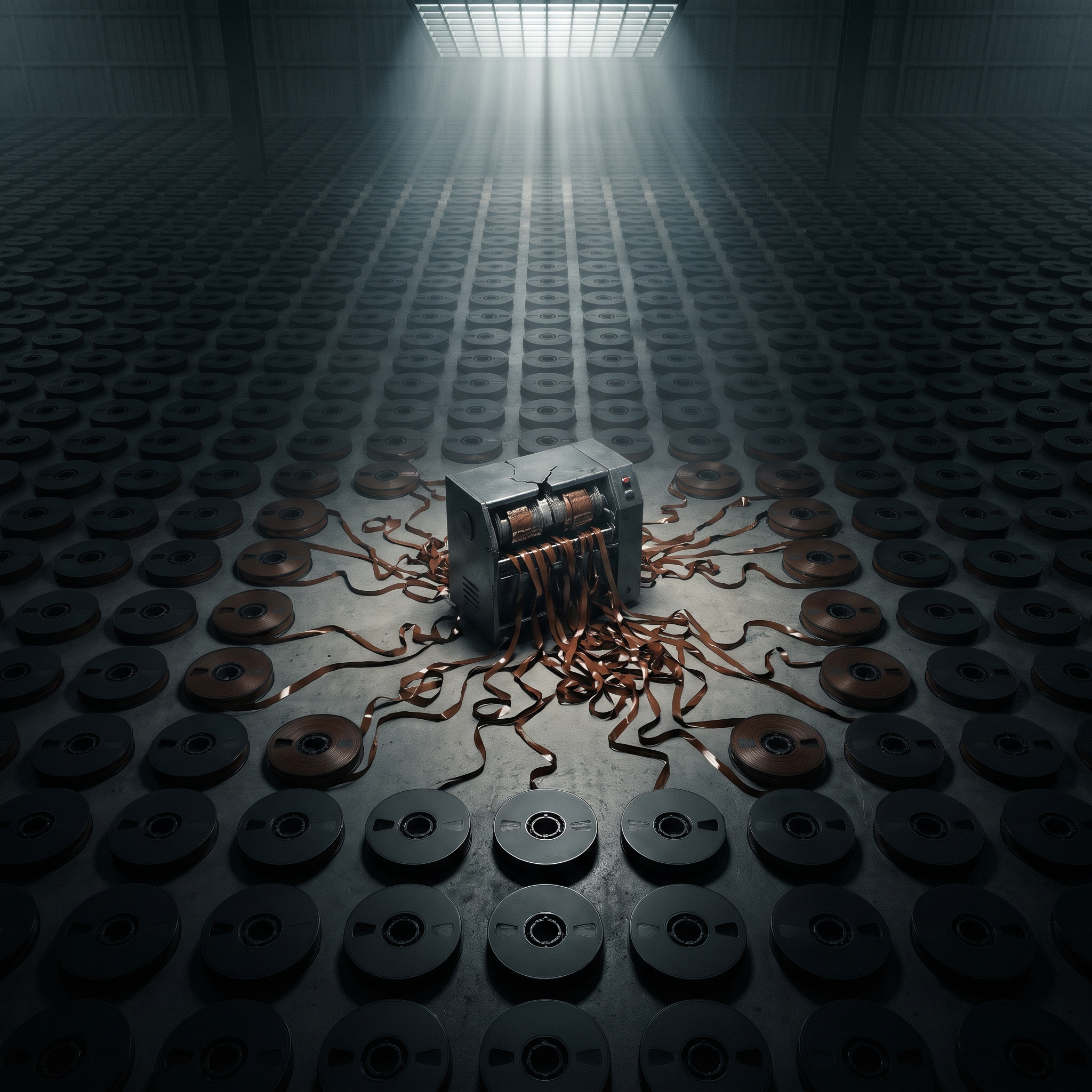
Juniper Vale: Pricey, yes, but you could use it again. Film you burn through once. Tape you record over. And that's wiping: deliberately erasing a recording and reusing the tape for something new. In the 1960s and 70s it was routine.
Finn Brooks: Oh man. So the same shrug, just with an eraser built in.
Juniper Vale: Right, that's a good way to say it. And the reason the shrug stuck is that tape costs, storage, decay and rights fees all pointed the same direction. That math is where I want to go next.
Finn Brooks: But wait, that's the tape side. Tape's pricey, fine, but a reel on a shelf only costs shelf money, right? Picture 1971. A tape librarian, rack of two-inch reels, a schedule, a budget line for new stock. There's a sitcom nobody's bought overseas. Wipe it, reuse it, done by lunch. Nobody's the villain. Honestly, that's what's creepy.
Juniper Vale: Mm-hm. And I'd say shelf money is the small part. Early videotape needed climate-controlled storage, so yes, there's a real bill. But the bigger bill is who you'd owe if you ever aired it again.
Finn Brooks: Owe? Wait, who?
Juniper Vale: The actors. Equity, the UK actors' union, had agreements that capped rebroadcasts, often to one or two airings in a short window. After that, residuals. Those are recurring payments to talent every time a show is rebroadcast or sold on.
Finn Brooks: Okay but that's only if you air it. If it just sits there, who's paying?
Juniper Vale: Right, and that's actually the part that matters. Think of it like a rental car you owe a fee on every time you look at it. You don't have to drive it, but the second you do, the meter runs. Plus, selling it abroad meant rights clearances, which were complicated and costly to keep sorted. So that tape in your librarian's rack isn't an asset. It's a loan with strings.
Finn Brooks: See THIS is the thing nobody tells you. I always figured it was just tape being expensive, like a storage-unit problem, but it's a legal problem.
Juniper Vale: And America had the same pressure. SAG and AFTRA contracts created parallel disincentives, so US networks weren't exactly rewarded for hoarding either.
Finn Brooks: So which one wins? Storage or rights? I mean, I'm leaning rights, because storage you can solve with a bigger room, but you can't build a bigger room around a contract.
Juniper Vale: I'd lean that way too. Storage was the proximate cause, the thing the clerk actually sees. But rights did more to make keeping unattractive. Whether that lets anyone off the hook, I'm not sure it does. Was it policy or a thousand tape-room decisions? And the Library of Congress 1997 report, with its more than 100 formats, doesn't answer it the way you'd think. The BBC and The Likely Lads are where that gets uncomfortable.
Finn Brooks: Hang on, before we get to the BBC. If it's all just math, then it's nobody's fault, and that feels too clean. Was there a memo? Or was it a thousand clerks each doing their own sums?
Juniper Vale: I'll be honest with you, the sources don't say. They don't tell us whether there was an explicit erasure mandate or just decentralized cost decisions. But I'd still call it systematic policy, not negligence. Same incentives, same answer, over and over, for decades. That's a loop, not a lapse.
Finn Brooks: Okay, but a loop with no memo is weirdly worse? Nobody even had to decide.
Juniper Vale: Mm-hm. Low syndication value, rights complexity, storage cost, and a reel you can reuse. Each year those four lined up again. Take The Likely Lads, 1964 to 1966, a BBC sitcom people still quote. It got caught in the wiping era, and that wasn't one careless person. It was routine institutional practice.
Finn Brooks: Right, but here's my devil's advocate. Tape decays, right? The Library of Congress said so. Isn't that just a real reason?
Juniper Vale: It's a real problem, but timing matters. The 1997 report says videotape was never designed as a permanent medium. Chemical deterioration, physical damage, obsolete playback machines. And more than 100 competing formats. Wait, let me say that again, because it got me. More than a hundred.
Finn Brooks: A hundred formats? Dude.
Juniper Vale: So even a network that wanted to keep everything would've been migrating forever. Copy it, then copy the copy when the machines die. But here's what I can't tell you: whether that 1997 description fits tape in the 1960s and 70s, or only tape after decades on a shelf. If the tapes were fine then, decay isn't why they were erased.
Finn Brooks: Okay, I love the rational framing, BUT rational isn't excusable. Somebody could've said keep it anyway, cost be damned. Who was that person? What did it cost them?
Juniper Vale: Okay, that's fair, and I don't think rational lets anyone off. It explains the default. It doesn't say the default was right. The person who kept the Edsel Show is proof someone could.
Finn Brooks: And the irony kills me. Tape is now four to eight times cheaper than disk for cold data.
Juniper Vale: It is, though the sources don't compare costs across eras. So I wouldn't say it was cheap then. I'd just say the medium they couldn't afford to keep is now the cheap way to keep things.
Finn Brooks: Okay, but can I hold onto one hopeful thing before we stop? Doctor Who. By 1981 only 57 of 253 episodes were known to exist. By 2024, it's 156. That's ninety-nine episodes that came back from the dead.
Juniper Vale: It's real, and I love that number too. But look at where they came from. Overseas broadcasters returned prints they'd been holding, and the BFI had deposits of film copies. Nobody found them in the BBC's own tape room.
Finn Brooks: Wait, so the copies lived because they were somewhere else?
Juniper Vale: Yes. Outside the originating network's erasure cycle. No clerk with a pull list, no reuse budget, no meter running on residuals. So recovery is possible, but I'd call it exceptional. Ninety-nine back still leaves 97 gone.
Finn Brooks: Ninety-seven. Okay, that stings. But I still want to believe there's more out there, in some broadcaster's closet or a collector's attic. Is that naive?
Juniper Vale: I don't think it's naive to hope. I just can't tell you how much is left, and the sources don't either. That part's unresolved.
Finn Brooks: So what clicked for me is smaller than I expected. Things survived when somebody or somewhere sat outside the cheap-reuse logic. Whoever kept the Edsel Show, a film print in another country, a BFI shelf.
Juniper Vale: Mm-hm. And nothing we've read says what would stop that same logic from deciding what gets kept next. That's what I'd sit with, honestly.
Finn Brooks: Yeah. I came in mad at a dead network, and I'm leaving oddly grateful for a few stubborn people with spare shelf space.
Juniper Vale: Me too. Go call someone who owns a shelf.