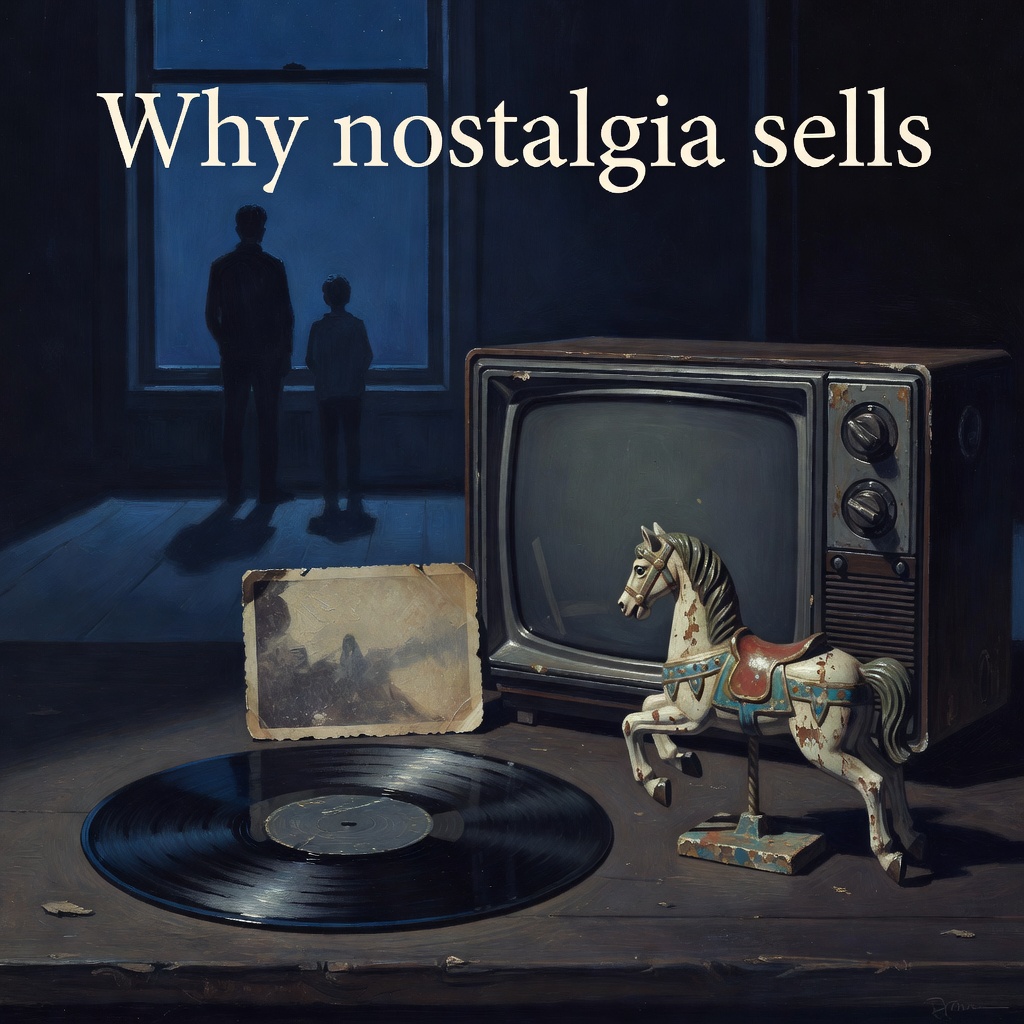
Spuds Oxley: The 1990s ended about twenty-five years ago. I want you to actually hold that number for a second.
Spuds Oxley: Because in 2023, Good Humor re-released this layered vanilla ice cream cake — the Vanilla Viennetta — that had been gone since roughly then. And people responded to it the way you respond to the return of something you'd genuinely grieved. Not nostalgia in the casual, throwaway sense. Something with more texture than that. Joy, yes. But also… loss.
Spuds Oxley: And funny enough — that's the actual definition.
Spuds Oxley: Psychologists describe nostalgia as a sentimental longing that holds both of those emotions at once — pleasure and absence, together, in the same moment. It's not daydreaming. It's not just warm fondness. It has measurable cognitive and behavioral effects that researchers can document under controlled conditions. It's a specific state.
Spuds Oxley: An ice cream cake produced it. In 2023.
Spuds Oxley: And I find that — look, I find that genuinely strange. Not cynically strange. The kind of strange that wants an explanation. Because something in the architecture of how we remember, and how we feel about what we remember, got leveraged by a brand decision in a boardroom somewhere, and the result was an emotional response that the people experiencing it weren't entirely in control of.
Spuds Oxley: That gap — between the product and the feeling — that's what this is really about.
Spuds Oxley: Why does it work on us the way it does. What's actually happening.
Spuds Oxley: I've come to think — and it took me a while to say it this plainly — nostalgia marketing isn't primarily about warmth. It's about timing.
Spuds Oxley: The warmth is real, I'm not dismissing that. But the moment when nostalgia hits hardest — the moment when a brand can just walk right through the door — that moment is not when life is going well. It's when something feels unmoored. Economic turbulence. Social upheaval. That particular low-grade dread of not knowing what comes next. That's when people reach backward, and the reaching isn't random. It's a reflex.
Spuds Oxley: A comfort mechanism that runs almost automatically.
Spuds Oxley: The psychological engine underneath that reflex has two main parts, and I think both of them matter. The first is what researchers call self-continuity — this sense that your life has a coherent shape, that the person you are now and the person you were then are the same person on the same thread. When that feeling gets shaky — and it gets shaky in uncertain times — nostalgia reinforces it. It hands you evidence that you have a past. That you have a through-line. The second part is social connectedness. Nostalgia reliably increases the feeling that you belong to other people, that you share something with them. The ice cream your whole generation remembers. The jingle nobody had to teach you. That shared memory does something functional — it pushes against loneliness.
Spuds Oxley: And brands have learned to stand right at that junction.
Spuds Oxley: Jannine Lasaleta — a psychologist who spent years running lab experiments on exactly this — found something crucial. When she had participants write about nostalgic events, they became measurably more willing to spend money on desired goods. More than that: in a related experiment, participants in a nostalgic state drew coins smaller than participants who weren't. Smaller. As if the money in their hand had lost some of its weight. Nostalgia doesn't just make you feel good — it literally reduces the subjective value of money. Which is… that's the mechanism, right there.
Spuds Oxley: The documented result, across research, is a willingness-to-pay premium of somewhere between ten and fifteen percent. Consumers will spend that much more for a product that evokes nostalgic feeling than for a functionally identical product that doesn't. Ten to fifteen percent. That's not a rounding error. That's a margin decision.
Spuds Oxley: Honestly, I find it hard to call that entirely innocent. The vulnerability nostalgia targets — the unmoored feeling, the need for continuity, for connection — those are genuine needs. Real ones. And something in me objects to those needs being mapped and monetized with this much precision. But I'll stay with the claim for now: the warmth is the surface. The timing is the strategy. And that ten-to-fifteen percent is the proof that someone, somewhere, knows exactly what they're doing.
Spuds Oxley: The coin thing, though.
Spuds Oxley: Because it's the most physically strange result in Lasaleta's work. Not the spending data — you could explain that away a dozen different ways. The coin. Participants in a nostalgic state drew coins SMALLER than participants who weren't. Smaller. The physical object in their imagination had shrunk. As if money, in that moment, had become less real to them.
Spuds Oxley: Think about what that means for a purchase decision.
Spuds Oxley: The question I kept sitting with was — why. Why does remembering something fondly cause the friction of spending to drop. And the answer, as best I can piece it together, runs through the brain's reward circuit. Nostalgic stimuli trigger dopamine release. The same pathway that registers comfort, safety, pleasure. The memory doesn't just feel good — it actively recalibrates the emotional register you're operating in. Threat goes down. Openness goes up. And money, which is fundamentally a symbol of future security, starts to feel less precious when the present already feels safe.
Spuds Oxley: Dopamine doesn't ask whether the memory is accurate.
Spuds Oxley: It just responds to the trigger.
Spuds Oxley: Nielsen ran the numbers on this from the outside — from ad performance data rather than a lab — and the figure they arrived at was a 23% lift in sales for emotionally resonant ads. Twenty-three percent. That's not a tweak. That's the difference between a campaign that moves product and one that doesn't.
Spuds Oxley: Kantar came at it from a different angle — enjoyability scores, ad distinctiveness — and found nostalgic ads gained 15 points on enjoyability and 14 points on distinctiveness compared to ads that didn't carry that register. You're not just selling more. You're making the ad itself into something people actually want to experience.
Spuds Oxley: That's a different category of influence.
Spuds Oxley: And then — the amplification. GlobalWebIndex tracked what people actually share on social media, and nostalgic content moves at higher rates than most other kinds. Which means the brand is no longer doing all the distribution. The audience is. Someone shares a post about the return of the Vanilla Viennetta and they're not sharing an ad — they're sharing a feeling. A memory that belongs to them personally. And every person who sees it and recognizes it gets the dopamine hit. The mechanism propagates.
Spuds Oxley: The brand gets the reach. The audience does the work.
Spuds Oxley: Once you see the toolkit, it's hard to unsee it. Retro packaging — the deliberate visual callback to an earlier era. Revived product lines, which Good Humor understood perfectly. Vintage aesthetics applied to products that never existed before. And then the deeper cuts: the cartoons, the toys, the TV shows, the music — generationally shared touchstones that don't need explanation because the recognition is already there, already wired in.
Spuds Oxley: They're not referencing culture. They're borrowing its emotional charge.
Spuds Oxley: And this is where I want to slow down for a second — because the easy read here is pure cynicism. Brand finds lever, pulls lever, extracts money. But there's something underneath that framing that's worth taking seriously.
Spuds Oxley: Nostalgia isn't just a trick. Consumer psychologists talk about cultural mythology — the idea that brands, the ones that last, embed themselves in shared narratives. Archetypes that run deeper than any single product. The hearth. The journey. The return. Nostalgia is one of those archetypes. It isn't manufactured from nothing. It has roots in how people actually make meaning — from the stories they tell about where they came from, and who was there with them.
Spuds Oxley: The brand that gets inside that story isn't just selling a product.
Spuds Oxley: It's offering to be part of the narrative.
Spuds Oxley: Whether that's a beautiful thing or an unsettling one — I think that depends on what you believe about where the memory actually comes from. And that… is the part that gets complicated.
Spuds Oxley: Here's where I have to turn on my own argument a little.
Spuds Oxley: The thing that nags at me is the memory problem. Not nostalgia as an emotion. The memory underneath it.
Spuds Oxley: Autobiographical memory isn't a recording. You probably know this in the abstract. But the actual implication is — every time you recall something, you're rebuilding it. Reconstructing it from fragments, patching the gaps, shading the feeling. The memory that comes back is not the memory that went in. It's been edited, gently and without your permission, every single time you've visited it.
Spuds Oxley: Which means the past nostalgia evokes is partly idealized. Partly confabulated.
Spuds Oxley: And if that's true — and the research is fairly clear that it is — then what exactly is Kantar measuring when they report that nostalgic ads score 15 points higher on enjoyability. What is Nielsen measuring when they report a 23% sales lift. Are they measuring a genuine emotional response to a genuine memory… or are they measuring the comfort of a story that the brain has been quietly improving for twenty years.
Spuds Oxley: I don't think those are the same thing.
Spuds Oxley: And there's another layer — one I find genuinely uncomfortable. Nostalgia intensifies during economic uncertainty. During social upheaval. We've established that. But sit with what that actually means for a brand making the decision to run a nostalgia campaign. You're choosing to deploy this mechanism at the precise moment when people are most unmoored, most in need of comfort, least defended against it.
Spuds Oxley: That's not a coincidence. That's a targeting decision.
Spuds Oxley: I want to be honest — I'm not sure I can fully defend that. The position I've been building is that nostalgia marketing meets a genuine need. Comfort, continuity, connection — real things. But if the memory being comforted is partly false, and the timing is calibrated to catch people at their most vulnerable, then what exactly is being served. The consumer, or the margin.
Spuds Oxley: I don't have a clean answer to that.
Spuds Oxley: There's also the nowstalgia question, which pulls in a different direction. If the nostalgia cycle keeps compressing — if Good Humor can revive a nineties product in 2023 and generate that response, and the gap keeps shrinking — then at some point the distance that gives nostalgia its emotional charge simply isn't there. The thing you're longing for happened six years ago. You're not even sure it's gone. And the mechanism that depends on absence… might be eating itself.
Spuds Oxley: I raised the Nielsen and Kantar numbers earlier as evidence, and I should acknowledge — those come largely from industry sources. They're not independent peer review. They measure what moved, not necessarily why, and not under controlled conditions the way Lasaleta's lab work does. So the quantitative case is a little softer than it first appeared. The emotional mechanism — the dopamine response, the reconstructive memory, the willingness-to-pay premium — that's on firmer ground. The sales data is real but not quite clean. And I think the honest thing is to say: the doubt doesn't dissolve the argument. It just means the argument is living in murkier water than it looked like from the outside.
Spuds Oxley: The thing I haven't quite settled is what happens when the instability doesn't end. When the uncertainty isn't a season but a climate. Because nostalgia, as a reflex, was studied at the University of Southampton as a response to acute dislocation — homesickness, rupture, loss. It started as a medical term. A diagnosis. Something you recovered from. And the whole architecture of the emotion assumes a contrast — that the present is the unmoored part and the past is the stable shore you're reaching toward.
Spuds Oxley: But what if there is no shore. What if the condition that makes nostalgia work — the anxiety, the low-grade sense that the ground is shifting — just… stays. Becomes ordinary. Not a crisis you navigate through but the water you swim in. Does the reflex exhaust itself, or does it calcify into something else — a permanent orientation, a default mode, where the past isn't a comfort you occasionally reach for but the only place that feels habitable at all.
Spuds Oxley: I keep sitting with the Good Humor decision. Bring back a product from the nineties, in 2023, after a pandemic that rearranged almost everything — and the response is grief and joy, together, for an ice cream cake. That's not a small thing. That's the mechanism working at full strength. And if the people in that boardroom are watching that response, and the cycle is compressing the way nowstalgia suggests it is, then the next revival doesn't need thirty years of distance. It needs six. It needs the FEELING of distance, which is different. Which is — that's the part that unsettles me. The emotion is genuine. The memory it's touching is partly reconstructed. And the conditions that make you reach for it are being read, mapped, and timed by people whose job is to know when you're most open to the feeling.
Spuds Oxley: I don't know if that makes nostalgia marketing a legitimate service — meeting real needs for self-continuity, for the sense that you belong to something — or whether it makes it something closer to a closed loop. A mechanism feeding on the very anxiety it momentarily soothes. Both things feel true to me. At the same time. And I'm not sure that tension resolves.