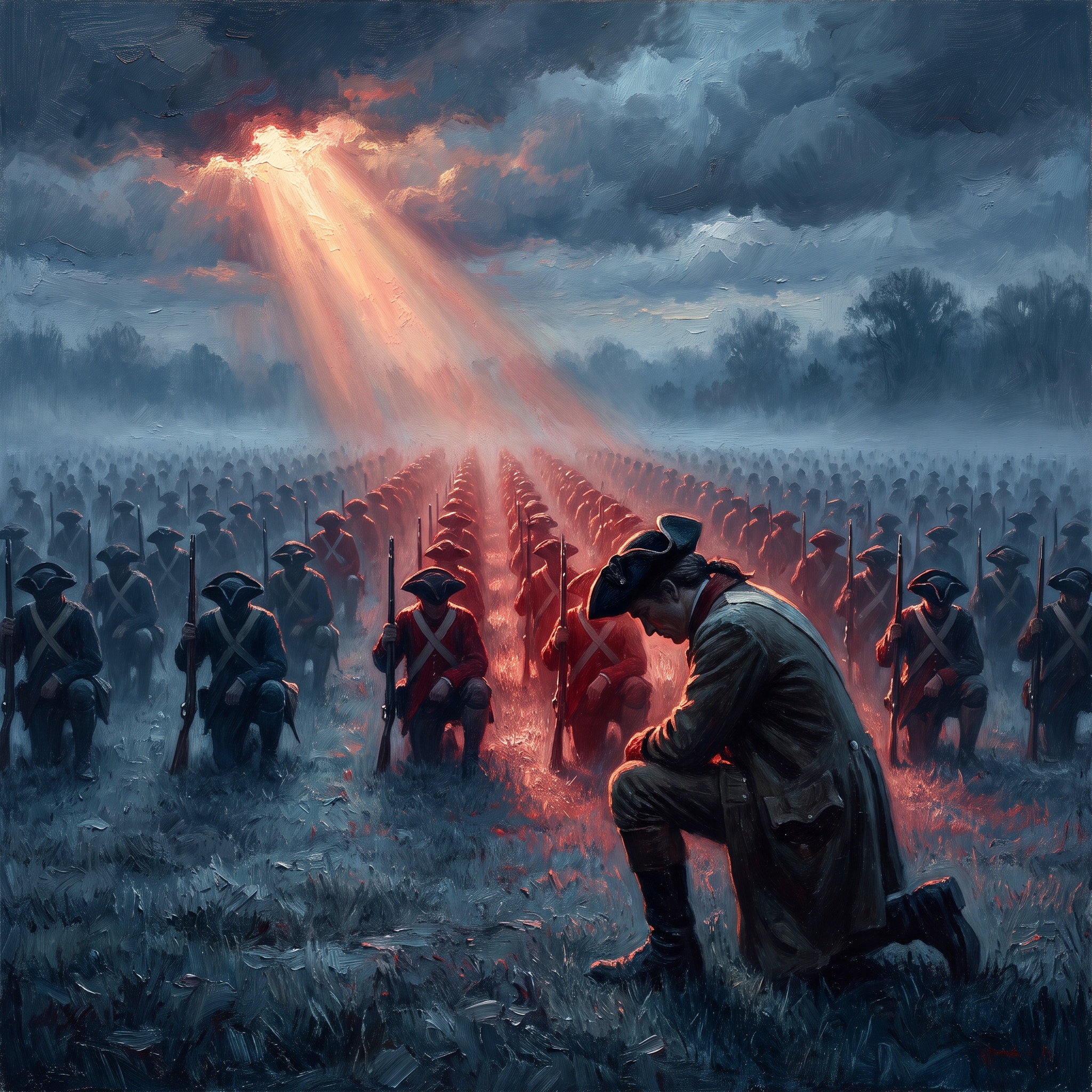
Finn Brooks: There's this line Washington wrote — or, depending on the source, issued as a formal military order — somewhere in July 1776. And it reads: 'The fate of unborn millions will now depend, under God, on the courage and conduct of this Army.'
Finn Brooks: Unborn millions.
Finn Brooks: That's not rhetoric pulled from a speech. That's a General Order — a formal command directive — issued to the Continental Army at the exact moment General William Howe's British forces were landing on Staten Island and filling New York Harbor with warships and transport vessels until American soldiers, in their own accounts, described it as just… crammed with ships.
Finn Brooks: Roughly 32,000 troops. Largest British expeditionary force of the entire 18th century. Washington's headquarters: Manhattan. Howe's army: across the water and growing.
Finn Brooks: The Continental Congress had just adopted the Declaration of Independence on July 4th.
Finn Brooks: And Washington is — wait, this is the part that actually made me stop — Washington is issuing General Orders requiring his troops to attend divine services, directing that chaplains be appointed to each regiment, and framing the whole thing as a matter of spiritual obligation.
Finn Brooks: In a military command directive.
Finn Brooks: Now — and this is genuinely strange — the date is contested. Some sources put it at July 2nd, some July 9th, some July 21st, 1776. Three dates for what seems to be the same body of orders. Historians are still sorting it out. The July 9th anchor is the most cited, tied to the first public reading of the Declaration to the troops, but even that's not airtight.
Finn Brooks: Which is — look, think about that for a second. The most famous piece of Washington's providential language, the one that gets quoted every July, and we can't even agree on the day he said it.
Finn Brooks: But the military crisis that produced it? Not contested at all.
Finn Brooks: Howe lands on Staten Island, the harbor fills up, the Continental Army is outnumbered and outgunned, and Washington reaches for God — formally, in a command document, on paper, with his name on it.
Finn Brooks: The question I can't shake is whether that reach was faith or strategy — and the disputed dating, strangely, is one of the clues.
Finn Brooks: Washington was not writing sermons.
Finn Brooks: He was a reserved Anglican, basically his whole life, who almost never committed personal theological views to paper. Not in private letters. Not in diaries. Ron Chernow dug through decades of Washington's writing and what he found wasn't devotion — it was this carefully maintained public framing, what Chernow actually calls an 'aura of providential favor.' Which is a fascinating phrase. An aura. Not a belief system. A cultivated presence.
Finn Brooks: Now contrast that with Jefferson, or Franklin, or Adams.
Finn Brooks: Those three left explicit religious writings — debates, letters, actual positions. Jefferson literally rewrote the Gospels. Adams had long arguments about theology in correspondence. Franklin proposed a daily prayer at the Constitutional Convention and explained exactly why. They were OPINIONATED about God, on the record, and Washington just… wasn't. He stayed quiet. And then in a General Order he invokes divine providence like it's load-bearing.
Finn Brooks: Because it was.
Finn Brooks: I mean — the Continental Army had no artillery advantage, no real supply chain, no professional military tradition to draw on. Howe is sitting on Staten Island with thirty-two thousand troops and a harbor so full of warships that American soldiers wrote home about it like they were describing a nightmare. Washington's headquartered in Manhattan and the math is genuinely terrible.
Finn Brooks: What do you give an outnumbered army when you can't give them better odds?
Finn Brooks: Divine Providence — the actual concept, not just the phrase — is the belief that God actively guides human affairs. Not a deist watchmaker God who wound up the universe and stepped back. An intervening God, a God who picks sides. Washington's public language consistently landed there. And that framing, in 1776, carried enormous cultural weight because Puritan covenant theology had been shaping how New Englanders especially read political events for over a century — revolution as divine judgment, suffering as covenant test, victory as blessing.
Finn Brooks: Washington plugged directly into that current.
Finn Brooks: And the chaplain order — that's not just rhetoric, that's structure. The July 9th General Orders don't just invoke God, they direct that chaplains be appointed to each regiment. That's an institutional decision. That's Washington embedding clergy into the Continental Army's organizational DNA, and that precedent has literally never been reversed. The U.S. military still has regimental chaplains. Two hundred and fifty years later.
Finn Brooks: One General Order. Still running.
Finn Brooks: Now — the honest objection here is that maybe Washington actually believed all of it. Chernow's own argument leans that direction — that the pattern across decades, surviving near-death experiences, the consistency of the providence language, points to something more than cold strategy. And I don't think that's wrong. But I also don't think the two things are mutually exclusive, which is actually the more interesting read.
Finn Brooks: A man can believe something AND know it's useful. Those aren't contradictions.
Finn Brooks: What I can't shake is the silence. If Washington had sincere, deep Anglican faith, why did he guard his private theology so carefully when Jefferson and Adams were basically publishing theirs? The silence itself is a choice — and a man who cultivated an aura knows exactly what he's doing with silence.
Finn Brooks: And the silence doesn't end in 1776.
Finn Brooks: Washington crosses the Delaware on December 25th into the 26th, 1776 — Christmas night, a blizzard, nine miles of river, troops with frostbitten feet — and the moral frame he'd been building all summer through those General Orders, the divine providence language, the chaplains embedded in every regiment, that whole architecture of meaning is suddenly load-bearing in a way it wasn't before. Because they pull it off. Trenton falls. And the story that gets told afterward is a story about God being on the right side.
Finn Brooks: David Hackett Fischer, in Washington's Crossing, traces exactly this — how the moral and military resolve Washington tried to build in those summer orders becomes the actual psychological thread that holds the army together through the worst months.
Finn Brooks: Not incidentally.
Finn Brooks: Then 1789 — Washington issues the Thanksgiving Proclamation, often called the first executive order of the new government, and the language is unmistakable. Same register. Grateful acknowledgment of providential favor, a day of prayer, the whole frame. Thirteen years after Staten Island and the harbor full of warships, and he's STILL running the same operating system.
Finn Brooks: That's not a crisis move. That's a pattern.
Finn Brooks: Which brings me to the thing I actually want to flag — every July 4th, commentators reach for the July 1776 General Orders to win a present-day argument. The Christian nation crowd quotes them one way, the strict separationist crowd quotes them the other way, and both sides are holding a document they haven't actually sat with. Christine Leigh Heyrman has written on exactly this problem — religion and the Revolution were entangled in ways that don't map cleanly onto modern culture-war positions. The 18th-century context is genuinely different, and projecting our fights backward onto it just produces a Washington who looks suspiciously like whoever is doing the projecting.
Finn Brooks: Mount Vernon has done real work here — documenting the General Orders, publishing the religious history, trying to hold the line on what the primary sources actually say versus what people WANT them to say.
Finn Brooks: But here's the honest problem — if we can't agree on whether the divine services order was July 2nd, July 9th, or July 21st, 1776, what exactly are modern observers commemorating every anniversary week? The document? The meaning they've assigned to it?
Finn Brooks: Because those are not the same thing.
Finn Brooks: The Battle of Long Island hits on August 27th, 1776 — largest battle of the entire Revolutionary War — and the Continental Army loses badly, gets flanked, barely escapes across the East River. Whatever spiritual architecture Washington built that summer gets tested immediately and fails the military test. Howe's armada was just bigger. Providence, if it was operating, was operating on a longer timeline than the soldiers sleeping in Brooklyn that night could see.
Finn Brooks: What stays permanently open is this — the private belief is unknowable. Chernow gets close, Fischer gets close, Heyrman frames the broader context, Mount Vernon holds the documents. But the man himself? He guarded it. Deliberately. And a man who cultivated an aura that carefully, who knew exactly what silence does, leaves you with just enough to project onto — which maybe was always the point.
Finn Brooks: And look — here is the part that actually sits with me. Washington never stated, not once, not in a letter, not in a diary, not anywhere researchers have found, whether he believed in a personal God. Not yes. Not no. A man who wrote thousands of words about divine providence and never once said what he actually thought providence was. At least one researcher has flagged that the July 21st order can't even be confirmed — can't place it, can't pin it. So we have a document we quote constantly, a date we can't verify, and a theology we cannot source. And the argument — two hundred and fifty years later — is still running.
Finn Brooks: We are still fighting over what he meant. Which tells you something — not about Washington, but about us. About what we need him to have meant.