Brian Reed: Hey. Good to be here. I have been sitting on this one all morning.
Eliza Ward: Yeah, same. It's — wait, it's a weird one to even describe out loud.
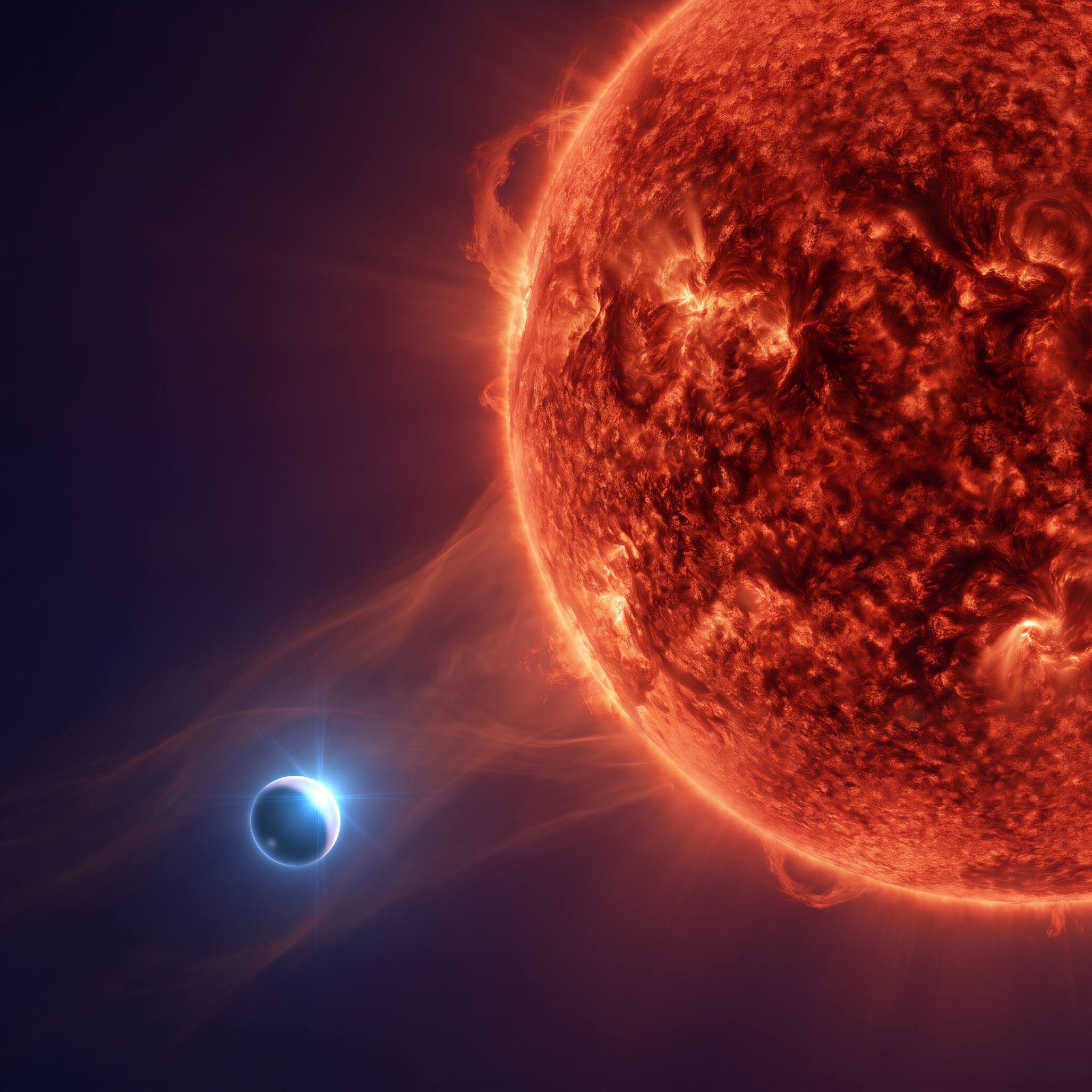
Brian Reed: So let me try. J0008+0128 — astronomers found a star, a red giant, being orbited by something they cannot see. Something that weighs more than two Suns.
Eliza Ward: And the only reason they know it's there at all is — think of a merry-go-round. One person is on it, spinning visibly. No partner you can see. But the way they move tells you exactly how heavy the missing person is.
Brian Reed: That's exactly it. LAMOST and APOGEE — two spectroscopic surveys — they watched the red giant wobble. Tracked it for 1,218 days. Nearly circular path, 3.3-year orbit.
Eliza Ward: No light from the companion. Nothing.
Brian Reed: Right — and when they did the mass math, the best estimate came back 2.2 solar masses. Range of 1.8 to 2.8. And that number is… let me see, that's the part that made me stop.
Eliza Ward: It lands right in the mass gap. The territory between the heaviest neutron stars and the lightest black holes where, by most of our models, things aren't supposed to exist.
Brian Reed: But hang on — 'supposed to exist' is doing a lot of heavy lifting there. Because GW190814 was supposed to settle exactly that. August 2019. LIGO-Virgo caught a merger — 23-solar-mass black hole swallowing something at 2.6 solar masses. Right in the gap.
Eliza Ward: And Patrick Brady — LIGO Scientific Collaboration spokesperson — said after that event that the mass gap, quote, 'may in fact not exist at all.'
Brian Reed: So why are we treating J0008+0128 like the first crack?
Eliza Ward: That's — yeah. That's the real question. And NGC 1851E is another one. Binary pulsar, dark companion pushing right up against the gap boundary, published in Science. Pulsar timing, not gravitational waves. Different method, same problem.
Brian Reed: So we've had gravitational-wave evidence, we've had pulsar timing evidence, and now spectroscopic evidence from LAMOST and APOGEE. That's three independent methods all pointing at the same uncomfortable region.
Eliza Ward: Right — but I want to slow down on the mass number itself, because the 2.2 figure isn't a direct measurement. It's model-dependent. The actual range is 1.8 to 2.8. And that matters because — wait, the gap's lower boundary is itself contested. Some definitions put it at 2 solar masses, some at 2.5.
Brian Reed: So at 1.8 it might not even be in the gap.
Eliza Ward: Exactly. Which means the headline 'contradicts the mass gap' — I mean, that's the strong version. What's actually confirmed is that the system sits somewhere in a range that overlaps with the gap, depending on which model you use and where you draw the boundary. Those are different claims.
Brian Reed: So the new part isn't that the gap is broken. It's that we now have an optically visible binary — a star you can actually watch moving — and even 300,000 POSYDON simulations can't produce it. GW190814 was a flash. This one you can keep looking at.
Eliza Ward: And that's the thing people are getting wrong. The headline running around right now is '300,000 simulations failed, physics is broken.' That's — wait, no. That's not what failed.
Brian Reed: What actually failed?
Eliza Ward: POSYDON failed. That's a specific framework — it models mass transfer, stellar winds, supernova kick distributions, isolated binary evolution. Those 300,000 runs lived entirely inside that set of assumptions. And not one of them produced: high compact-object mass, red giant companion, wide orbit, low eccentricity, all together.
Brian Reed: So it's like — hang on, let me see if I've got this — if you only test arch bridges using suspension-bridge equations, the math breaks, but the bridge is still standing.
Eliza Ward: Exactly that. POSYDON exhausted its own parameter space. It didn't exhaust the universe's options.
Brian Reed: And the orbit matters here. Because — actually, the reason a supernova should leave an elliptical orbit is a natal kick, right? The explosion is asymmetric, it shoves the compact object sideways, and that stretches the path. J0008+0128 is nearly circular. Wide and calm. POSYDON is built around isolated binary evolution — which kind of assumes that kick happened on cue, in a system that was already paired. If this thing assembled some other way — dynamical assembly in a dense stellar cluster, say — none of those kick assumptions even apply.
Eliza Ward: And that hasn't been ruled out. That's what I want people to hold onto. Dynamical assembly in clusters is still on the table. POSYDON doesn't cover it.
Brian Reed: So the take that's circulating — 'physics is broken' — the more precise version is: our isolated binary evolution models were too narrow. And honestly, there's a bigger pattern here that makes this look less like a one-off and more like — well, we should probably get into that, because J0008+0128 is not the first time something's shown up that the models couldn't account for.
Eliza Ward: Right — and the full list of those anomalies, once you put them next to each other, is where this gets genuinely uncomfortable. That's coming.
Brian Reed: And that list — it doesn't start with J0008. N6946-BH1. A giant star that was just... there in Hubble images in 2007. By 2015 it was gone. No explosion, no supernova signature. Just — absent.
Eliza Ward: Gone. Direct collapse, suspected.
Brian Reed: Which matters here because — hang on, let me connect this — if stars can skip the supernova entirely and fall straight into a compact object, the natal kick never happens. No kick, circular orbit, wide separation. That's exactly the profile POSYDON couldn't build.
Eliza Ward: And Isaac Legred actually pushed this further. He proposed that the dip in black-hole masses in gravitational-wave data — around 12 to 16 solar masses — could itself be an artifact of failed supernovae. Meaning the gap's shape, its edges, might be a fingerprint of incomplete stellar death physics, not a real physical boundary.
Brian Reed: Wait — so the gap we're trying to explain might be constructed by the same process that fills it?
Eliza Ward: That's the uncomfortable version, yeah. And then there's PSR J0653+0443 — FAST found it through the GPPS survey — binary neutron star with an orbital eccentricity of 0.992. Highest known among Galactic binary neutron stars. That thing is stretched so elliptically it barely counts as an orbit.
Brian Reed: Which means the kick that made it was violent. Almost the opposite geometry from J0008. So — I mean, we're not looking at one anomaly now. We've got direct-collapse disappearances, nearly-circular wide systems, and extremely elliptical tight ones, and none of them fit neatly inside the same model.
Eliza Ward: Right — and picture someone like a researcher pulling up the FAST timing data on J0653 at three in the morning and trying to run it against their formation code, and the eccentricity just breaks the prior. That's happening repeatedly now, across instruments, across methods. The next thing that actually closes this — it's not more simulations. It's whether deeper spectroscopy on J0008 or a new gravitational-wave detection can distinguish dynamical cluster assembly from a failed supernova channel. Those two origins produce different orbital signatures. That's the specific fork.
Brian Reed: And until that fork resolves — we're not in 'physics is broken' territory. We're in 'we've been modeling one road and there were always two.'
Eliza Ward: Two roads. And the thing is — POSYDON's 300,000 runs only ever paved one of them. Dense cluster assembly, failed supernovae as a formation channel — those weren't in the parameter space at all. So when the mass range on J0008+0128 comes back 1.8 to 2.8 and the orbit is that quiet, that circular — we're not even asking the right question yet about where it came from.
Brian Reed: And the classification isn't settled. That's the part I keep wanting to flag — 2.2 is the best guess, but the model dependency means we genuinely don't know if this is the heaviest neutron star anyone's found, or the lightest black hole. Those are different objects with different physics.
Eliza Ward: Right — confirmed: the system exists. Confirmed: isolated binary evolution can't build it. Not confirmed: what it is, or how it got there.
Brian Reed: So what would actually move this? Like — I mean, not 'more data' generally — what specific observation changes the confidence in one direction? Because if deeper spectroscopy on J0008 sharpens that mass range, or a gravitational-wave detection catches something with the same orbital fingerprint assembling in a cluster environment — those two things would actually separate the channels. That's the fork. And until one of those lands, we're... I don't know. Honestly, we're still at the map edge.
Eliza Ward: Map edge is exactly it. That's where we are. The object's real. The orbit's real. The models broke. Everything else is still open.