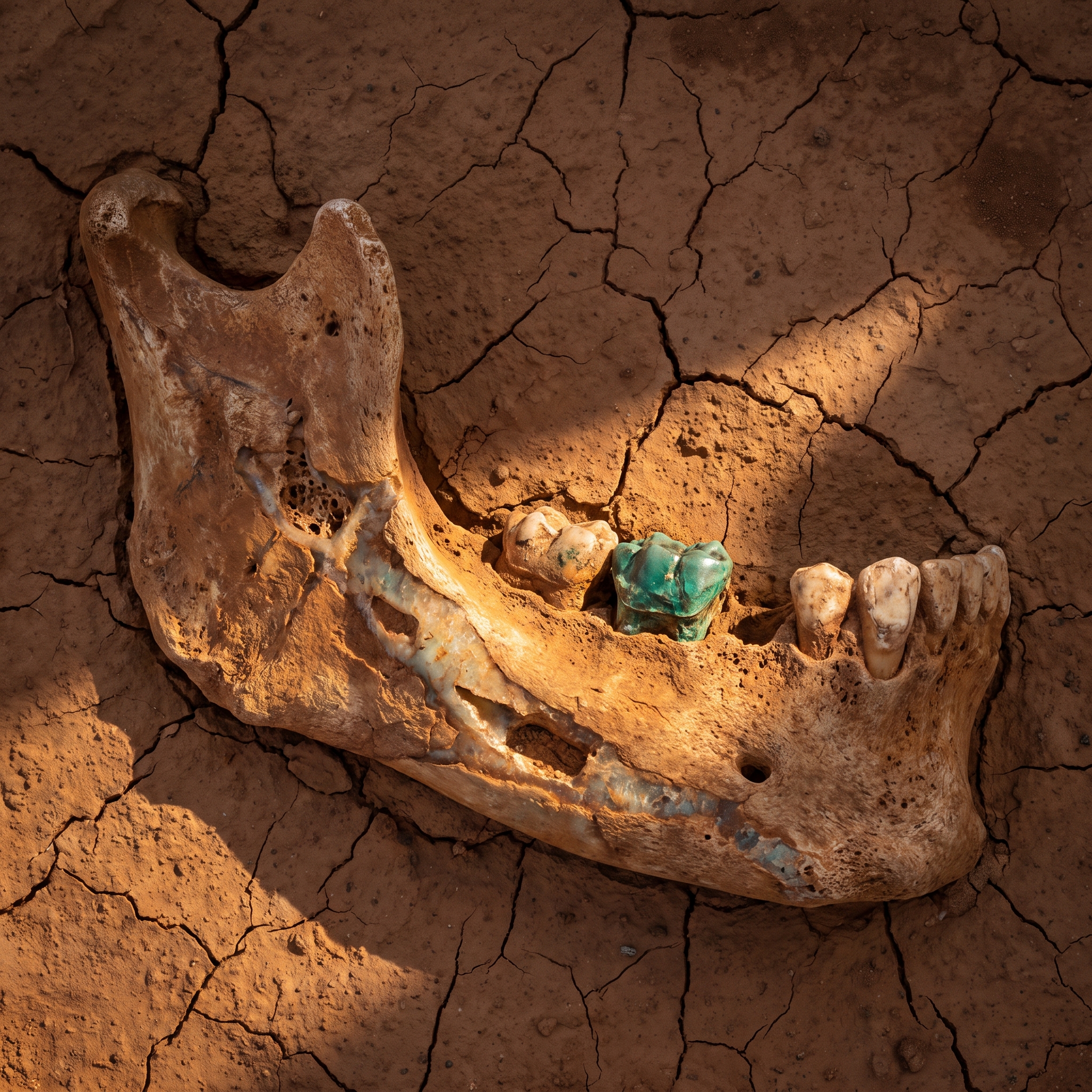
Otis Kim: Iris, good to be back — I want to start with an image, because this one actually got to me a little. A field team kneeling in the Afar dirt, and one of them picks up what looks like a fragment of cracked stone. And it's a jaw. A two-and-a-half-million-year-old jaw from a hominin that had zero confirmed presence in that entire region.
Iris Holm: The Mille-Logya site.
Otis Kim: Mille-Logya, yeah. Zeresenay Alemseged, University of Chicago — his team publishes this in Nature, January 2026. Paranthropus jaw, 2.6 million years old, first of its kind from the Afar region. And the Afar is not some blank patch of map — it had already produced hundreds of hominin fossils before this. Paranthropus just never showed up.
Iris Holm: Which is the interesting part. Not the find — the absence before it.
Otis Kim: Right, and that's — actually that's what I want to dig into. Because the analogy I keep reaching for is this: imagine a nature reserve where ecologists have catalogued the wildlife for forty years, and wolves are just not on the list. Then someone digs one grid square to the left and finds a wolf skull. Did wolves just arrive? Or did we just stop looking?
Iris Holm: That's the question underneath all of this. Whether a single jaw proves range, or proves we had a blind spot.
Otis Kim: And that's what we're here to figure out.
Iris Holm: Fair. Let's do it.
Otis Kim: But that blind spot wasn't some accident. The Afar had already given up Ardipithecus, Australopithecus, early Homo — hundreds of specimens, over a dozen species. And Paranthropus was just... not there. So at some point the field stops asking why and starts treating the gap as the answer.
Iris Holm: That's exactly the move. Absence hardens into consensus. Nobody publishes 'we didn't find Paranthropus in the Afar.' That's not a paper. So the gap stays invisible.
Otis Kim: So we decided it was never there because we didn't find it.
Iris Holm: Essentially. And then Mille-Logya produces one jaw — 2.6 million years old — and suddenly the known range extends more than a thousand kilometers northward. That's not a small correction. That is the entire prior map being wrong.
Otis Kim: A thousand kilometers. From one jaw fragment.
Iris Holm: One jaw. And here's what nobody leads with — Woranso-Mille, also in the Afar, produced Australopithecus mandibles dated to 3.7 million years ago. So the region was already populated well before this window. The Afar wasn't empty territory Paranthropus stumbled into. It was — actually, wait — it was already a crowded neighborhood for over a million years before this jaw.
Otis Kim: Which makes the absence weirder, not less weird.
Iris Holm: Right. And then stack LD 350-1 on top. The Homo jaw from Ledi-Geraru — 2.8 million years old, found in 2013, pushed back the origins of our own genus by around 400,000 years. That site is 150 kilometers south of Mille-Logya. So at 2.8 million years ago, early Homo is already in the Afar. Paranthropus shows up at 2.6. The question isn't whether these lineages coexisted — it's whether we have any idea how crowded that landscape actually was.
Otis Kim: And the branching model everyone talks about — multiple lineages competing, adapting — that's not new theory. But we keep being surprised every time we find actual evidence of it.
Iris Holm: And we keep being surprised because the ladder story is more comfortable. Easier to teach. Older species gives way to newer species, one clean line. But pin three flags on a map of Ethiopia — Mille-Logya, Ledi-Geraru, Woranso-Mille — same latitude, same two-hundred-thousand-year window, and you've got Paranthropus, early Homo, Australopithecus all overlapping. That's not a ladder. That's a bush.
Otis Kim: A graduate student in 2026 could literally draw that with three different colored pins and break the ladder story in thirty seconds.
Iris Holm: That's the branching model. It's been the working framework for decades. So the part I cannot resolve — the headline says this challenges established understanding. But multi-lineage coexistence was already established.
Otis Kim: Yeah, and that's what actually bothers me. Not the finding — the framing. Because what we knew was that Paranthropus, Australopithecus, and early Homo could coexist in principle. What we did not know is whether they were genuinely sharing the Afar, specifically, between 2.8 and 2.5 million years ago. That window — that's the gap. So LD 350-1 puts early Homo there at 2.8. The Mille-Logya jaw puts Paranthropus there at 2.6. And now the question isn't whether they met — it's what that actually meant. Competition? Niche partitioning? Total geographic separation within the same region?
Iris Holm: Which remains actively debated. Nobody has a behavior. Nobody has a diet. One jaw.
Otis Kim: Right — and that's actually what happens later. Because the micro-CT scanning was supposed to crack that open — root canals, cortical bone density, internal geometry of the jaw. All that resolution. And the species is still unresolved. The diet is still unknown. That part I want to get into.
Iris Holm: Frankly, that's the sharper story.
Otis Kim: But to land the pattern first — three lineages, same landscape, no clean succession. That's not a revision of the ladder. That's evidence the ladder was wrong from the start.
Iris Holm: The question is whether one site in the Afar proves the pattern — or whether it's just the only place we looked hard enough.
Otis Kim: And that's exactly where the micro-CT thing breaks me a little. Because the promise of that tool is — okay, we can't cut open the specimen, it's irreplaceable, but we map the inside without destroying anything. Root canals, cortical bone density, the internal geometry of the jaw. Non-destructive. More data than surface morphology ever gave us. And Alemseged's team runs all of that on the Mille-Logya jaw. And then — still can't say if it's Paranthropus robustus or P. boisei or something else entirely.
Iris Holm: Better imaging. More precise uncertainty.
Otis Kim: That's — yeah. That's the thing. Sharper picture of what we don't know.
Iris Holm: Which is not nothing, actually. The micro-CT is non-destructive — that matters. You're not grinding the specimen to dust for isotope analysis. But the gap between 'we can now describe the trabecular structure in exquisite detail' and 'we know what this animal ate' — that gap does not close. The bone was shaped this way. Full stop. What shaped it? Still open.
Otis Kim: Wait — so the species assignment is genuinely unresolved? After all of that?
Iris Holm: Published in Nature, January 2026. Unresolved. No confirmed diet, no confirmed ecological niche. The scanning adds resolution to the description — it does not add resolution to the interpretation. Those are different problems.
Otis Kim: I mean, that's almost the crystallizing detail for the whole fossil record problem, isn't it. We developed a tool precise enough to read the inside of a 2.6-million-year-old jaw — actually, no, the tool is impressive, I'm not undercutting it — but the fossil record is so incomplete that even that precision lands in a void. We have one jaw. One data point. Micro-CT gives you higher resolution on a sample size of one.
Iris Holm: The incompleteness is structural. Known hominin fossils are a fraction of what actually lived. Absence of Paranthropus in the Afar was never evidence it wasn't there — it was evidence we hadn't found it. The consensus formed around a gap. The gap turned out to be a gap in our searching.
Otis Kim: So better tools, same fundamental problem. The uncertainty just gets more precisely labeled.
Iris Holm: The map got bigger. Not clearer.
Otis Kim: Yeah. I mean — that's actually the most honest thing you can say about it. We have a 2.6-million-year-old jaw from Mille-Logya. We cannot name the species. We cannot say what it ate. The questions about diet, ecological flexibility, how it interacted with the Australopithecus and early Homo lineages sharing that landscape — none of that moved. Not one inch. And that's not a failure of the find. That's just... what the find is.
Iris Holm: That's the job, actually. You find the jaw. You describe the jaw as precisely as you can — micro-CT and all. And then you sit with it being unresolved. That's not a gap in the science. That's the science.
Otis Kim: Yeah. That's the job.
Iris Holm: Good conversation. Genuinely.