Eliza Ward: Hey. Good to be here.
Brian Reed: Yeah, likewise — though I'll be honest, I've been sitting with this study all morning and I'm still a little rattled by it.
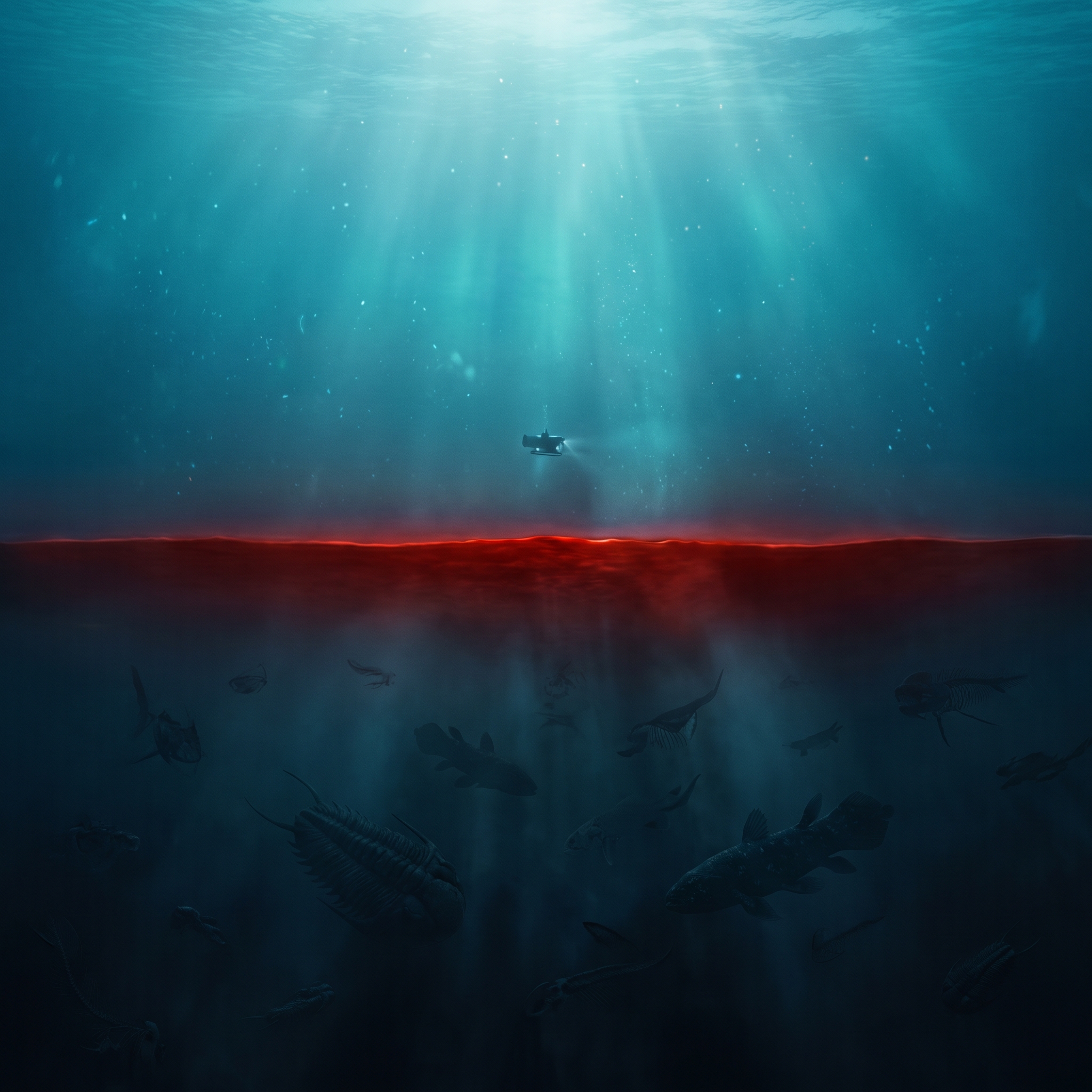
Eliza Ward: Okay, let's just get into it. PNAS just published a study — Marquez and Sperling at Stanford — and the claim is that they've identified the specific kill mechanism behind the end-Permian extinction. Not a theory. Physiological evidence.
Brian Reed: Ninety to ninety-six percent of marine species. Gone.
Eliza Ward: Right — 252 million years ago. The Siberian Traps are the trigger, that part's been established. What Marquez and Sperling are saying is the actual mechanism — warm water holds less oxygen and raises metabolic demand simultaneously. Animals hit a wall.
Brian Reed: Wait — that's temperature-dependent hypoxia? That's the thing Penn and Deutsch were modeling earlier, and now there's direct fossil evidence for it?
Eliza Ward: That's the claim, yeah. Marquez builds on that framework. And the part I — actually, the number that keeps stopping me is 70 to 75 percent of terrestrial species too. This wasn't just an ocean event.
Brian Reed: And scientists are saying the same combination — warming, deoxygenation — is measurably showing up in oceans right now.
Eliza Ward: And that's exactly where the Penn and Deutsch framework was sitting — they modeled that the mechanism could do this, but Marquez and Sperling are the ones who actually show it in the fossil record. Which taxa survived, which didn't. Not random. Not predation. Physiology.
Brian Reed: Okay, so let me — let me just say this plainly. Imagine you're a fish in a bathtub. Someone turns the heat up. Two things happen at once: the water holds less air, and your body needs more air just to stay calm. You're getting squeezed from both sides simultaneously. That's it. That's the whole thing.
Eliza Ward: That's it. Both directions at once.
Brian Reed: And what Sperling and Marquez add — at Stanford, publishing in PNAS — is they can now point at specific groups and say: these animals couldn't tolerate that squeeze, and here's where they died first. Shallow basins. The geography matches the physiology. That's... I mean, that's not a model prediction anymore, that's a match.
Eliza Ward: Wait — but I want to be careful here. Penn and Deutsch had the theoretical framework. What's actually new is the taxonomic selectivity part, right? The study tells us which marine taxa survived based on physiological tolerance. That's the signal. The mechanism existing was already — that was Penn and Deutsch's contribution.
Brian Reed: Right, and — yeah, that distinction matters. Because the headline version is 'scientists solved the Permian extinction' and the actual version is more like 'we now have direct evidence for who died and why, not just that a lot of things died.'
Eliza Ward: And the permanence piece. It wasn't a temporary disruption — the ecosystem composition after the extinction just... stayed reorganized. The groups that dominated before don't come back.
Brian Reed: The number that genuinely stopped me cold: the extinction pulse itself lasted roughly 61,000 years — give or take 48,000. Geologically, that's nothing. The Siberian Traps were erupting for maybe a million years, and the actual dying happened in this narrow window. That's not a slow slide. That's a wall.
Eliza Ward: 61,000 years — because there's a specific critical pulse of magmatism in there. Which means the question for modern oceans isn't how long the stressor lasts. It's whether you hit the threshold at all.
Brian Reed: But that's actually where I want to pump the brakes, because there's a version of this story circulating that I think is just — it's wrong. People are reading the Marquez paper and going 'the Permian is happening again.' And I don't think the evidence reaches that.
Eliza Ward: Name it. What's the specific overreach?
Brian Reed: The cause asymmetry. The Siberian Traps were erupting over, let me see — thousands of years. Maybe a million. Today's emissions are fossil fuels and land-use change compressed into 150 years. That's a completely different delivery mechanism. Different ocean circulation, different continents, different ecosystems. You can't just — you can't read off the Permian number and apply it.
Eliza Ward: No, that's right. And the end-Permian warming was something like 8 to 12 degrees Celsius above baseline. We're not there. The mechanism could be the same — temperature-dependent hypoxia is real — but the structural conditions are different enough that any direct quantitative transfer is... I mean, it's not what the 2026 PNAS study is actually claiming.
Brian Reed: So the study is solid, the analogy is the problem.
Eliza Ward: The mechanism is solid. The analogy is — okay, instructive but not transferable. The coral bleaching report Reuters ran in August 2026, the Australian giant cuttlefish collapses, those are real distress signals. But neither of those is directly quantified as warming-plus-deoxygenation specifically. Could be acidification, could be a broader mix of stressors. The causal chain from the PNAS mechanism to those outcomes is still inferential.
Brian Reed: Wait — so we're saying the ancient evidence is forensically tight, but the modern link is actually... thin?
Eliza Ward: That's the honest version, yeah. Predicting modern vulnerability runs on climate and ocean models, not paleontology alone. Marquez and Sperling explain who died 252 million years ago. Whether today's oceans hit the same threshold — that's a separate question requiring separate evidence.
Brian Reed: And the part that I think is going to make all of this messier — the geochemical side, the mercury anomalies, the sulfur isotope records — there's forensic evidence for what the Siberian Traps actually did to the ancient atmosphere, and whether any of that maps onto what we're measuring now is something we haven't gotten to yet.
Eliza Ward: The mercury anomalies are actually the clearest thread into that — they show up in sedimentary records at end-Permian boundary sites in South China, and they fingerprint the Siberian Traps specifically. That's how you tie the volcanism to the kill. Sulfur isotope ratios do the same thing, tracing the aerosols back to that province. The ancient forensics are — I mean, they're genuinely tight. The puzzle is we built that case from proxies. Rock chemistry. Today we have actual sensors in the water.
Brian Reed: Wait — we're measuring in real time and the ancient case is still more settled?
Eliza Ward: For the mechanism, yeah. Because the proxy record closes the loop — volcanism, greenhouse gas, deoxygenation, extinction pattern. Modern oceans, we're watching the oxygen readings drop in dead zones off the Oregon coast right now. Same numbers the ancient shallow basins show. But the causal chain from those readings to a specific extinction outcome is still... we haven't closed it.
Brian Reed: So picture a marine biologist out on a research vessel off Oregon, summer sampling, pulling water up — and the oxygen reading is actually below survivable threshold. That's not a model. That's happening.
Eliza Ward: And those dead zones are expanding. That's the documented trend — modern oxygen minimum zones growing. Which is the direct analog to what the Permian record shows in the shallow basins. Not a metaphor. Same physical process.
Brian Reed: Right — but the part I don't get is, okay, we've got the dead zones, we've got the August 2026 Reuters report saying coral bleaching is now happening too frequently for reefs to actually recover between events. Ocean acidification running alongside all of it. What would actually close the causal gap? What evidence are we still missing?
Eliza Ward: Honest answer? You'd need to show that species loss in those dead zones tracks physiological oxygen tolerance specifically — not temperature alone, not acidification alone. The acidification is a co-stressor, it was present in the Permian too, and we can't always untangle which lever is doing the damage. That causal specificity is — wait, that's actually where the Marquez framework becomes useful going forward. It tells you which traits to look for.
Brian Reed: So the thing to actually watch is whether fisheries mortality data or population collapses in those expanding dead zones start matching the tolerance profiles Marquez identified. That's the test.
Eliza Ward: That's the test. And it's not answered yet.
Brian Reed: And that test could run for decades before we have an answer. That's the uncomfortable part. Sperling's at the Stanford Doerr School of Sustainability — so this isn't just paleontology sitting on a shelf. There's an active program around it. But even then, closing the causal gap between the PNAS mechanism and what's actually killing populations in modern dead zones... I don't think that's a near-term result.
Eliza Ward: No, it's not. And — wait, I want to be clear about where we actually landed. The warming-plus-deoxygenation combination explains end-Permian taxonomic selectivity. That part is solid. Whether that same mechanism now predicts which modern fisheries collapse first — that's climate and ocean modeling, not what Marquez and Sperling were doing.
Brian Reed: So the authors themselves acknowledge that limit?
Eliza Ward: From what we've got, yeah. The ancient mechanism is confirmed. The modern forecast is — I mean, it's a different instrument entirely. Paleontology tells you the trap is real. It doesn't tell you which species walks into it next.
Brian Reed: That's where I'm sitting too. And I'm not sure that question gets answered without data we just don't have yet.