Megan Skiendel: You know what you never think about on July 4th? That in 1795 someone buried a brass capsule under the Boston State House and it sat there until December 2014.
David Sterling: Two hundred nineteen years. Right. And now America250 just sealed something meant to go two-fifty.
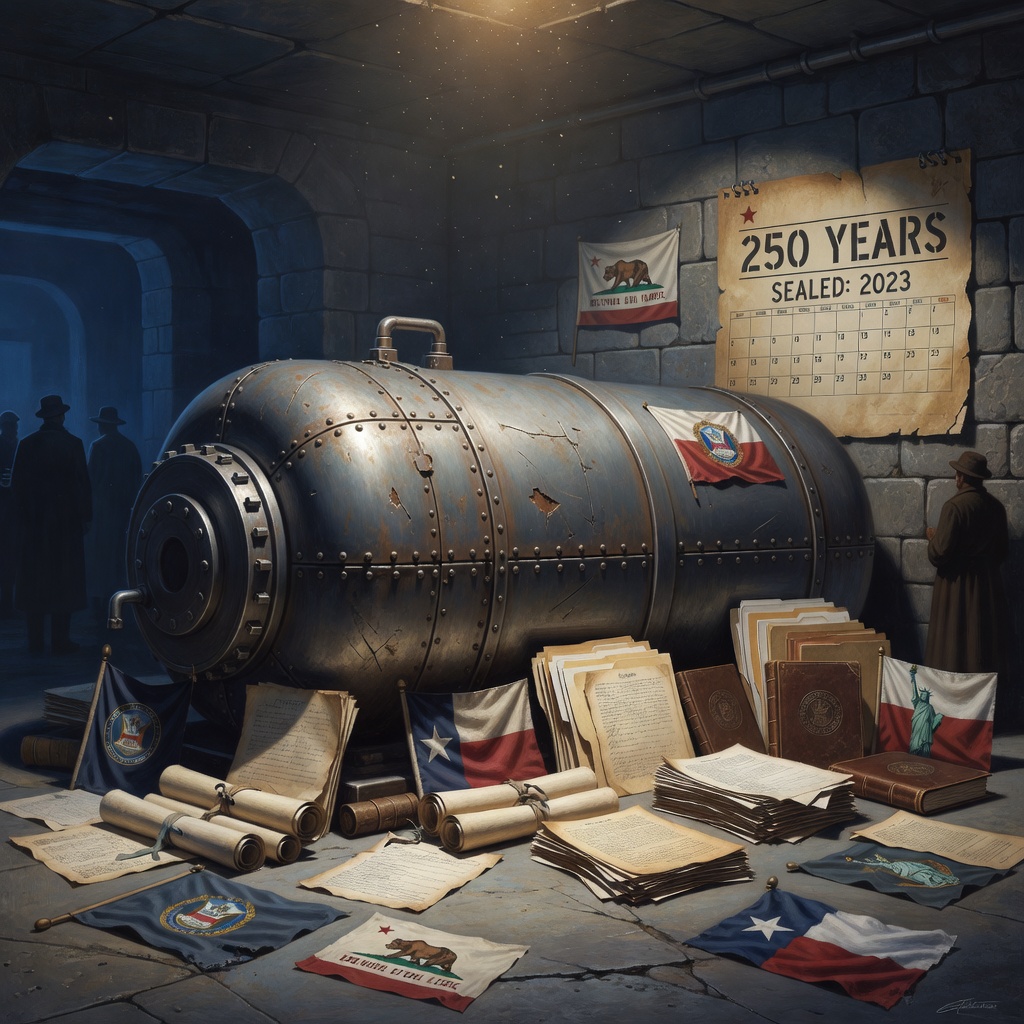
Megan Skiendel: America's Time Capsule. Nine hundred pounds. NIST did the engineering, Library of Congress did preservation. Tom Medema managed it — actually assembled the whole cross-disciplinary team.
David Sterling: Sealed in June. Buried at Independence National Historical Park on July 4, 2026. Law mandates it doesn't open until 2276.
Megan Skiendel: The Semiquincentennial. And inside — I mean, honestly — California sent an AI-generated future forecast. Arizona nano-etched the full Declaration of Independence. Maine sent — wait, I still can't get past this — a whale bone.
David Sterling: Phillies Opening Day lineup card.
Megan Skiendel: A 3D rendering of Lincoln's hand. Right. Rosie Rios said — and I'm quoting — when it opens in 2276, future generations will see the care, pride, and optimism with which Americans marked our 250th anniversary.
Megan Skiendel: Megan Skiendel: 'Care, pride, and optimism.' That's the official frame. And then you have Tom Medema saying the whole point is that the time capsule gives everybody the chance to talk to the future, it's time travel for ideas. Fine. But who's everybody? Because — wait, actually — 'meticulous review of collected items' is doing an enormous amount of work in the press release. Somebody rejected things. We don't know who, or what the criteria were.
David Sterling: America250 is Congress-chartered. That means something structurally.
Megan Skiendel: Does it? Because Freedom 250 is also a real organization. White House-connected. National Mall events. Most of their announced performers withdrew — citing politicization.
David Sterling: Trump canceled the whole concert series. Replaced it with — what did he call it.
Megan Skiendel: A 'Rally to end all Rallies.' And that's the signal problem. Two organizations, one branding moment — America250 and Freedom 250 — and the public couldn't distinguish them. The nonpartisan story didn't land as nonpartisan.
David Sterling: So the new thing isn't intergenerational communication. That's ancient. The new thing is — an unelected commission made editorial choices about the national record with no public accounting. And the political noise made that invisible.
Megan Skiendel: Exactly. Rosie Rios can say future generations will see American optimism. But they'll see whatever America250 decided to put in. That's not the same thing.
David Sterling: Here's the bad take that's circulating. Everyone is treating this as an engineering success story — NIST solved it, the materials hold, the capsule lasts. That's not the problem.
Megan Skiendel: The institution doesn't last.
David Sterling: The 2016 law mandates a 2276 opening. But there is no enforcement mechanism. The law doesn't — I mean, what court in 2276 compels compliance? The legal authority behind the instruction has nothing holding it up except the assumption that everything between now and then continues intact. That's the single point of failure. And Berilla — NIST's own fabrication director — said when the capsule closed it felt 'a little bit anti-climactic.' The people who built it felt it. On some level they knew the opening is conditional.
Megan Skiendel: Wait — but the Boston State House capsule. 1795, no federal law, no mandate. Survived two hundred nineteen years because the community kept the story alive. Not enforcement. Memory.
David Sterling: That's actually — no, that complicates it rather than solves it. NIST engineered for 250 years on the interior humidity controls. Library of Congress archival standards assume 500 years minimum for paper preservation. So if it opens on schedule, the engineering may have undershooted the institution's own floor.
Megan Skiendel: So it's a 250-year unfunded liability and it may not even be calibrated right.
Megan Skiendel: And that's — I mean, that's the thing nobody wants to say out loud. The 900 pounds of steel will absolutely be in the ground at Independence National Historical Park in 2276. That part I believe. NIST built for it. But the authority? Who actually has standing to say — legally, institutionally — okay, July 4th, 2276, we open this now? That's not a NIST problem. That institution doesn't exist yet. It may not look anything like America250, or Congress as we know it, or — honestly — any framework alive today.
David Sterling: The capsule outlasts the mandate. That's the bet, isn't it. A 2016 law, no enforcement chain, one burial site — and two hundred fifty years of assuming the political succession holds. Who enforces it?