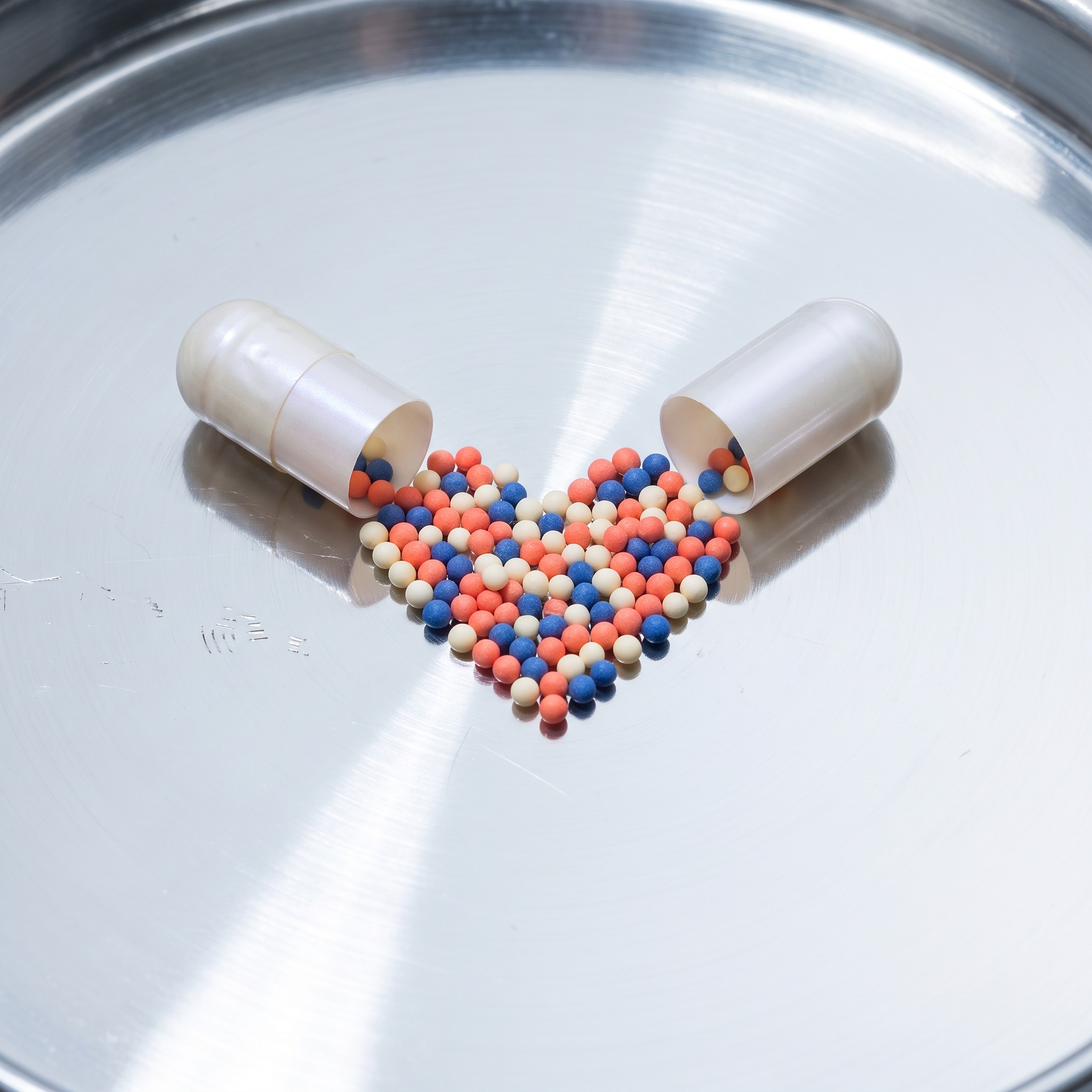
Hope Sterling: Hey, I need to start today with a confession — I genuinely had a moment this week where I thought I'd invented something, and then it turned out scientists already did it better.
Juniper Vale: Okay, what was the moment?
Hope Sterling: I was helping my roommate sort her medications — she has like, four different bottles — and I literally said out loud, why can't they just put these in one pill? And then I saw the Michigan Medicine and UT Southwestern study in Nature Medicine and I was like... they did. They did that. And polypill patients had sixty percent fewer heart failure hospitalizations or ER visits than people on standard multi-drug therapy.
Juniper Vale: Sixty percent fewer — and the reason isn't a better molecule. The reason is that a polypill, which is just a single capsule with multiple drugs at fixed doses, removes the friction of managing separate pills entirely.
Hope Sterling: Which is — okay, stop. The answer was adherence this whole time? Like, guideline-directed medications already existed for heart failure and most patients just... weren't taking all of them?
Juniper Vale: That's exactly what the study authors argue. And I think we have to sit with how uncomfortable that is — because it raises the question of whether this is brilliant or whether it's a sign of something the system failed to fix a long time ago.
Hope Sterling: But like — wait, that's the part that's messing with me. Because sixty percent is a huge number, and I want to celebrate it, but is the win actually that the pill is better or just that people... finally took it?
Juniper Vale: That's exactly the right place to push. Think of it like a to-do list app — it doesn't give you new tasks, it just makes sure you actually do the ones already on the list. The polypill doesn't add a single new drug. It's metoprolol, lisinopril, the same guideline-directed medications cardiologists have prescribed for years. The chemistry didn't change. The calendar did.
Hope Sterling: Stop. So the sixty percent — that's an adherence win, not a pharmacology win.
Juniper Vale: Exactly. And I want to be honest about what the evidence does and doesn't say here, because — okay, there is a real signal. Left Ventricular Ejection Fraction — basically how much blood your heart actually squeezes out with each beat — that improved meaningfully in polypill patients. That's published in Nature Medicine, Michigan Medicine and UT Southwestern co-leading. But LVEF is a surrogate marker. It's encouraging, it's not nothing, it's actually a strong signal — I mean, it's what cardiologists watch closely — but whether that translates to people living longer? The confirmatory trials haven't run yet. We don't know.
Hope Sterling: Okay, that's — yeah, that's the brake I needed pumped. So picture the person this actually affects. Like, not the journal paper version.
Juniper Vale: A 71-year-old leaves a Tuesday cardiology appointment with three separate prescriptions, three different refill schedules, one pharmacy that's closed on weekends. Six months later she's back in the ER — not because the drugs failed, because the calendar did. And the cardiovascular field has known for years that guideline-directed heart failure medications are massively under-utilized in practice. That's not a fringe concern — that's the whole reason this research program exists. Oh, and there's a second data point coming that makes this even more interesting — the hypertension side of this story actually changes the safety math in a way I didn't expect.
Hope Sterling: Wait — the safety math changes? Like, not just convenience, but actually safer?
Juniper Vale: That's the Kangbuk Samsung Hospital finding — Professor Sung Ki-cheol's team, published in JACC. And I mean — I assumed 'combination pill' meant same doses, just bundled. But no. The triple pill they tested — amlodipine, losartan, and chlorthalidone — each drug at one-third standard dose. Not full doses combined. One-third.
Hope Sterling: Stop. One-third each? And it still — it worked better than a single drug?
Juniper Vale: Beat single-drug therapy for newly diagnosed hypertension patients over eight weeks. Minimal side effects. So the conversation isn't just 'one pill is easier' anymore — it's actually, wait, could lower individual doses mean fewer people stopping treatment because they feel terrible on it? That's a different claim entirely.
Hope Sterling: Okay that's — I mean, that's the thing I didn't see coming. Because the reason people quit meds isn't always the schedule, it's sometimes the side effects, right? And if one-third doses sidestep that—
Juniper Vale: Both studies together — heart failure, hypertension, different populations — they're pointing the same direction: away from sequential add-on prescribing, where you start one drug, wait, add another. Toward combination strategies as the structural default. That's real. I'd still call 'paradigm shift' aspirational language with two studies. But the direction of travel? Yeah, you were right about that.
Hope Sterling: I'll take the partial win.
Juniper Vale: I keep wanting to celebrate the 60% number and then I remember — it doesn't fix cost, it doesn't fix side effects, it doesn't fix a physician who isn't prescribing aggressively enough. And the fixed-dose problem is real too. If someone develops a side effect and needs to back off one component, you can't just pull that drug. You pull everything. Not every clinician is comfortable with that trade.
Hope Sterling: Okay, yeah — I'll fully concede that. Like, for someone who needs really fine-grained dose management, the polypill is actually a net loss of precision. That's a real thing. But — I mean, I can't walk away from 60% fewer hospitalizations like it's a footnote. That number is published in Nature Medicine, it's not a vibe.
Juniper Vale: No, it's not a footnote. The honest landing, I think, is this: the polypill solves the pill-count problem, and only that. If 'simple and sufficient' keeps that many more patients out of the hospital — I mean, the uncomfortable question isn't whether the polypill is perfect. It's why it took cardiology this long to admit that perfect was the enemy of taken.
Hope Sterling: That's — yeah. That's kind of a damning sentence for the field, actually.
Juniper Vale: A little bit. Good conversation, though — genuinely.