Ben Okonkwo: Jonathan, hey — tell me you've had a normal week, because I have not.
Jonathan Ingles: Spent three days reading about a rocket that's going to hit the Moon and nobody officially cared until a guy in Maine noticed. So, no.
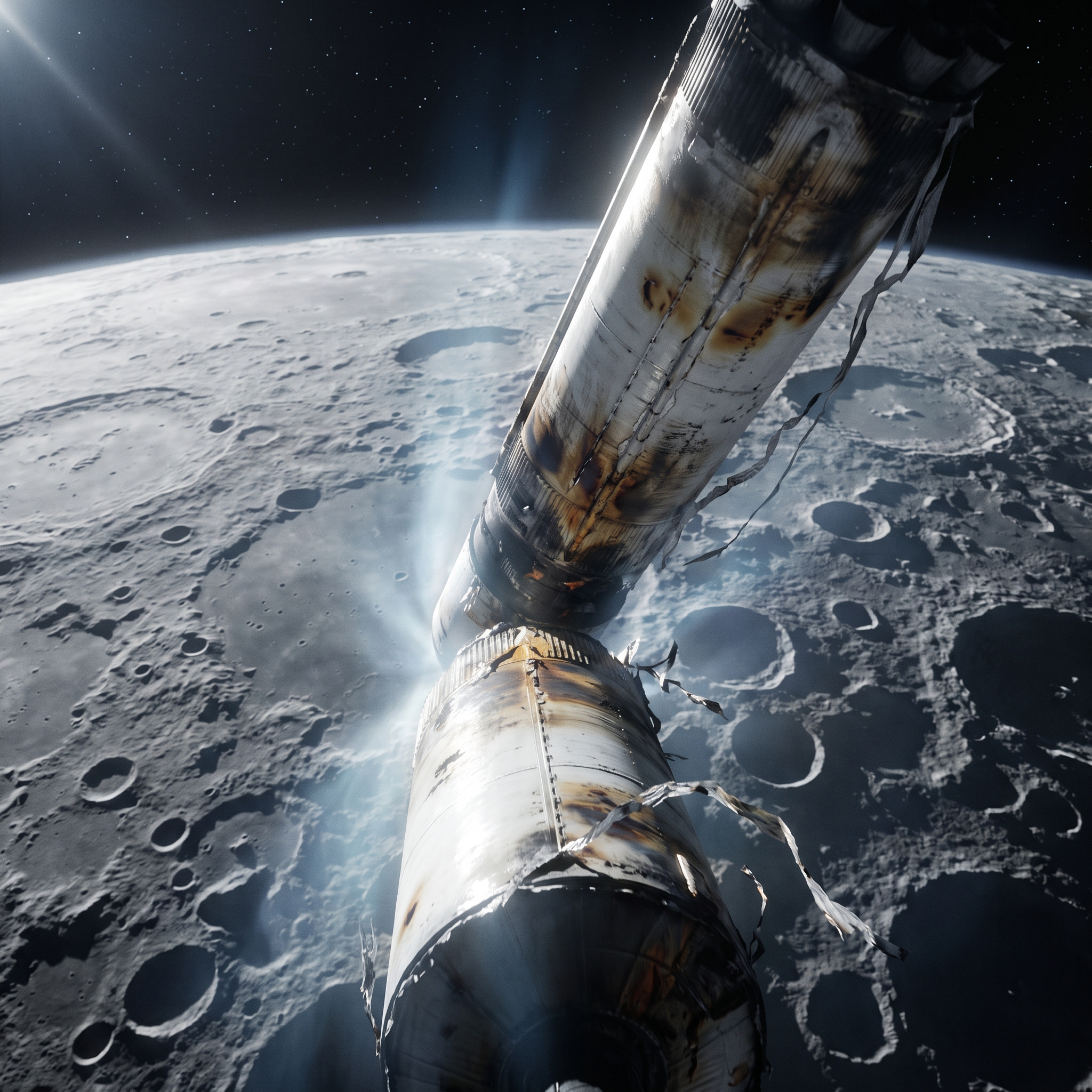
Ben Okonkwo: That's — yeah, that's exactly it. So here's where we're starting. The Falcon 9 upper stage from the January 15th, 2025 launch out of Kennedy Space Center's Launch Complex 39A — SpaceX put it up carrying Firefly Aerospace's Blue Ghost Mission 1 and ispace's Hakuto-R Resilience — that spent second stage is on a confirmed course to strike the Moon.
Jonathan Ingles: August 5th, 2026. 06:34 UTC, give or take a minute. Einstein Crater, sunlit western limb. At approximately 5,400 miles per hour.
Ben Okonkwo: And the object itself — 4,000 kilograms, 13.8 meters. This isn't a stray bolt. It's a full spent second stage.
Jonathan Ingles: The two payloads, for context — Blue Ghost landed on March 2nd, successfully. Hakuto-R Resilience crashed, lost contact about 90 seconds before touchdown. So the mission is done. The upper stage is the only thing still moving.
Ben Okonkwo: And this is only — only — the second time in history a human-made object has unintentionally hit the Moon. That number stopped me.
Jonathan Ingles: The second time. And the question that matters is who was supposed to prevent it.
Ben Okonkwo: And who caught it — that's the thing that doesn't fit the headline. Not NASA. Not SpaceX. Bill Gray. One person, running Project Pluto software, tracking deep-space objects from Maine. He's the reason we know the words 'Einstein Crater' right now.
Jonathan Ingles: No government agency tracks cislunar debris systematically. That's not a gap in the system — it is the system.
Ben Okonkwo: Right — the analogy that fits is this. Imagine a school bus is rolling toward your neighborhood, and the only person who noticed is a retired math teacher watching from his porch with binoculars. That's the structural situation. Except the school bus is catalogued as 2025-010D, NORAD 62719, and the math teacher filed an arXiv preprint on July 27th.
Jonathan Ingles: July 27th, 2026. Nine days before impact.
Ben Okonkwo: And it's still — okay, this is the second fragility — it's still a preprint. Preprint 2607.23904, Gray and William Jo from UT Austin. The ejecta modeling, the plume predictions, all of it. Not peer-reviewed. So the world's only serious cislunar early-warning system produced the world's only serious impact model, and that model hasn't been independently validated.
Jonathan Ingles: Wait — the FAA licensed this mission. SpaceX has engineers. NASA has deep-space tracking infrastructure. And the single document telling us what happens August 5th is sitting on arXiv, unreviewed.
Ben Okonkwo: That's exactly it. The headline says 'SpaceX booster hits Moon' — and that's true, but it's almost the wrong story. The actual news is that Project Pluto is doing the job that no institution has been funded or mandated to do. One person's software is the entire early-warning architecture for moon-crossing orbits.
Jonathan Ingles: And frankly, nobody's embarrassed about that. SpaceX is silent. NASA is treating it as a science opportunity. The FAA licensed the launch and apparently that's where their jurisdiction ends.
Ben Okonkwo: Which means — I mean, the real question sitting under all of this is whether the surveillance failure and the regulatory vacuum are actually the same problem or two different fixes. Because funding a tracking network is not the same as writing enforcement law, and right now we have neither.
Jonathan Ingles: And that's where the 'SpaceX was careless' take completely falls apart — because careless implies they had an easy choice and skipped it. They didn't. After deploying both Blue Ghost and Hakuto-R Resilience, the upper stage had no fuel margin left for a disposal burn. That's not a last-minute oversight. That's baked into the mission architecture.
Ben Okonkwo: Right — but the part that doesn't fit is whether anyone required them to design it differently. Because the fuel budget being constrained by the mission profile, that's a physics fact. Whether they had to care about that constraint is a governance question.
Jonathan Ingles: Exactly. And no one did. The FAA licensed this launch. Their jurisdiction is Earth-return trajectories. The Outer Space Treaty, the Liability Convention — no enforcement mechanism for an upper stage drifting into a moon-crossing orbit. So SpaceX launched, collected revenue from Firefly Aerospace and ispace, and externalized the risk.
Ben Okonkwo: Hold on — that's worth pressing on. Because 'externalized the risk' implies there was a viable alternative they chose not to take. Was there? Given the energy budget on a dual-lander deep-space mission, I'm not sure the disposal burn was physically achievable.
Jonathan Ingles: Right, and no law required them to design it so that it was achievable. That's the indictment. Not that SpaceX made the wrong call — it's that nobody forced them to make a different one.
Ben Okonkwo: Now, this actually reframes the whole picture. The 2025-010D situation isn't, strictly speaking, a first warning. There's a 2015 Falcon 9 upper stage that's been drifting in a chaotic Earth-Moon orbit for nearly seven years. Same operator, same architecture, same outcome. The incentive math has been running this long.
Jonathan Ingles: Wait. A 2015 booster. Still up there.
Ben Okonkwo: Still up there. Chaotic orbit, meaning its trajectory is genuinely hard to predict past a certain window. This August impact isn't — I mean, it isn't even the first signal. It's just the first one loud enough to get a preprint.
Jonathan Ingles: And after August 5th, there's the ejecta data, the crater science, the regulatory pressure — or not — and frankly that's the part of this story that actually decides whether anything changes. We'll get there.
Ben Okonkwo: And that's — okay, so that 2015 booster is the setup, but August 5th is where we actually get to watch the consequence. Gray's preprint with William Jo at UT Austin models the ejecta curtain reaching 15 to 20 kilometers altitude, and the central spike going up to 100 kilometers. That's the number I want pinned to this. An astronomer at an observatory in New Mexico that night trains on Einstein Crater and she watches a column of lunar regolith climb 100 kilometers above the surface in real time.
Jonathan Ingles: And by dawn it's filed as a science win.
Ben Okonkwo: That's exactly the risk — I mean, the data is genuinely useful, that's not spin. Calibrated impact physics, subsurface composition from the ejecta, crater formation dynamics extending 183 kilometers laterally. That's real. But it doesn't — wait, this is the distinction that actually matters — it doesn't change the fact that nobody planned to collect it.
Jonathan Ingles: LCROSS was designed. This wasn't. The science is identical. The accountability is not.
Ben Okonkwo: Right — but the part that worries me beyond August 5th is Firefly, ispace, Artemis-era traffic. The frequency of high-energy lunar trajectories is about to go up sharply. If no agency currently has the mandate to prevent or penalize an uncontrolled impact, then this isn't an outlier event. It's actually the first of a pattern.
Jonathan Ingles: One more of those hits a future lunar base and we're not talking about a science opportunity.
Ben Okonkwo: No agency has the mandate. That's the specific gap. Not vague regulatory lag — the Outer Space Treaty doesn't cover cislunar debris, and no enforcement mechanism exists for an upper stage that drifts into a moon-crossing orbit after payload separation. So the question after August 5th isn't whether the ejecta data validates Gray's preprint. It's whether that footage from New Mexico gets cited in a policy brief or just in a journal.
Jonathan Ingles: And frankly the regulatory moment is now — before the third unintentional impact. Because after it, whatever gets hit is already gone.
Ben Okonkwo: So watch the ejecta data, watch whether it validates or revises the preprint — honestly either outcome is useful. But watch what nobody does with it. That's the actual story.
Jonathan Ingles: And the part that stays with me — August 6th, Project Pluto is still just Bill Gray's laptop. Nothing in the regulatory picture changes because an ejecta plume looks impressive on camera. SpaceX doesn't get fined. The FAA's jurisdiction still stops at payload separation. The 2015 booster is still drifting.
Ben Okonkwo: Mm — and the thing I actually can't answer is whether the surveillance problem and the enforcement problem have the same solution. Because you could fund a tracking network tomorrow and still have no legal instrument to require a disposal burn. Those are two separate gaps and I'm not sure which one is actually load-bearing.
Ben Okonkwo: So the question isn't what happens on August 5th. It's whether anything changes on August 6th.
Jonathan Ingles: Probably not. But now at least we've said it out loud.